
Blog

Nu är de på gång
Madeleine Westin till rors på väg från Les Sables d’Olonne.
Mobilen ringde… det var “Bamse” Ringhagen. Skall du inte med och segla hem vår Pogo frågade han. Från Dover till Kielkanalen. Bara 300 distans… det går fort!
Han tyckte väl att det var dags att släppa bloggandet och komma in i matchen… prova på ordentligt. Funderade ett tag på hur kallt det är på Nordsjön i februari… Tyvärr satte ett styrelsemöte stopp för stuntet. Fan också!
Man borde vara framme i Tyskland när som helst. Man har mellanlandat i Brest för lite båtfix, och sedan i Dover. Vädret verkar ha varit nice, även om de säkert fick en släng av fredagens storm? Rekortfart hittills är 17.5 knop. Sweet

Ny och attraktiv båtklass till Sverige
Class 40 har utvecklats som en attraktiv och prisvärd segelplattform för havskappseglare som vill söka sig till shorthanded segling. Klassen domineras inte helt ologiskt av fransmännen men klassen växer snabbt utanför Frankrikes gränser. I Frankrike säkras tillväxten av seglare till klassen från andra klasser som Mini, Figaro och andra Open båtar. Men även seglare från England, Italien ansluter vilket ger klassen en mer internationell prägel.
Redan idag, 1,5 år sedan Class 40 skapades, har ca 70 båtar tillverkats och sjösatts och ytterligare 70 båtar har beställts. Om man har beställt en Pogo 40, får man vänta i 18 månader på leverans. Efterfrågan är större än tillgången vilket kommer att vara mycket bra för andrahandsvärdet under åren som kommer.
Under en lång tid har det funnits ett stort hål i stegen från Mini Transat 6.5 till de stora, dyra och extremt snabba IMOCA 60 båtarna. Dessa större 60-fotare kräver en stora budgetar och den som har mest pengar brukar ha störst chans att vinna totalt. Således har det varit svårt för seglare på sin väg uppåt i klasserna att ta steget från en “billig” 6.5:a till en okristligt dyr IMOCA 60. Seglarna har tvingats att välja andra båtklasser vilket varit en fara för tillväxten när det gäller shorthanded segling. Inte nu längre.
Målet med klassen är att hålla nere tillverkningskostnaderna. Detta är möjligt tack vare en fast köl istället för en svängköl, inga exotiska material tillåts i skrovtillverkningen men däremot i riggen. Epoxy och modernt distansmaterial tillåts dock.
Båtarna är 12 meter långa, 4.500 kg tunga, 4,5 meter breda, 3 meter djupa och har en mast som är 19 meter hög. Båten är trots sitt låga pris utrustad med ett vattenballast-system på 750 kg per sida fördelat på två tankar för trimmets skull. Segeluppsättningen är 115 kvm på kryssen och 250 kvm på undanvinden. Man får ha högst 8 segel ombord som måste vara tillverkat av vävd eller laminerad polyester samt nylon för genakern.
Det finns idag över 20 olika designalternativ från kända och mindre kända båtkonstruktörer. Idag tillverkas dessa i ca 13 fabriker i Europa och i Tunisien.
Man måste också ha minst fyra kojplatser vilket betyder att Class 40 även kan användas av en besättning upp till 8 personer. Men båten måste kunna seglas av en person. Nuvarande trend pekar på 2-mansbesättningar som det populäraste alternativet bland seglare men även ur en publiksynpunkt.
Klassen är här för att stanna och växer så det knakar varje dag.


Seglar för miljön
För de flesta av oss står idag miljön och klimatet högt upp på dagordningen. Äntligen tar nu några greppet om vår miljö ute på sjön.
Tillsammans med Världsnaturfonden WWF kommer företaget 4 Oceans AB att genomföra ett nytt spännande projekt vars lansering kommer att ske i samband med Allt för sjön första veckan i mars 2008.
Med segling som plattform och redskap kommer projektet att drivas med fokus på Östersjön och en förbättring av dess miljö. Uppropet är att få alla inom båtbranschen såsom båtklubbar, organisationer, föreningar, branschfolk och givetvis privatpersoner och beslutsfattare att verka för, och långsiktigt jobba för en friskare Östersjö. Budskapet kommer att framföras aktivt genom strandhugg hos båtklubbar, gästhamnar, kommuner och föreningar.
Denna kunskap kommer att spridas runt våra kuster med hjälp av en för oss i Skandinavien ny båtklass. Class 40 båtar. Dessa extrema båtar kommer till sommaren att synas på samtliga större kappseglingar och kännas igen genom Världsnaturfondens logga på samtliga försegel. Båtarna kommer att seglas av professionella kappseglare som dessutom ger plats åt nästa generation ombord på båten.
I uppropet kommer det att ingå rekommendationer och information om vad man som båtägare kan göra själv för att förbättra miljön, bland annat genom sophantering, latrintömmning, val och användande av bottenfärger, båtbränsletyper mm.
Bakom projektet som drivs tillsammans med Världsnaturfonden står fyra personer med erfarenhet inom segling, konceptutveckling/marknadsföringsstrategier och media.
4 Oceans AB är ett nystartat företag med ambitionen att driva nationella och internationella kappseglings-projekt på absolut högsta nivå med filosofin att knyta ihop segling som budbärare för klimat, miljö och framtid
Östersjöområdet har utsetts av WWF som en i världen prioriterad ekoregion. Regionen har en unik och mycket känslig miljö med en hög belastning där algblommning, utarmning av fisket bara är några expempel på problem!
Den första Class 40 båten seglades upp i början av februari och kommer att visas på Allt för Sjön.
4 Oceans AB består av:
Christopher ”Bamse” Ringhagen – seglare
Madeleine Westin – kappseglingsmeteorolog
Joachim Hägg – grafisk formgivare
Anders Westin – marknadschef
Webbadress: www.4oceans.se

En mini-seglares vardag
Uploaded by gregorymagne
Grégory Magne under racet Sables d’Olonne-Azorerna-Les Sables d’Olonne. Blev nästan sist i Transat 6.50, men en kul video är det i alla fall.
Spritfest 2007
http://video.google.com/videoplay?docid=-515247420234142183
Spritfest låter ju som en svensk uppfinning… Lite för lång video, och musiken kan man ha delade meningar om, men det är i alla fall massor av J/109:or.
35 J/Boats turned out for the inaugural Sprit Fest Regatta held June 2-3rd at the Breakwater Yacht Club, Sag Harbor, NY. The event originated as the J/80 Long Island Championship and was this year expanded to include the J/80, J/105, and J/109 owners. Each class sailed one-design for a championship trophy including the J/80 Long Island Championship, the J/105 Fleet 24 Championship and the J/109 East Coast Championship. A total of five races took place just off the bluffs of Sag Harbor on Noyack Bay. With rain in the forecast, the fleet was treated to blue skies with temperatures in the low 80s and winds blowing 6-12 knots through-out the day Saturday. After the first three races the competition was quite close in all classes. Saturday night festivities included a BBQ at the club with great food, fun people, and video of racing action.
Sunday brought gray skies and 8-12 knot conditions. Early in the day two races were sailed and then, with the remnants of a tropical storm system threatening, the RC called it a day and led the fleet back to port. At the awards presentation after a 5 race/one throw-out weekend Steve Tedeschi’s Tastes Like Chicken claimed the J/109 East Coast Championship hardware with 11 points. David Betts, Instant Karma won the J/105 Fleet 24 Championship trophy with a near perfect 5 points and Blake Fleetwood with USA 352 defended his J/80 Long Island Championship title with a low point score of 13. After the awards everyone departed but will not soon forget this fun weekend of sailing. A special thanks to David Jannetti, to Breakwater YC and to all the volunteers, competitors and sponsors…
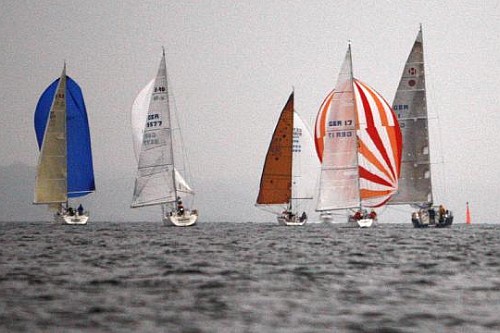
Musto Double Hand Challenge

Även i Tyskland kör man shorthanded. Musto Double Hand Challenge körs för fjärde gången 4-5 juli i Flensburg. Förra året var man 54 båtar. Bild: segel-bilder.de
Nedan en skön sekvens från 2005, Benjamin och Christoph Morgen i en J/109:


2008 Two Handed Round North Island Race

UPDATE: SSANZ Two Handed Round North Island Race start postponed until 10am Sunday 24th Feb
UPDATE: här kan man följa Waka under racet.
Idag startar SSNZ (Short Handed Sailing Association of New Zealand) Two Handed Round North Island Race. 1500 distans runt nordön på två man. 24 båtar kommer till start.
På misnat båten i fältet, en Mull 9.5, har man en enkel strategi. Låter som man är glada om man kommer runt…
- Stay away from the hard bits around the edges
- Turn left at every opportunity
- Keep the wet stuff under us
- Keep the stick pointing towards the sky
- If in doubt – put the kettle on!
Auckland – Manganui: The race starts on 23 February 2008 with a short leg of 200nm from Auckland up the east coast to Manganui. After a 24 hour pit stop the boats all restart together.
Manganui – Wellington: The longest leg, around the North Cape where the Pacific Ocean and the Tasman sea collide, down the West Coast and into the Roaring 40’s, through Cook Strait and into Wellington for a well earned 48 hour stopover.
Wellington – Napier: Around the notorious Cape Palliser and up the Wairarapa coast to Napier, for this whole 400nm stretch there is nowhere to stop for repairs or even take shelter. Castle Point which marks the halfway point in the leg, is regarded by many as one of the windiest places of the entire NZ coastline. Once in Napier the boats get a 48 hour stopover to recover.
Napier – Auckland: This is where the game gets serious. The race is won and lost on the last leg – everyone knows where they stand and who they have to beat.
After starting off Napier’s Westshore Beach the boats head out of Hawke’s Bay, around East Cape, across the Bay of Plenty and back in to the Hauraki Gulf to complete the circumnavigation and await the final race results.

En av favoriterna är Waka, en Thompson 850. Sweet…
Waka’s pre race thoughts and prep
After many months of preparation we finally feel like the boat is ready to take on the race.
The idea first started when Jonty rang me to ask what sails I thought he would need to compete in the race and if I thought it was a stupid idea. Straight away I knew that this was the about the coolest boat I could think of doing the race on. For the last race in 2005 I was going to charter the T30 foundation but due to prior commitments overseas, I couldn’t follow through to compete so was determined to do the race this year.
Jonty was impressed by my enthusiasm to what he thought to be a fairly wild idea and committed to entering as long as we passed all the safety cat 2 requirements and had our entry accepted. For those of you who don’t know a lot about the race it is a brutal 1500nm 2 handed race circumnavigating the north island of NZ. You get to sail in the pacific ocean, tasman sea, and the roaring 40s all in one race, around 3 menacing capes and through the notorious cook strait. First leg is from Auckland to mongonui for a 24hr pitstop, then around the top and down to wellington. After a 48hr stopover in wellington we head up the wairapa coast to Napier for another 48hr stopover and then onto Auckland to complete the circumnavigation. Not a race to be unprepared for!
After a successful simrad series the next step was the cat 2 and an active sponsorship hunt. Targeting the White island race as a warm up and qualifier for the race we set about getting the boat ready. The job list included a number of large jobs‐ re fair the keel, strengthen the rudder and gudgeons, strengthen the forestay fitting and prod rotation system on the bow, adding leecloths, snuffers to all the kites, outboard sheeting padeyes, storm jib and trysail… as well as hundreds of small jobs. The White island race went well with an overall PHRF win in both the shorthanded and fully crew divisions. With the qualifier and cat 2 signed off, we got stuck into the sponsorship hunt and the finer details making sure the boat was as ready as it could be. Our entry was accepted and we were committed to doing the race.
We went out on a windy day to try the reefing system, storm jib and trysail out. After a beat out of the harbor changing between the trysail and deep reefs we went back to a full main and hoisted the fractional gennaker for the ride back home. During this we practiced gybing with the snuffer verses gybing without. The snuffers make gybing in any wind very easy. Anything above 25 kts and we will snuff the kite, gybe and then pull the snuffer back up. The snuffers also make hoisting and droping the sails much easier. We couldn’t find any full sponsors but managed to get support from North Sails NZ, EAS supplements, and Gary Pattern at Leading Edge Boat builders.
North Sails really supported us for this event, as an employee of over 8 years and consultant for the company it really meant a lot to me to get full support from North’s and be able to compete with a lot of new sails that we otherwise wouldn’t have had. Bicky and the other senior staff members really have a passion for local racing and especially events like this.
EAS provided all the food supplements we required. We found this to be very valuable in the White Island race to help keep the energy levels up and the mind focused. In total it is a lot of food to feed us(me in particular) for the entire race, this includes, energy gels, meal replacement shakes, and energy bars, this combined with freeze dried will be the only food on board. Gary Patten, from Leading edge boat builders has been a good friend of mine for many years and in fact I even worked for him at one stage. Gary has done all the boat building work for us and most recently added some extra large foot chocks in the cockpit Gary is very thorough and we know that we can trust all the work he has done.
The forecast for the first leg is 30‐35 from the NE which will not suit us as the smallest boat in the fleet in tight reach up the coast but on the bright side at least we get a shower in 24hrs and a good feed of fish and chips in Mangonui!
The race starts on Saturday at 2pm from Devonport. It could be an exciting start with plenty of breeze forecast and Big waves.
Thanks to all those who have supported us and I will give a further update from Mangonui.
