

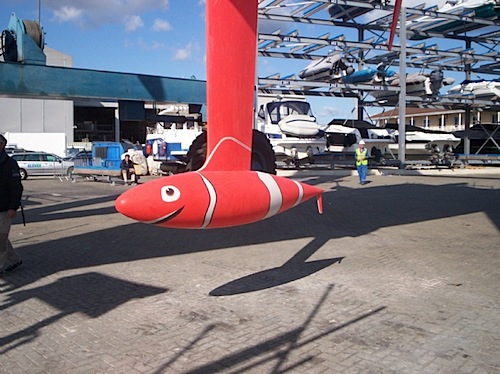
Ecover | stilstudie
Skall Mike Golding slutligen få till det i årets Vendee Globe?
Han har i alla fall en glad bulb..
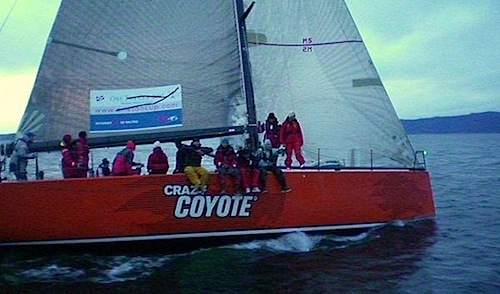
Crazy Coyote
Apropå Juan K och hans radikala kontruktioner så såg jag att en av hans IMS 50 från 1999 körde i Trondhjem (med ett LYS på 1.57).
Är detta samma båt som hade en ostagad kolfibermast eller var Krazy K-Yote Two efterföljaren?
VOR StealthPlay
Här har vi en lite spännande twist på Volvo Ocean Race, där en båt kan “bli osynlig” för de andra under en period när man vill göra smarta eller oväntade taktiska drag. Detta känns helt rätt i en värld där man är på väg mot att ha 100% koll på konkurrenterna 24×7.
Under Artemis Transat hade man ju en “blackout” på 36 timmar för alla båtar, men här kan varje båt välja när man vill utnyttja möjligheten. Skall bli spännande att se hur olika team använder StealthPlay!?
STEALTHPLAY: VOLVO OCEAN RACE FLEET IN HIDING
Until the 1997-98 Whitbread Round the World Race, which became the Volvo Ocean Race from 2001-02 onwards, the fleet sailed over the horizon and had little or no contact with the rest of the world or the boats they were sailing against. Now it is different, with data-packed position reports issued to the fleet and the world every three hours, 24 hours a day, seven days a week, with nowhere to run and nowhere to hide. But today that changes again, as StealthPlay is introduced, giving each boat competing in the 10th edition of the race, the chance to hide once more, although not for an entire leg.
The idea behind StealthPlay is to allow a team to make a tactical break from the fleet without the rest of competitors knowing what they are doing and where they are on the race track. Once a team opts to use StealthPlay their position will not be visible to the rest of the fleet, or the public, and they will ‘disappear’ for 12 hours, adding a new thrilling tactical dimension to the race.
If, having analyzed their own position and those of their competitors from a position report, a team decides to activate StealthPlay, they must call Race Headquarters within 30 minutes of the position report being released. The play will last for the next 12 hours and boat’s position will not be shown on the three scheduled reports normally released within that period. The boat will become visible again at the next position report after that period.
StealthPlay is an option and is not mandatory, and it can only be called on the longer offshore legs. It will be in action for the first time on leg one from Alicante to Cape Town (starting this Saturday) and then on leg two (Cape Town to Cochin), leg five (Qingdao to Rio), leg six (Rio to Baltimore) and leg seven (Baltimore to Galway). If it is not used on one leg, it cannot be accumulated for use on a following leg.
When a boat in play passes a scoring gate and there are seven gates around the course, her rounding time and points scored will be made public. Her position will also be made public when the team is within 50 nautical miles of the finish.
Race Headquarters in the UK will continue to monitor each boat’s progress every 15 minutes for safety reasons, but this information is never made public.
Position reporting times will be every three hours at 1000, 1300, 1600, 1900, 2200, 0100, 0400, 0700 throughout the duration of each offshore leg of the race. Position reports are circulated among the fleet as well as being published on www.volvooceanrace.org along with other technical data.
Professorn startar en motor…
Mark Chisnell (seglarproffs, journalist & författare) är en av killarna som skall hjälpa oss att följa Volvo Ocean Race genom dagliga rapporter och kommentarer.
Här en bra skröna från hans blogg.
That Vendee was the race that made Ellen MacArthur famous. It would have been hard to believe if you’d read the British headlines at the time, but she didn’t actually win. She came second behind a yacht called PRB, sailed by Frenchman Michel Desjoyeaux, also known as Le Professeur for his analytical, intelligent approach to the sport. But it was a close run thing, and it was never closer than on the approach to Cape Horn, when PRB reported that the starter motor on the Professor’s generator had given out.
As you may (or may not) know, the generator is absolutely essential aboard these boats, as they don’t carry enough water to complete the voyage. Instead, they carry a desalinator to make the water as they go along. These machines are run off the electrical power in the batteries, and the batteries are charged by the generator or engine. No generator or engine means no water, and since pretty much all the food on board is freeze dried and needs to be rehydrated, nothing to eat either. And that’s before we’ve got started on all the other systems that go down when there’s no power on the boat – navigation, communication, lights… although the toilet should still work.
And the Vendee is non-stop, no assistance – for Desjoyeaux, a stop at Cape Horn for spares meant that he was out of the race, handing our Ellen (or l’anglais, depending on your viewpoint) the lead. As the hours ticked by, Desjoyeaux and his support team ashore racked their brains for a way to repair the motor with what was onboard. The boat held north, heading for Chile and retirement, while everyone watching (via the internet) held their breath.
Then, PRB dived south towards the Horn – alone in the Southern Ocean, Le Professeur had worked a fix. How did he do it? It was breathtaking in its ingenuity. Desjoyeaux had a hand crank for his generator, at first glance useless, because he wasn’t strong enough to turn the engine over… but there are other sources of power aboard a sail boat.
Desjoyeaux had set PRB up on a beam reach, then pulled the mainsail in as hard as possible, making it fast with the sail ridiculously over-sheeted on the centreline of the boat. He then guided the rest of the mainsheet down below, through a series of blocks, until he could wrap it around a drum fastened to the hand crank on the starter motor. The set up was just like the starting cord on a manual outboard engine, or petrol lawn mower.
With everything in place, Desjoyeaux climbed back on deck and, warily I suspect, let the mainsheet go. The load on the over-sheeted sail pushed it out at huge speed, hauling the mainsheet through the blocks all the way back to where it was wrapped around the hand crank on the starter motor, spinning the drum and… Bingo. One engine, running – this was creative genius on the level of the guitar riff out of the instrumental in Led Zep’s Whole Lotta Love. And it saved the race for Michel Desjoyeaux.

Mumm 30 | prestigemöte

Nu var det dags för Mumm 30-gänget att avgöra vem som “äger scenen”. Drabbningen skedde under Thiele Cup i Rungsted, och Rail Runners har hela storyn och en del sköna bilder. Foto: Lars Taarnskov.

Jimmy piskar stjärnorna

Jimmy Hellberg och Aksel Magdahl från E3 piskade upp alla de stora killarna när det var dags för modellsegling i Alicante. Foto: Rick Tomlinson/Volvo Ocean Race.
Jimmys korta kommentar var:
Det kändes fint att få spöa Ken Read!
Figaro | stilstudie
I morgon startar femte etappen av Cap Istanbul 2008: 110 distans med målgång i Istanbul där man avslutar med inshore-race till helgen. Sjyssta undanvindar i alla fall…