Hur gör vi med planerade tävlingar? SSF följer utvecklingen noggrant och kommer att komma med konkreta råd och beslut när så krävs. Från och med 1 april är all form utav tävling förbjudenoch detta tills vidare. Vi uppdaterar så snart förbudet hävts.
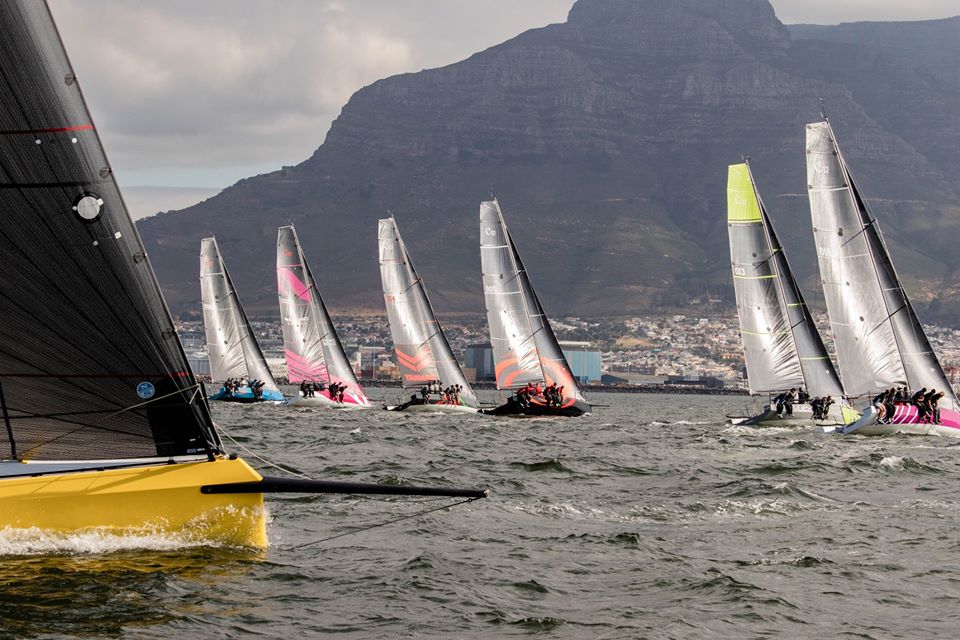
I had a great time hanging out with the Cape 31 crews when I was in Cape Town in February (video here).
Recently they hold their Cape 31 Invitational Regatta, with Ian Ainslie coaching. Ian is an Olympic sailor that were part of Team Shosholoza, and also head coach for the Dutch olympic team.
I thought it would be interesting, both as great example on how useful a coach is, and also Ians thoughts on strategy on the race course and how we make decisions.
It is interesting to discuss how you make a general plan for going around the racecourse and how you position the boat during the race to take advantage of wind, waves and current.
Also, to discuss the decision making process.
Firstly, even in hindsight, sailing is not an exact science. Happily, we are playing in mother nature, where there are plenty of things happening that we cannot predict or rely on. The best you can do is to look at what is before you and make your best judgement call and try to play the odds a bit better than the others and that try to respond to what actually happens a bit better on the day. It is normally hindsight bias when someone says that “it was obvious” and gives the impression that it is all controllable. So, it is good to reflect after a regatta (in this time of corona virus) and find out whether you missed something or didn’t play the odds well enough.
Table Bay is a very nuanced place. The water is very cold compared to the land temperature, the topography extreme, the vertical temperature profile is complicated. There is some current.
In the TP52 super series, most teams requested the help of local sailors to explain what was going on. David Hudson, Geoff Meek, Mike Giles, David Rae etc were all sought out to share their local knowledge. Adam Beashel, from the damaged Sled boat, thought that their biggest disadvantage was that that they were missing out on learning about the bay for the next regatta. (since cancelled). The forecast models and forecasters have improved a lot in the last years, but the influences in Table Bay are so local that it can be hard to predict what is going to happen at such a fine resolution.
Thinking: fast and slow
You try to develop a mental picture in your head of how things are going to play out. The more experience you have, the more detailed your observations are, the better you reflect after races, the better the picture in your head will be.
My favourite book about thinking is by Daniel Kahneman. He talks about fast thinking (more intuitive) and slow thinking (more rational). Your fast thinking is more powerful when it is working well (that is what helped our ancestors survive without being eaten) but is easily swayed by biases (e.g.”it always pays to go to the mountain”, only seeing things that confirm your bias etc)and, more particularly, by emotions – like stress. There are some slow thinking problems. It is, well, slow. It also wants to rely too much on information which can sway you into not believing your eyes or not recognising the subtleties of the situation.
During the heat of battle, your best tools are your eyes and your sensations. Looking at the water, the angles of boats, how much pressure they have. Now is not the time to confuse this awareness with too many theories. On a dinghy, you have less time available because you are busy with lots of things. So, trust your quick mind and the sensations more. On a bigger boat like a C31, you have more information to integrate- from instruments, more input from teammates, and mostly more time to make a call because the tactician’s whole attention is on the racecourse. In any case, you must be able to combine the fast and slow thinking optimally to build a picture of reality and be able to predict what the future looks like to be able to make the best call.
Building an understanding.
Let’s look at the race area with fresh eyes and try to build an understanding of the place in the conditions we experienced. It is always interesting to race in a new venue; you must figure it out quickly. Often your only chance is on the way to the starting area. The best way to learn a new venue is to race there, because the fleet spreads out across the race area and you see all the influences.
If you are a coach in a dinghy fleet, you get a good idea of the big picture trends by looking from the outside. As a sailor, you really experience the details that are not easily visible from a distance. Little changes in water surface, little differences in the pressure in the rig etc. Together (big picture and small picture), you can build up an image in your heads that tries to represent what reality looks like. It can be interesting to talk to different teams or sailors after a race day and understand how they saw a race, especially if they were on fire that day. Try to find out where their focus was and how they pictured the racecourse. The guys that have the best insights from a racecourse that I know are the coach/sailor team of Aaron McIntosh and Dorian van Rijsselberghe, (NED RSX team). Talk to them and you will be guaranteed to learn a lot about what the wind is doing on the day. Their pre-race plan discussion and post-race debrief will typically consist of only a few sentences. But is highly nuanced and only about what made the difference. Like other high-performance boats that don’t tack well, the good RSX sailors really become experts at sensing small differences in wind pressure – like subtle bands of more wind and how they are moving across the race area.
The process of building an understanding of the race area is different to the process of making your race plan and your strategy during the race.
Pre-regatta, when you are confronted by a new venue or a new day you are trying to get the confidence from the feeling of “ah yes, I’ve seen this movie before”, based on your past experiences and pattern recognition. During racing you want to exclude all the noise and just understand what is going to make the difference now, and how it plays out in the time frame of a few minutes.
As a coach or a teammate trying to support the tactician, you must help them build the picture in their head with information that is relevant and that they can act on. Here the enemy is TOO MUCH INFORMATION. There may be 100 different things happening but only 1 or two are important, so identify them and don’t talk about all the other things at this time. Normally your decision can be pared to the binary: “should I tack (gybe) or should I carry on.” (don’t be the “cleva oke” who complicates the story at this point.)
For the cape31 invitational regatta, the general strategy was not too complicated. The racing was more about execution and dealing with the critical moments in the race. Still, it is always interesting to reflect and exchange ideas to build a better picture for next time. For the analysis (next post), lets unpack a lot of detail to build the mental picture and then look for “the simplicity on the other side of complexity” that we can use during the race. Here we are looking for the one or two details that we could have used in the race at the right time. Then we can also look at dealing with the dilemma of when it goes pear-shaped in a race.
Local conditions
The C31 event happened at end of summer. The conditions we experienced were typical for this time, when the weather starts changing. You start getting little coastal lows that travel down the west coast around cape town and up the east coast. These can start keeping out the SE’s and may bring fog. The cold fronts are not getting to SA yet. If you sail at the venue a lot, you will have a good idea of how it will all play out. But for the exercise, let us use the conditions and racing to try to improve our mental picture of how mother nature likes to behave.
What to consider in these conditions and this venue:
1. Differences in temperature with height over the water. The water is still cold in autumn and the air above it is still warm. Like oil resting on water, the layers of air don’t like to mix. The layer of cold air below can be very shallow. One of the TP52 super series races was sailed in the same area in the similar conditions. On the race committee boat, we were treated to a blast of very hot air just after every boat crossed the finish line. The warm air layer was so close to the top of the rigs that the vortex from the rig (spinnakers) mixed in some hot air behind each boat.
This kind of condition means that within a given air flow, there will be no big “downdraft” puffs or big shifts. The wind will flow like a river around the mountains and points. In these shallow wind conditions, you can imagine the “stream of the wind” blowing toward you and it makes sense how it is going to behave around points. Look for bands of stronger wind downwind of a point where the wind is “compressed”. The gradient wind (if it is not too strong) will mostly flow over the top of our wind and not affect us.
2. There is a shore next to the racecourse. Shores always have some influence on the wind, especially in Table Bay where the topography is so dramatic. Until you sail at a place, I find it hard to predict exactly how the shore will change the wind. Sometime the greater friction of the wind over land plays a role.
However, in Table Bay, not only do you have the effects of the wind bending around the topography but much more important than friction is the effect of the air near the shore being much warmer in these conditions. You can see how much thicker the layer is by the paragliders jumping off Lion’s Head. In this case you get a bit more pressure and a lefty on the top LHS, where the wind is blowing off the shore.
3. The breeze we had was mostly thermal in origin (hot land, cold water). That means it will have a life cycle and be strongest when the day is hottest. You can look for a transition from a very localised thermal wind to a larger scale one. There will be a trend on the race area while the breeze is in the building phase which might not be there when the wind is stable or in the dying phase of the day.
4. Will the SE wind come through? (it is called a SE but it is actually S in this area)
5. Current. Normally the current can really favour the LHS on a SW day (it is called a SW but is actually W in this area). Even a few boat lengths a minute of current at the gate mark would make a big difference.
So, this is what we think we know about the racecourse, now it is helpful to eliminate what is not in play and really look at what is going to be the decider. Going back to the quick-thinking vs slow-thinking model.
Going through the list 1 to 5 above an applying it to the races.
4 we could eliminate. Most local sailors can look for the signs of the start of a SE and they were not there on these days.
5 – I didn’t measure (who would have anticipated corona quarantine torpor?) but I didn’t notice any around the leeward gate marks. I don’t think it had an effect. (Did anyone measure the current?)
The shore effect was what you had to work with. (combine points 1 and 2). What was interesting to focus on was how far away from the shore the effect would be felt and how big the effect would be.
On the racecourse
On the racecourse we had, the objective was to be powerful when you got to the top left-hand side. I already spoke about how to maximize your chances in terms of execution. Let’s go really detailed and see the best choices of winning it.
Every day, things change. This breeze was completely steered by the mountain but you could notice that there was a bit of a trend with the phase of the day
Early on, in the building phase, the wind was lighter and really hard to see on the cold water. It was more streaky and there seemed to be a relatively lighter patch early on the left hand side and the boats that started towards the pin could run into less pressure. Sometimes the new, building pressure would also come in from the RHS at the bottom of the course. You could gain by starting near the favoured boat end and get strong on the boats to leeward. (Seascape – tactician Asenathi Jim)
Going down the run, generally the bear away set was better so that you could stay in the lefty pressure at the top, but on occasion the RHS (looking upwind) made a big gain when the boats ran out of the band in the bottom LHS (mountain side) – Nitro David Rae did this well a few times.
As the day progressed the wind filled in more evenly, was a few degrees more right at the bottom so there was no “hole” on the early LHS. The LHS band was wider at the top of the course. You could rely on leading to the LHS. Nemesis (tactician David Hudson ) on day 2 in the later races started at the unfavoured pin end and sent it left and came out strong each time.
Most consistent boat throughout the day was TNT (tactician- the skinny white boy). They generally started in the middle third of the line, executed very well, chose a good line out of the left hand side and were always strong by the top mark. A very impressive race was when they got dumped on a few times and got out of phase and were last at the top mark. Whereas most would start “banging the corner” to catch up, they patiently positioned themselves in a clear lane and continued to do the follow the strategy of getting left as best as they could. They ended up 3rd in that race, which put them in a very strong position overall.
I samarbete med North Sails så kör Stockholms Seglarförbund ett antal föreläsningar… som nu har “transformerats” till ett antal onlinetillfällen under rubriken “Sen kväll med Nisse och Harding”😃
Söndag 29/3, 16-18 = Jesper Radich om en taktikers roll i en besättning
Söndag 5/4, 16-18 =
Söndag 12/4, 16-18 =
Söndag 19/4, 16-18 =
Söndag 26/4, 16-18 =
Söndag 3/5, 16-18 =
Söndag 10/5, 16-18 =
Söndag 17/5, 16-18 =
Söndag 24/5, 16-18 =
Söndag 31/5, 16-18 =
Hej och välkomna till Sen kväll med Nisse och Harding!
Efter del två av vinterns kölbåtsföreläsningar online som blev väldigt populärt och bra så har vi nu bestämt oss för att köra vidare under hela våren. Med tanke på den knepiga situation som vi alla befinner oss i så kommer vi sända live två timmar varje söndag.
Vi kommer ha väldigt intressanta gäster, gå igenom olika roller på båtar och diskutera lärdomar och erfarenheter som både vi själva och andra har. Tanken med fortsättningen är att ni ska få möjlighet att få lyssna, ställa frågor och få ta del av kunskapen som våra gäster har så ni kan komma så förberedda som möjligt inför säsongen när den drar igång.
Första tillfället får ni möjlighet att lyssna till Jesper Radich som talar om en taktikers roll i en besättning, sina erfarenheter från olika team och hans lärdomar. Vi har även en hemliggäst så missa inte det!
E sport och segling är nytt och hett! Vi kommer gå igenom hur man spelar, vart man hittar sina vänner och lite tips och trix. Vi kommer även förklara vart man hittar svenska seglare att segla mot, både unga och vassa samt gamla legender!
Vi kommer avsluta varje program med en frågesport om gästerna eller ämnena som vi har tagit upp och ni kan även vinna roliga priser.
Via Zoom så erbjuder vi 12 föreläsningar med gäster online! Varje söndag kl 16-18!
Var?
https://zoom.us/j/5988394256
Meeting ID: 598 839 4256
För vilka?
Syftet med kurserna är att ge främst unga seglare i åldrarna 17-30 år en gedigen utbildning i hur man seglar en kölbåt, vad som krävs för att få komma med i team och hur man sköter om en båt. Om det känns som något för dig så anmäl dig direkt!
Föreläsningarna riktar sig till både elitseglare och till de som vill lära sig mer, till tjejer och till killar. Så tveka inte att anmäla er! Vid mån av plats så kommer även äldre att erbjudas plats under föreläsningarna.
Kostnad
Stockholms Seglarförbund tillsammans med North sails värnar om nästa generations kölbåtsseglare vi erbjuder dessa föreläsningar kostnadsfritt för de seglare som vill lära sig mer!
In August we installed a smarttune to measure forestay tension (story here). The initial impressions were great; installation was super simple and having the tension on the mast display made communication much easier.
But after sailing Rolex Middle Sea Race and also the Coastal Race in Malta (that hade a very shifty upwind leg) we also had some data to work with. Above are forestay tension (in kg) as a function of TWS (in knots). So in 12 knots of wind, 1400 kg is a good starting point with the J2 jib.
This is just the first iteration, and we need more data before this becomes a cheat-sheet in the cockpit. But it felt great to be able to convert our experience, and prior references on the backstay, to hard numbers. Also, communication worked very well, and it felt we could be more proactive with backstay tension when we hade the numbers in view rather than behind us…
Me and Martin Gadman from Happy Yachting met with Sam Cray from Cyclops Marine at METS in Amsterdam. It’s always fun to meet entrepreneurs and people from small technical companies, and this was no exception. They are still iterating on the optimal design, figuring out production, and trying to keep up with demand. Often stressful, but always fun and the best stage to be involved in any company.
The three standard models (7/16″, 1/2″ and 5/8″) now have a slightly more rounded design, to prevent spinnaker sheets to get caught. It’s also possible to measure the distance between the threaded stubs, which will make it easier to replicate the original settings when mounting.
I was happy with the first version, but this is even better.
There’s also a new app to set up and communicate with the smarttune.
Cyclops Marine can do custom sizes of the smarttune, as well as custom solutions. Some of the projects they are working on now are
• Smart tension link: measures and records clew load wirelessly on superyacht headsails to prevent sail damage and provide direct load feedback for safety on captive winches (based on innovative Cyclops fail-safe tension link). • Smart furler: directly measures furler luff load (sail and cable) • Smart headstay ram: directly measures forestay load without the inherent inaccuracies of a loadpin.
Here’s the new Smartlink. Ineos Team UK took delivery of 9 of these last month, with plenty of riggers wanting one to have in their pocket too. This is a concept that they originally produced for Bella Mente for their Mainsheet ring. Available in 2t, 5t, and 10t load ratings.