Pogo 40 = 1.58
Ni som undrar hur sweet en Pogo 40 är kan fråga norska LYS-kommittén…
(båtdata för Sverre Ellingsens Pogo).
Ni som undrar hur sweet en Pogo 40 är kan fråga norska LYS-kommittén…
(båtdata för Sverre Ellingsens Pogo).

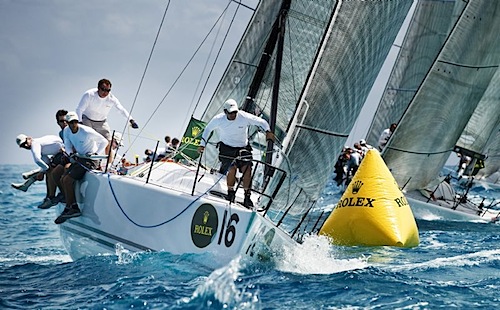
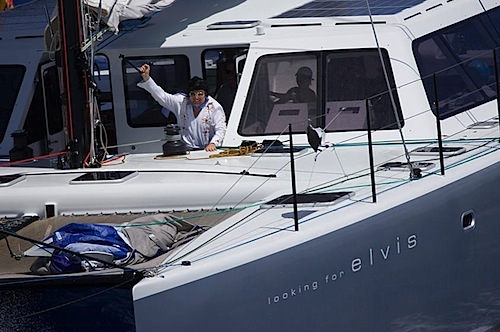
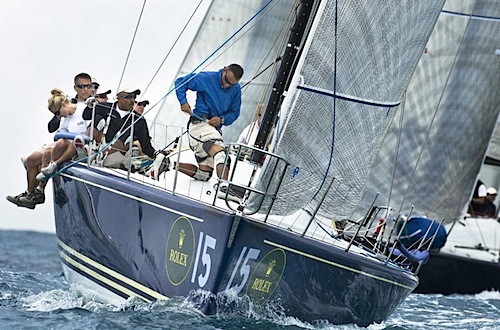
I dag börjar Farr 40 VM i Miami. Här är några bilder från för-VM som visar hur det kan gå till. Ser ju inget vidare ut… Alla bilder: Rolex/Kurt Arrigo


För er som bara måste ha seglingsrelaterade prylar i iPoden
Sailing World Podcast Series, April 2, 2008
Kicking Back and Giving Back. With the America’s Cup mired in the courts and a multihull match looming, something, Peter Holmberg’s decision to step away from sailing’s premiere event after his stint as a helmsman for Alinghi, seems prescient. While his former teammates were trying to salvage Alain Gautier’s trimaran, which they capsized during training last weekend, Holmberg was back on Pillsbury Sound in the U.S. Virgin Islands, the same waters upon which he and his brother learned to sail 40 years ago. We took a moment to catch up with the most famous sailor to call St. Thomas home and find out what plans he has for himself in the near future.
Sailing World Podcast Series, March 4, 2008
Going South. Way South. North American sailors are quite familiar with the value of heading south to escape the winter doldrums. Sailing World editor at larger Herb McCormick took this concept to new heights, heading to Australia for two months. He took a deep gulp of the sailing lifestyle in Australia and Southeast Asia and came away fully impressed. He gives us the run down on his antipodean adventures.
Sailing World Podcast Series, January 31, 2008
Where did it go? 2008 Acura Key West Race Week is in the books and it’s hard to imagine five days passing any faster. The last one was a doozy, three races for all circles in a blustery post-frontal northerly. It certainly put a nice cap on the week. Two boats that came through in the clutch on the final day were Dave Ullman’s Melges 24 Pegasus 505 and Andy Fisher’s Club Swan 42 Bandit. Both had to overcome a few hurdles on the way to their respective class championships. Both were proud of the work put in by their crews.
Sailing World Podcast Series, January 25, 2008
When he puts the holidays in the rear view mirror, Tom Coates thoughts move right to Acura Key West Race Week. For nearly a decade, January has involved a trip to the Florida Keys for some racing. Almost as regularly, Coates has done well. With five races remaining, he’s perfectly positioned to win his fourth J/105 class title at Key West. We talked with Coates about the regatta. Also a one-on-one conversation with Alinghi’s Brad Butterworth where we discuss the battle with close friend Russell Coutts at BMW/Oracle Racing and the new 90-footer that Alinghi would like to use to race the next Cup.
Nu har killarna på Gran i Malmö fått till ett nytt flott loft. Jag hade hoppats på att få se Claes Hiersemann i dumstrut, men kan inte se den på bilderna…
Kan man förresten dra några slutsatser om segelmakarbranschen?
Förutom kedjorna som North, Quantum eller UK så verkar det finnas några lokala loft som race-seglarna använder. Typisk Albatross på västkusten och Gran i syd. Osäker på vilka som är heta i Stockholm?
Nån som är insatt som har spaningar på området?
Nya lokaler lyft för Gransegel i Malmö
Efter mer än trettio år på samma ställe flyttar nu Gransegel Malmö AB till nya, toppmoderna lokaler i Limhamns Småbåtshamn.
Även om flytten bara rör sig om 300 meter, är det ändå ljusårs avstånd mellan det gamla loftet och det nya, skräddarsydda segelmakeri som invigs på påskafton den 22 mars 2008.
Gransegels nya lokal är en del i ett helt nytt ”Marin Centrum” som har byggts upp i Limhamns Småbåtshamn, bara ett stenkast från den befintliga utrustningskajen. Sex marinanknutna företag flyttar under våren in i den nya fastigheten, belägen ett tjugotal meter från den planerade ”storbåtshamnen” med plats för ytterligare 200 större fritidbåtar.
– Vårt läge är perfekt, och vi kommer att förfoga över en ny flytbrygga dit Gransegels kunder kan komma med sina båtar för all slags segel- och riggservice, säger Claes Hierseman, chef för Gransegel i Malmö.
Gransegel disponerar 600 kvm i de nya lokalerna, mer än dubbla ytan jämfört med det gamla segelmakeriet. Bland finesserna märks en nedsänkt symaskinsbrunn som i nivå med golvet underlättar hanteringen av större och tyngre segel. Vattenburen golvvärme kommer att ge en jämn rumstemperatur, viktigt för att säkerställa kvaliteten i dagens moderna segeltillverkning där dukar i ”exotiska” material som kolfiber och aramider limmas ihop.
Gransegel i Malmö startades 1976 av Claes Hiersemann och ingår i Gransegel-gruppen med segelmakerier i Stockholm och Oslo.
På vårt loft i Malmö har vi idag fem årsanställda, men kommer nu äntligen att få möjlighet att växa till sju årsanställda, berättar Claes Hiersemann. Hans närmaste medarbetare är Åke Nettelblad, delägare i loftet och ansvarig för segeldesign, samt Anders Borg, som har produktionsansvaret som ”floor manager”.
Vi spanade ju in PRBs nya flärpar förra veckan. Nu har Adonnante.com frågat Pat Shaughnessy, President of från Farr Yacht Design om det var ett aprilskämt eller inte.
On April first, PRB came out of the shed with two new bow strakes. Was-it an April fool’s prank? Adonnante.com asked Pat Shaughnessy, President of Farr Yacht Design in Annapolis in an exclusive interview. With a few months to go before the Vendée Globe, Pat explained his view on the new IMOCA generation.
Gilles Morelle : PRB was seen on April 1st with new mustaches on the bow ? Was it an april fool ?
Pat Shaughnessy : While it was interesting that the boat came out of the shed on April 1st I can confirm that it is not an April fool’s prank. The bow strakes are an intended addition to the boat.GMo : Can you tell us a little more about this device? Was is the purpose of adding these?
PS : The bow strake is intended to produce dynamic lift for high speed reaching and running. The common application of strakes on powerboats are a similar reference although they are a bit more easy to position because they work exclusively in an upright boat orientation rather than in a variety of heeled boat orientations. Like many other aspects of boat design there are certainly trade offs. The boats will sacrifice some upwind sailing performance, especially in choppy conditions in exchange for superior high speed reaching and running.GMo : Recently we have seen several pictures of IMOCA 60s sailing upwind with their keel outside the water! Is that something you are working? And why?
PS : I think the media likes to see the boats with their keels out of the water like that, but in a pure performance sense they are probably over heeled. This is not a boat attitude that we are actively promoting.GMo : Your boats won the last few races (Barcelona World Race/Virbac-Paprec 2, Transat Jacques Vabre/Foncia, Trophée BtoB/Gitana 80). Can you tell us how you feel about that ? And how Farr Design can dominate the IMOCA class after such a short time on this specific designs market
PS : In 2007 Farr Yacht Design won every Open 60 event. I can assure you that this is a result we are extremely proud of. After our performance in the last Volvo Ocean Race we seriously re-committed ourselves to offshore sailing as an area of the sport we want to succeed in. Shorthanded sailing results are ultimately achieved by the sailors, and the success of our designs is largely achieved by attracting those sailors before the design work even starts. We have been incredibly fortunate to have the opportunity to work with so many great sailors in this last generation of Open 60 design work. Certainly we have worked very hard in a research and design sense to design fast boats for these teams.GMo : The Vendée is the ultimate goal for the majority of these guys. You have an impressive list of tandem Boat/Skipper. Which one is your favorite ?
PS : Inside the design group we might have some small favorites, but for the media I would say that we support our teams all equally. I can honestly say that it would be difficult to favor one team at the expense of another. As a fan of sailing I am very excited to watch the Vendee race unfold. I hope that the fleet as a whole experiences very few breakages and retirements so that we can watch a real race all the way to the finish.GMo : Each skipper gave you their input of what they think an IMOCA 60 should be. Can you provide us with your insight info on what are the main differences between your recent IMOCA boats?
PS : When we undertake research in the absence of a client as was the case with this past group of Open 60s we do that with the intention of sharing the work amongst several future clients. In that sort of approach it is critical to separate FYD intellectual property from the client’s intellectual property so that we can work with hopefully many clients fairly. To do that we prepare a base design that represents our opinion of the correct resulting boat. We review the research and our conclusion with each client and present them with the obvious options and possibilities that exist around our concluded base boat. Each team brings a unique set of experience and input that we then work to incorporate into their custom design. The obvious choices in this generation of boat were, beam (or power of boat), keel fin material (solid steel, fabricated steel, carbon), and mast configuration (conventional, rotating wing with or without deck spreaders). Around those larger areas there are of course an infinite number of smaller choices and preferences. Because the skippers have a very close relationship with the boats their preferences are extremely important and must be fully respected in the design process.GMo : If we have a close look at your opposition , is there one particular boat that you would have liked to have designed yourself. And could she beat yours ?
PS : All of the opposition is very strong, and I am reticent to pick any one boat out of it however there is one particular team that had access to an extremely large R&D budget. Our design team with that sort of a budget would have been able to produce some amazing things. Instead we have been working from a very modest self funded research base. Several of the boats differ in their concept considerably from our designs. Those boats will all almost certainly have days where they will shine on the water. Because we are all fans of the sport, in the end the differences between the boats are one of the things that make the fleet interesting and fun to watch. We still feel very confident that our overall concept is a good choice for the race as a whole.GMo : The Vendée Globe is a long race around the World, boats will sail in lots of different weather conditions (upwind, strong downwind, light air …). What are the secrets (power, light deplacement …) to make the best boat after going thrue these various weather patterns?
PS : The Vendee is certainly a very long race. In a conceptual sense we try to envision it as three separate races; down, around the bottom, and back up. In that sort of separation the first portion, down, is where a lead must be established. With a lead in hand, the portion around the bottom is frequently defined by the separation of individual weather patterns. A boat in one pattern will have trouble to advance into the next when chasing. The return portion back up the globe can be defended with an energy that is determined by the separation and push of the chasing boats. The single largest design variable to understand against the race modeling is how much power the skipper can handle. In the end the boats will operate at considerably less than 100% of their polar predicted speeds. How much less will depend on the skipper.GMo : During the last 12 months we have seen a mast epidemiology. Can you elaborate on what are the main reasons for these failures and have you made some specific changes to your boat to avoid it?
PS : I am not familiar enough with the individual mast failures to offer an educated comment. My person opinion is that these boats are being pushed harder all the time. When you have a platform that operates at less than 100% for the majority of the time it is possible to explore peak loading occasionally that is significantly higher than what have become typical working loads. The typical working loads are what the teams use to develop their knowledge and experience. That knowledge is often used to specify new gear or rigging based on what has worked in the past. If the designers keep bringing more powerful boats, and the sailors keep pushing them harder we will certainly all explore new performance together.GMo : In France we use to say that the Mini 6.50 are the laboratory for the IMOCA. Have you ever drew a boat for this class and/or are you preparing a design for this class?
PS : We have not designed a Mini, although we certainly watch them with great interest. Whenever we enter into a new class or area of the sport we need to do it very carefully and with the right partner. We are certainly open to design a Mini, or a Class 40, or a multihull or any other new type of boat.GMo : This year you are the designer for only team in the up coming Volvo Ocean Race. How come you have such a strong presence in the IMOCA class and a single design in the Volvo 70?
PS : In the last race a single team dominated the event. Part of that team’s success was related to its enormous R&D budget relative to what the other teams had access to. That success has paved the way for more large teams this time. Large teams, with large budgets, seek large exclusive commitments from their partners. This is the normal approach in events like the America’s Cup and appears to be the growth pattern in the Volvo Ocean Race. Although our team does not have the largest budget it has an ample one in support of our R&D work, and that has allowed us to explore plenty of new solutions. The product of this work will exit the shed soon and at that time the hard work will be obvious to everyone.GMo : What are the main differences between a Volvo 70 and an IMOCA 60 from a design stand-point?
PS : The VO70 and IMOCA 60 rules are philosophically different. The VO70 rule is a pure box rule that allows you to work within a specific space. The IMOCA 60 rule has very few restrictions, although those restrictions do seem to be growing with each evolution of the rule. The single largest defining rule in the IMOCA 60 rule is the “10 degree” rule which has created the very beamy boats the class is defined by today.Source : Gilles Morelle \ Adonnante.com
En J/100 på väg från varvet i Frankrike till lycklig ägare i Sverige.
Och här har vi en A-35 som har mellanlandat i frihamnen i Göteborg på väg till Stockholm. Redan fyra A-35 anmälda till Gotland Runt.
I helgen rev man av en så kallad J/Fest på flotta St. Francis Yacht Club. Ett antal J/båtar gjorde upp på San Francisco Bay och Crazy Diamond vann bland J/109:orna.
Sweet. Eller helt osannolik?
Juan K har ritat nya hundrafotaren Speedboat för Alex Jackson (tidigare Wally 80 Carrera och NYYC 42 Amelia). Cookson Boats har byggt. Sjösätts just nu. Ryktet säger att budgeten är ungefär som för en mindre Americas’ Cup kampanj (typ $100M). Hydraularmen till kölen kostade $500k.
Får en VO70 att se mesig ut :-)
Kan säkert få svårt på bana mot Alfa Romeo eller Wild Oats… men med rätt förhållanden så kan man säkert putsa rekordet på Sydney-Hobart eller Transpac. Vi får väl se om Juan K fått till det.
Update 080416: