
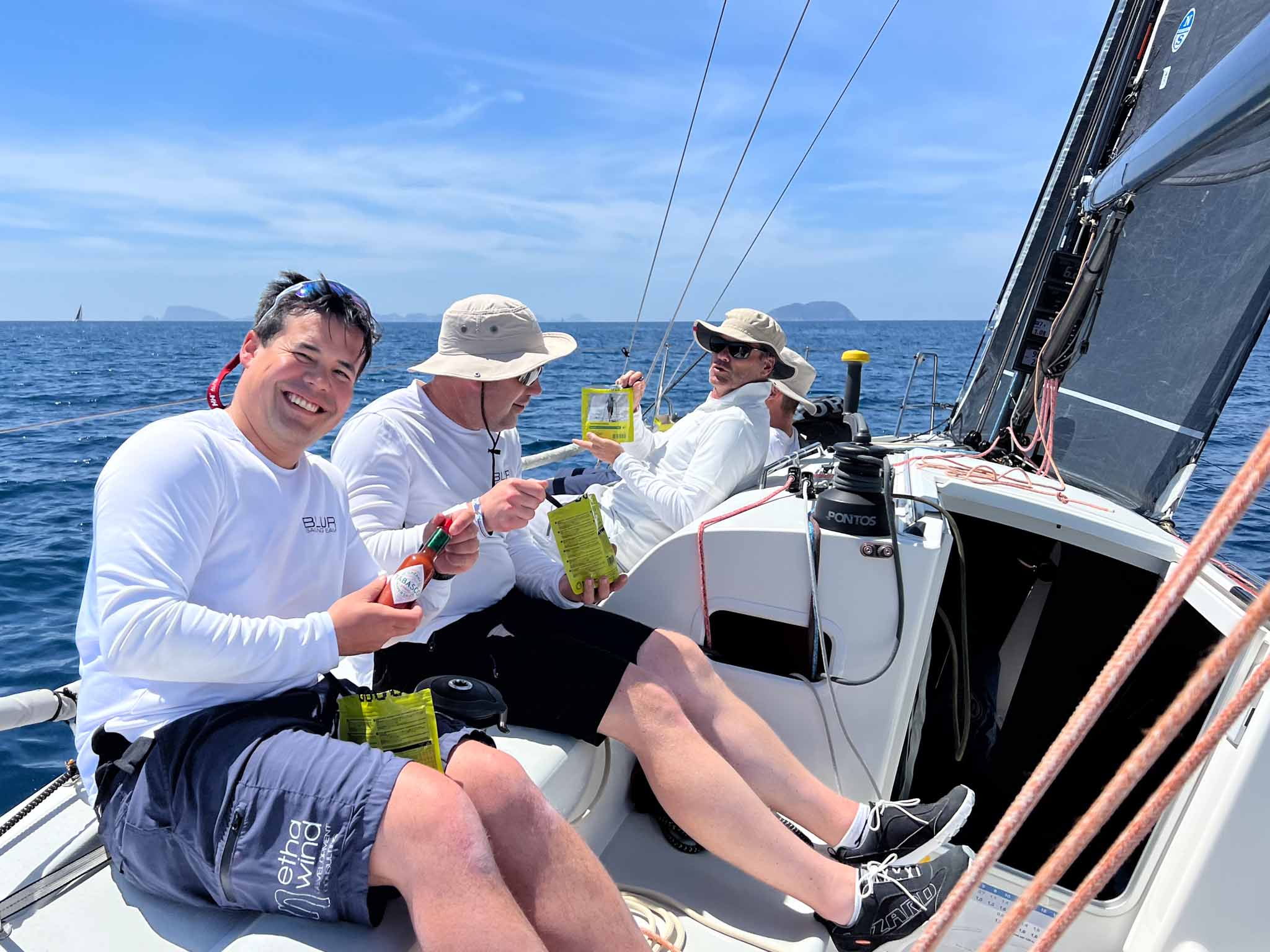
Eat to go fast: simple offshore nutrition
in collaboration with Maurten.
We’ve always been pretty data-driven. The kind of crew that nerds out on everything from sail cross-overs and weight placement to bottom paint. Sailing is a technical sport, after all.
One area that surprised us with how much it moved the needle was nutrition.
Years ago, leading up to Kerteminde Big Boat, one of our crew realized we could improve what we ate before, during, and after racing. We worked with a sports nutritionist, built a simple eating plan, and the difference was obvious: after a long day, other teams were slumped on deck while we were still sharp, debriefing in the cockpit. That’s when it clicked: this stuff changes outcomes.

When we shifted more toward offshore sailing, we kept the mindset but had to iterate on the implementation since the demands are very different. We did a ton of work ahead of Fastnet 2015, and have been iterating since. We’ve compared notes with ultra-marathon, triathlon and similar – trying to push hard for days is remarkably similar to a grueling offshore leg, physically and mentally.
Lately we’ve been collaborating with Maurten (a Gothenburg endurance-nutrition startup). Now we’re even more attentive to what we eat, when, and why.
If you only remember three things:
- Fuel 60–90 g carbs per hour while on watch.
- Drink ~3.5–4.0 L per 24 h (2-on/2-off, Swedish summer), include salt across the day.
- Keep the plan simple, repeatable, labeled by day & watch.
Why it matters (and what we learned since 2015)
In our 2015 article, the winning recipe was smart logistics: pack by watch, make eating easy, and aim high on daily energy. And stick to the plan; this isn’t about eating when you’re hungry, but fueling the crew deliberately. We have plenty of examples where a skipped meal led to poor performance, bad decisions, and sea-sickness. Like sleep, it becomes a safety issue – you need as many as possible at 100% when things go sideways.

The big picture hasn’t changed; long offshore legs quietly drain energy, focus, and strength. A simple plan that your whole crew can follow leads to a happier crew and better results.

Food options
Over the years we’ve tried different types and brands for the bigger meals: breakfast, lunch, and dinner.
We started with 24 Hour Meals, ready-to-eat “soft pouch” meals sealed in retort pouches. You warm them in their bag and eat directly which is great in rough seas. Then we moved to freeze-dried meals, ultra-light and compact, but you must add the stated amount of hot water, stir, and wait a few minutes (great when you have a watermaker and time). In the US we found Pinnacle Foods to be absolutely brilliant, and back in Scandinavia we’re trying lots of different brands.
Learnings: choose soft pouches for simplicity and reliability when it’s bumpy or you’re short on water; choose freeze-dried for weight savings and wider menu variety on longer legs (see our watermaker installation on the J/111 here).
| Pros & cons | Soft pouch | Freeze-dried |
|---|---|---|
| Weight & volume | Heavier & bulkier (you carry the water). | Much lighter & packs smaller; better for long legs. |
| Water & fuel need | Minimal water; heat-and-eat or even cold. | Needs measured hot water + wait time; cold-soak possible but meh. |
| Handling in sea state | Easiest in rough seas; one-hand friendly; low spill risk. | Fiddlier on heel; risk of hot-water spills; measuring is harder. |
| Taste & mouthfeel | Often “oily/rich”; many variants taste similar after a few days (your finding). | Wider range of flavors/recipes; texture can be great if fully rehydrated. |
| Variety & morale | Shorter menu lists; taste fatigue comes faster. | Big variety across brands; helps morale on day 3–5+. |
| GI comfort | Rich/fatty can sit heavy when seasick; easy to swallow, though. | Easier to tailor (low-fat, high-carb options); under-hydrated = chewy/dry. |
| Speed to serve | Fastest: dunk/warm, open, eat. | 7–10 min typical; requires someone “on galley.” |
| Cleanup & trash | Greasy pouches; heavier, smellier trash. | Drier pouches; lighter trash volume. |
| Reliability if gear fails | Works even with no stove (cold). | Cold-soak works, but quality tanks. |
| Nutrition targeting | Harder to micro-target macros (often higher fat/salt). | Easier to hit high-carb targets (pasta/rice); more control over macros. |
| Shelf life & storage | Long; tolerant to rough handling. | Often longer; sensitive to moisture ingress. |
| Night-friendly | Very night-friendly. | Less night-friendly (hot water + scoops + wait). |
| Cost per kcal | Varies; shipping heavier weight costs more. | Often pricier per pouch, but cheaper per kcal carried (weight). |
Over time we’ve also become more aware of the actual macros of each meal – and they can differ more than you think.
Ranked from high carb → low carb
Dinner/lunch
- 24hMeals Mediterranean Pasta with Chicken – 78 g
- Pinnacle Sticky Teriyaki Chicken – 72 g
- REAL Turmat Chicken Curry – 66 g
- 24hMeals Chicken Panang (soft pouch) – 35.6 g
Breakfast
- Pinnacle Strawberry Crunch Cereal – 93 g
- 24hMeals Oat Porridge Mango & Coconut – 92 g
- REAL Turmat Blueberry & Vanilla Muesli – 67 g
Curious why endurance records keep falling? This video explains the high-carb fueling shift; how mixing glucose + fructose lets athletes safely push 90-120 g carbs/hour for more power and fewer gut issues.
The simple plan (4-on / 4-off)
1) Carbs drive the bus.
Carbohydrates power trimming, sail changes, and clear decisions at 03:00. Aim for 60-90 g carbs per hour while on watch. In very hard, sustained periods (and only if you’ve practiced), some sailors go higher. The big surprise for us was how much fuel you actually need.
2) Hydrate on purpose.
Plan ~3.5-4.0 L per 24 h (Swedish summer). As a guide for 4-on/4-off: ~0.8–1.0 L during each 4-hour watch, plus ~0.35-0.5 L off-watch with your meal. Increase on warm/sunny or very active periods. Include sodium across the day.
3) Protein keeps you ticking.
Across the day, target 1.6-1.8 g/kg bodyweight (for an 85 kg sailor that’s ~135-150 g/day), split into 4-6 small hits. Worth the effort.
4) Keep fibre modest at sea.
Save the salads for the dock. Choose low-mess, low-fibre carbs during rough patches.
5) System over perfection.
Pre-label everything by day and watch. Have a clear schedule and owner on each watch. Make food, snacks, and water easy to find. Make eating the path of least resistance.
A practical day for an 85 kg (50-year-old) sailor
- Energy: roughly 3,500-4,500 kcal (scale with weather and role).
- Daily carbs: ~5–7 g/kg (~425-595 g/day).
Per 4-hour watch (on deck):
- Carbs: 60-90 g/h from drink + gel/bar.
- Fluids: ~0.8-1.0 L over the watch (more if it’s warm/active).
Off-watch (every ~4 h):
- Meal: ~1.0-1.2 g/kg carbs (85-100 g), 25-35 g protein, a little fat.
- Caffeine (optional, planned): small doses (~100-150 mg) to support night focus – don’t overdo it.
A watch-card you can copy (4-on / 4-off)
Per on-watch hour
- Sip a bottle that gives ~40-80 g carbs.
- Add a gel or small bar for +20-40 g carbs.
- Keep a separate bottle/sips to cover salt across the day.
After each 4-hour watch
- Eat a hot, simple meal (freeze-dried or soft pouch) with 25-35 g protein.
- If seasick, switch to easy carbs + sips until you recover.
Using Maurten at sea (easy mode)
Maurten’s hydrogel drinks and gels help many sailors hit higher carb targets with fewer stomach issues – a big win in rough water.
How to use it simply
- Drink Mix 320 = 80 g carbs in 500 ml.
- Drink Mix 320 Caf 100 = same carbs + 100 mg caffeine for night watches.
- Drink Mix 160 = 40 g carbs in 500 ml for lighter hours.
- Gel 160 = 40 g carbs when you can’t leave the rail.
- Gel 100 Caf 100 = 25 g carbs + 100 mg caffeine for a clean alertness bump.
Two small rules
- Mix to 500 ml per sachet – don’t over-dilute.
- Keep electrolytes separate. If you need more sodium (hot days, salty sweaters), take it in another bottle or between Maurten feeds.
Not married to one brand?
Maurten is great when the goal is “lots of carbs, calm stomach.” If you need more sodium in-bottle, pair gels with a saltier hydration mix in a second bottle.
Two levels (pick your ambition)
Club sailor – do the basics well
- One bottle (40-80 g carbs) + one gel (20-40 g) each watch hour.
- One hot meal every ~4 hours (add protein).
- Drink ~3.5-4.0 L/day; include salt.
- Modest caffeine at night if you like it.
Semi-pro – the last few %
- Train your gut to 90-100+ g carbs/h before the race.
- Personalize salt (sweat rate, climate).
- Plan small caffeine doses on key watches.
- Standardize mixes, label by watch/day/role, and debrief after each leg.
More Reading
Endurance performance
- Practical Fueling for Endurance Athletes – Kylee Van Horn (2025 – link)
Best for: turning science into a workable plan.
Why read: step-by-step guidance on carbs/hour, fluids, sodium, and caffeine – with simple templates that map neatly to a watch system.
Use it when: you want a clear “what to eat, when, and how much” playbook. - The Athlete’s Gut – Patrick Wilson (2020 – link)
Best for: preventing GI problems at sea.
Why read: explains why stomachs go bad under stress and how to “train the gut” to handle 60–90+ g carbs/h.
Use it when: you (or a crewmate) struggle with nausea, bloating, or cramping during long legs. - Carbohydrates and Endurance Exercise: A Narrative Review (2023 – link)
Best for: the “why” behind high-carb fueling.
Why read: clear summary of glucose+fructose intake, evidence for 60–90+ g/h, and practical ranges.
Use it when: you want to sanity-check your plan against current research.
Expedition / sailing
- Changes in hydration status of elite Olympic-class sailors (2013 – link)
Best for: hydration done right in heat vs. cool conditions.
Why read: shows why ad-lib drinking often under-delivers and how fixed, body-mass–scaled intake helps.
Use it when: setting daily fluid/sodium targets for different climates. - Energy turnover in a sailing crew during offshore racing around the world (1996 – link)
Best for: understanding real-world energy demands offshore.
Why read: classic Whitbread data on high daily expenditure and common energy deficits.
Use it when: deciding total calories per sailor per day and why steady fueling matters. - High-altitude/expedition nutrition review (2024 – link)
Best for: logistics over days to weeks in harsh environments.
Why read: transferable principles for appetite, meal design, and packing systems when weight, sleep, and weather all bite.
Use it when: planning menus and pack weights for multi-day legs and thinking about morale/variety.
Final thoughts
Offshore nutrition isn’t about perfect numbers – it’s about simple habits your whole crew can execute when it’s rough and you’re tired. Fuel steadily, drink on purpose, and make the right choice the easy choice. That’s how you sail fast on Day 1 and Day 4.


2025-12-01 @ 11:18
När jag körde med en dietist -97/-98 var 3500-4500 kcal/dygn lite i underkant. Vi låg mer uppåt 6000kcal/dygn i tuffa förhållanden ännu högre.
2025-12-01 @ 20:50
Fint att gelen är kvar på menyn… det var väl Pelles favorit? 😃