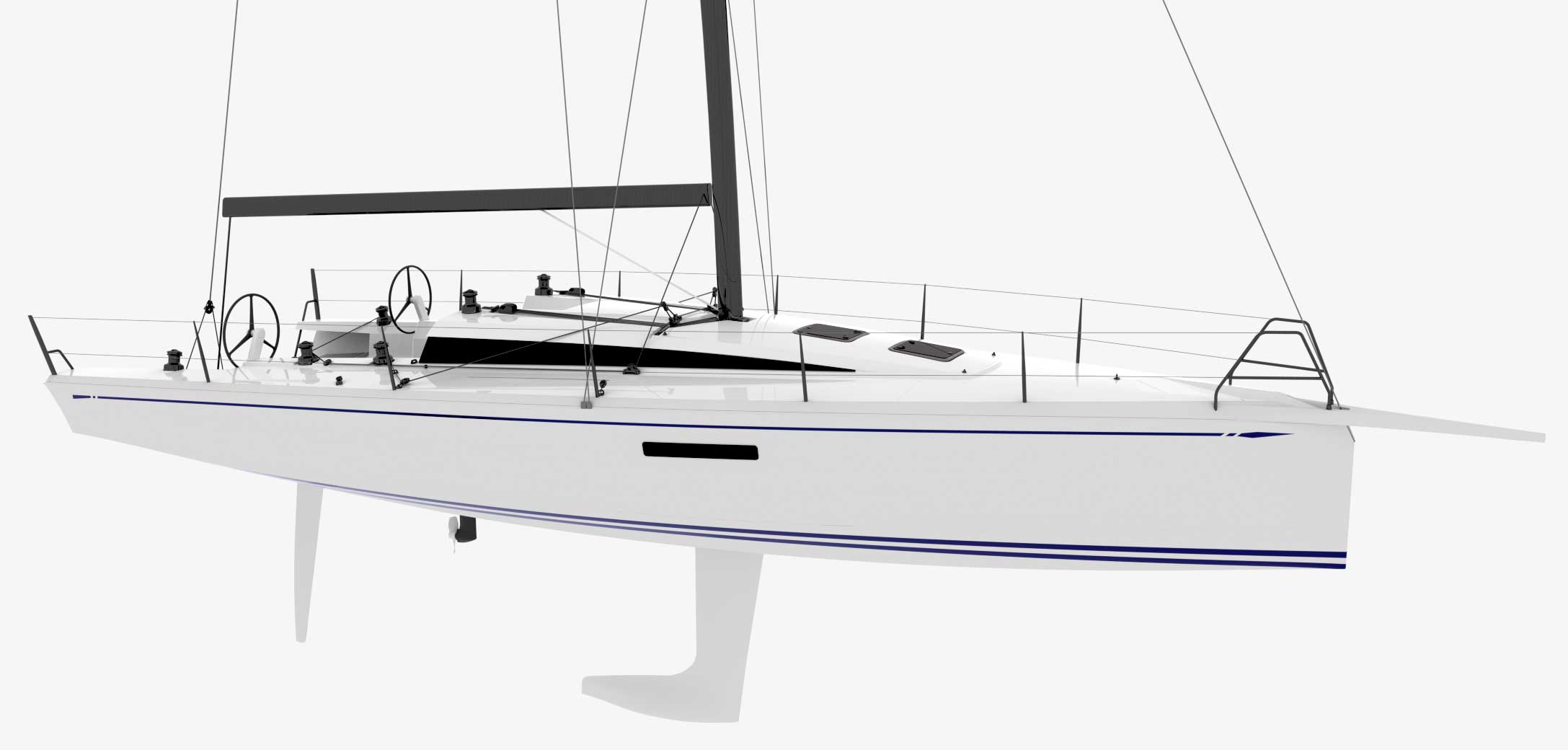
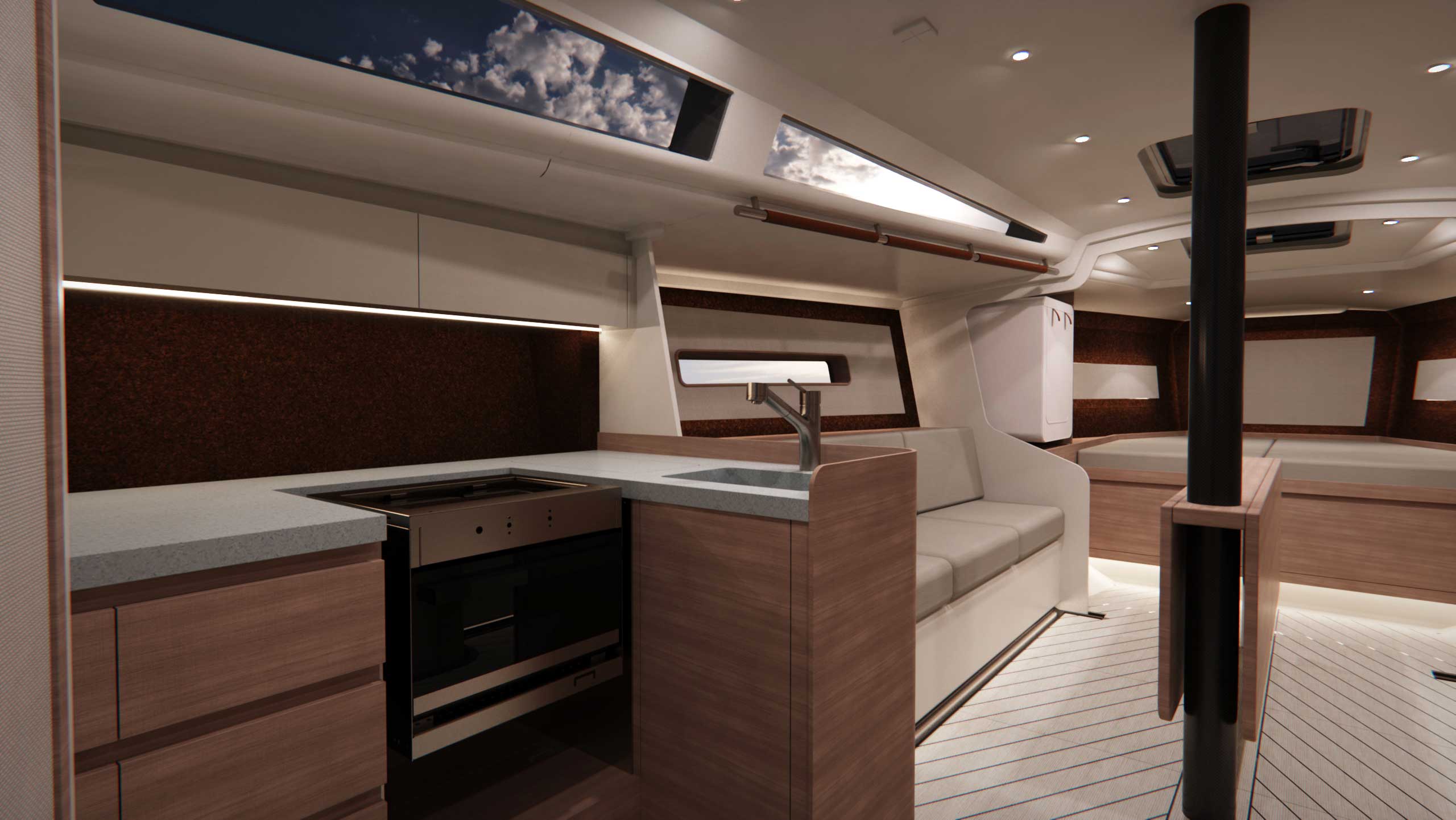
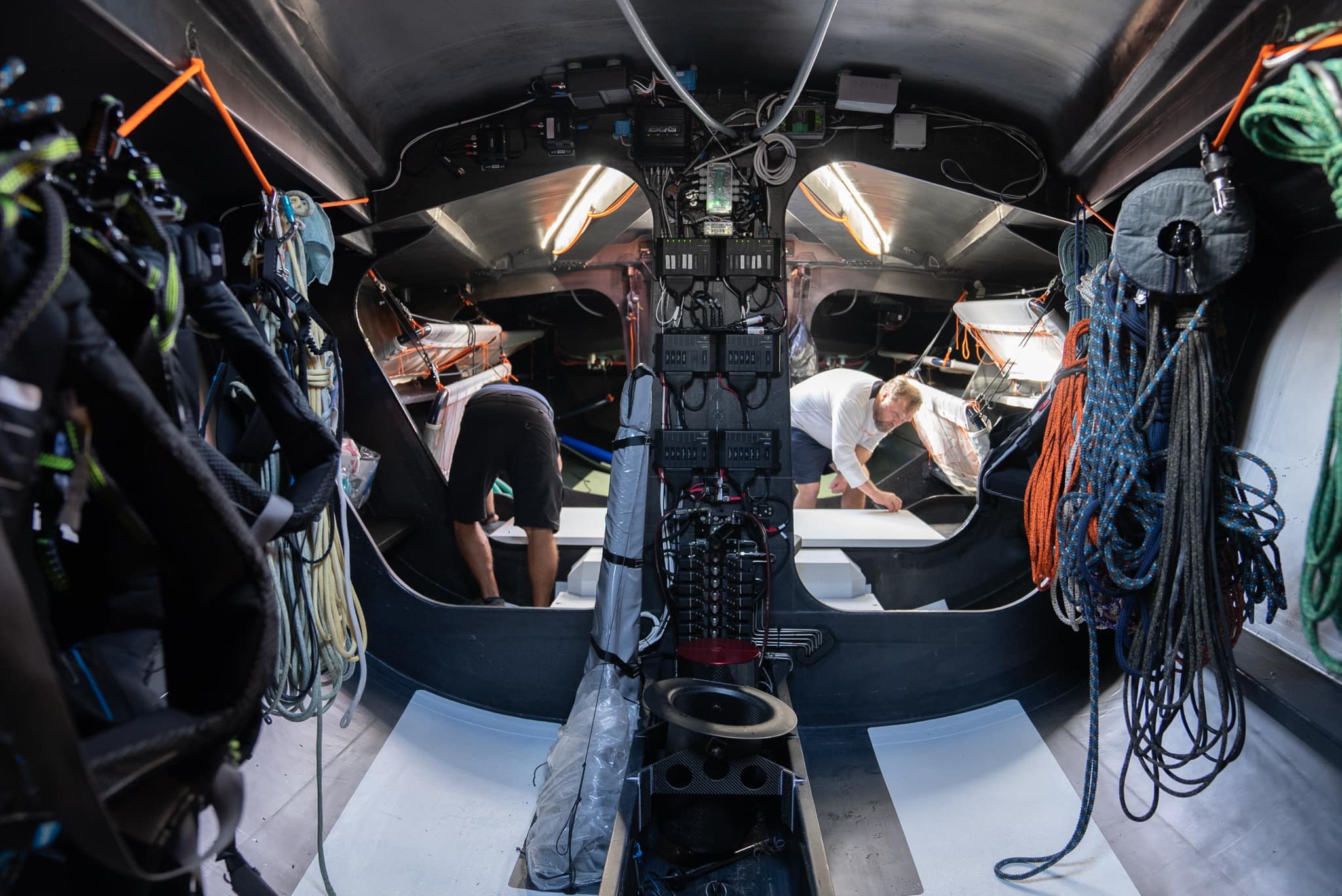
I september så smyglanserades ClubSwan 41, men det var nåt som inte stämde riktigt. Och nu verkar det som båten i stället blivit 43 fot.
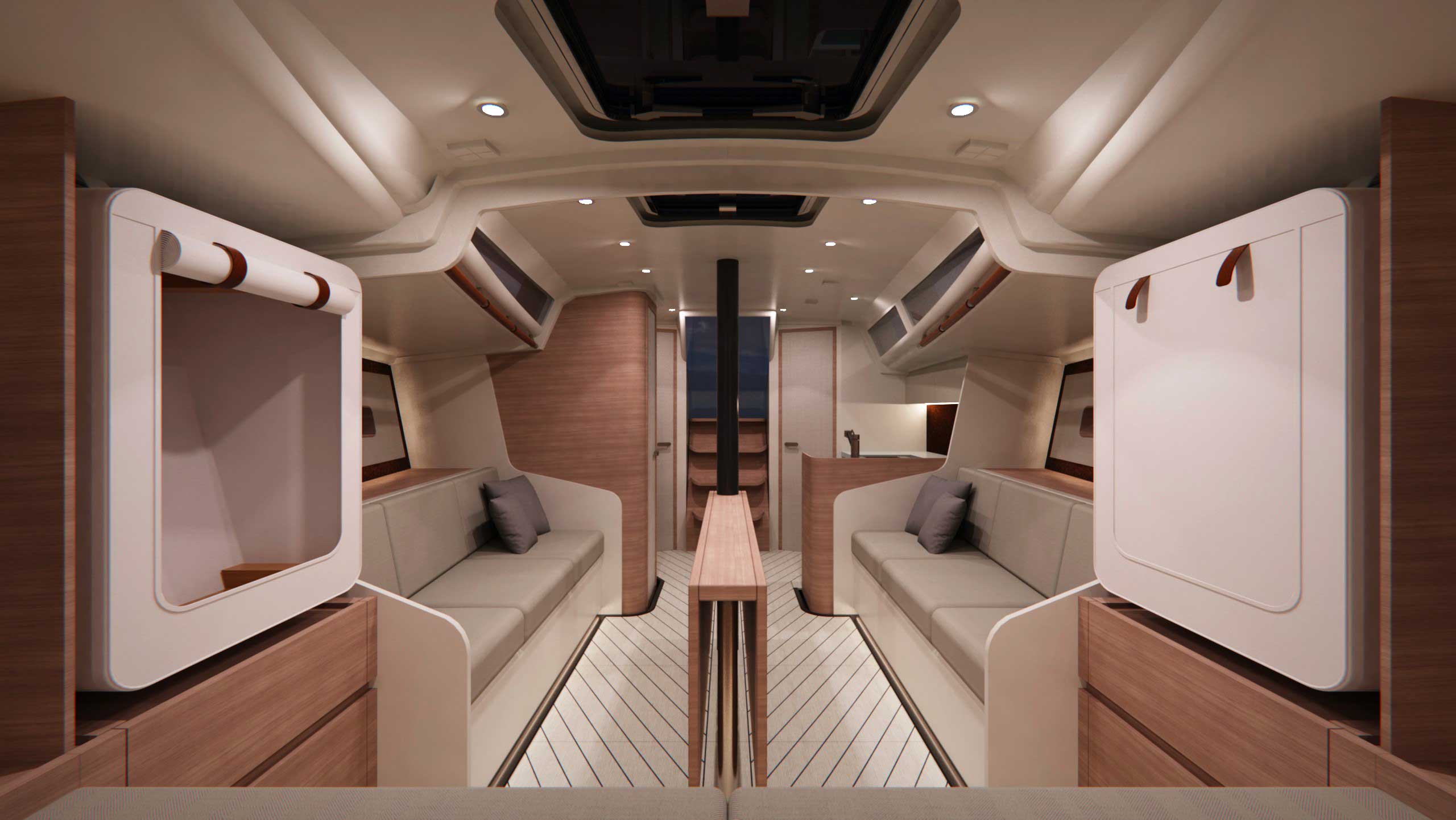
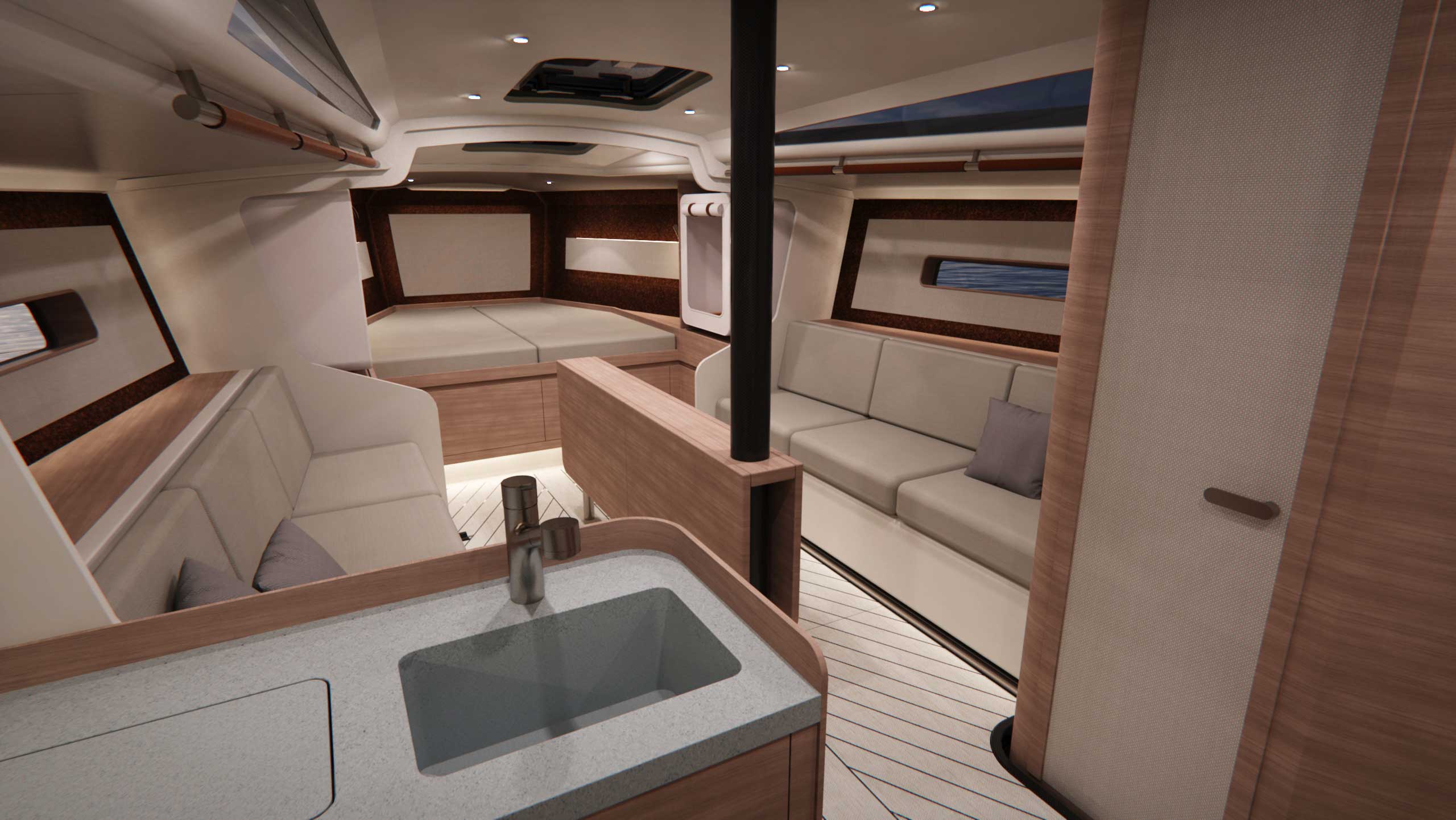
Ser fortfarande helt rätt ut på många sätt? Även om det känns som man fått iu väldigt mycket interiör på en båt som i första hand används för racing? Här var väl gamla 42:an inte alls dålig.
Intressant att Juan K gått ifrån T-kölen på de andra modellerna till en smäcker L-köl på 2.70.
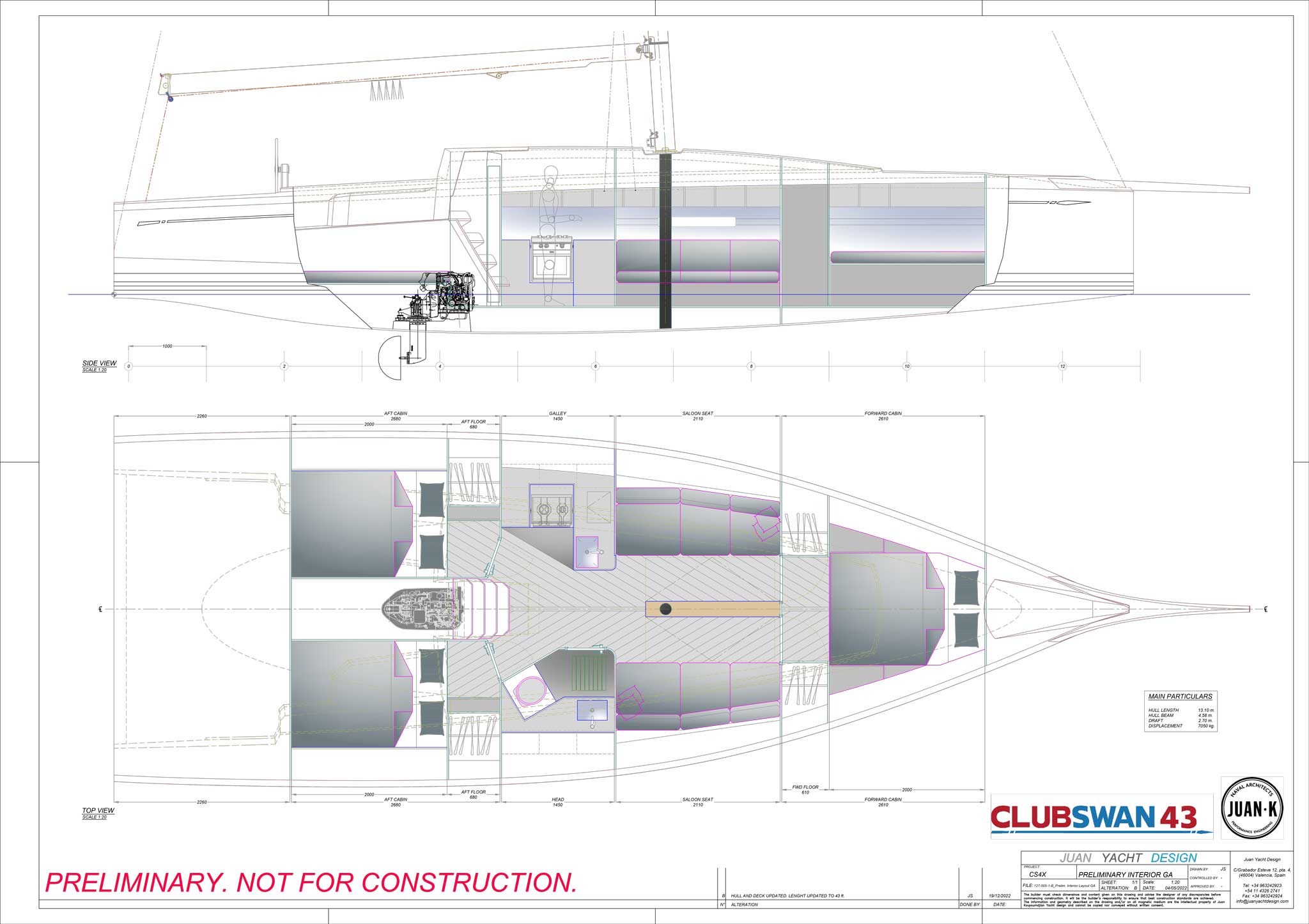
Layouten ser vettig ut. Hoppas de inte underdimensionerat vinscharna på samma sätt som på 50:an. Bilden visar väl cruising-varianten med ett häckstag.
Hull LOA (incl. bowsprit)
14.56 m
Hull construction length
13.10 m
Hull LWL
13.10 m
Beam max
4.58 m
Draught (empty)
2.70 m
Displacement (empty)
7050 kg
Total sail area
118.2 m²
Fore triangle
45.5 m²
Main sail
72.7 m²
Asymmetric spinnaker
174 m²
Engine Yanmar
40 Hp
Fuel Tank Capacity
150 L
Fresh water Tank Capacity
300 L
Black water Tank Capacity
83 L
THE CLUBSWAN YACHT RANGE BROADENS ITS POSSIBILITIES WITH THE CLUBSWAN 43
With a well-established Swan One Design Circuit and a high participation of ClubSwan Yachts in the established regattas, Nautor Swan broadens the range by introducing the ClubSwan 43, by Juan Kouyoumdjian.
Previously announced as a forty-one footer, the LOA has been changed to meet the new regulations in the ORC regattas and events, providing the owners with an exciting range of racing possibilities.
“The upgrade of the ClubSwan 41 toa ClubSwan 43, came from the need to meet the new ORC regatta regu!ations in order to give our owners a 360° round range of possibilities to participate to the events around the worfd” says Federico Michetti, ClubSwan 43 Product Manager. “By making an analysis of the circuits around the world, we came up with the solution to have a product that was not limited to just a specific category but something going beyond”.
Designed by Juan Kouyoumdjian, and previously announced as a forty-one footer by Giovanni Pomati, Nautor Group CEO on the occasion of the Cannes Yachting Festival, the ClubSwan 43 project has been formally announced at BOOT D0sseldorf, being at the cutting edge of contemporary yacht design, she has been conceived as the perfect crossover: a full racer able of competing in the mast captivating races worldwide and with the possibility to offer a ‘racing cruising’ experience.
Moreover, the yacht has been developed as a One Design package, taking advantage of Nautor’s expertise in this segment, which includes a professionally managed Class – she will be able to shine at the exclusive Swan One Design Circuits, such as The Nations League and the Swan One Design Worlds.
For this innovative project, Nautor Swan is coordinating a team of international expertise: Juan-K for naval architecture and performance analysis, Pure Design & Engineering has been entrusted for the engineering, the interior design comes from the drawing table of Lucia Micheletti, Micheletti+Partners while theconstruction will be assigned to Fibre Mechanics, in the UK.
The C/ubSwan 43 will be constructed, as every yacht with Nautor Swan’s signature, without compromiseand to the highest standards possible.
Both hull and deck will be built using E-glass in epoxy resin with carbon reinforcements, complementedwith carbon mast and boom.
“The ClubSwan 43 is an exciting evolution of the previous mode/ presented at Cannes. She is the best oftwo worlds, a pure racer with a stylish and elegant
interior design.” Says Juan K, Naval Architect. “It wi/1 be thrilling to watch her competing in both real time and rating races.”
The interior design has been envisioned by studying the needs of Owners considering this model and combines practicality and comfort for both racing and cruising modes.
Lucia Micheletti speaking about the project said: “With the new ClubSwan 43 we introduced new green materials, playing not only on style, but working on the project’s environmental impact with a constant desire to discover new elements from research and innovation.
Here’s an event that could be of interest to many of the teams going to the ORC World Championship in Kiel August 4-12?
Falsterbokanalen is a really nice place, strategically located on the southwest tip of Sweden. We have some fond memories from racing J/111 J-Hawk there in 2020.
Plenty of space in the harbor, and no harbour fees from July 24th to August 1st
Entry fees are from 4 000 to 7 000 SEK. Includes (harbour fees, get-together drinks, and food, m TracTrac for offshore races, lottery wins from sponsors, excellent prices, a corinthian class & photos and videos from races, also using drones)
Mitt tema är “att bygga ett engagerat team, sätta mål, skapa psykologisk säkerhet, prestera under press”, men jag är lite nyfiken på vilka frågor ni hade velat få svar på?
Det finns ju många aspekter av att driva ett projekt som vi gör.
Att få ordning på båt och material, bygga team och genomföra race är egentligen inte så stor skillnad jämfört med att segla här hemma. Det styrs ju av varför man håller på och var man lägger ribban.
Den största skillnaden med att segla internationellt är ju projektplanering, logistik, boende, och allt annat som följer av att man inte är på hemmaplan. Redan att ta båten till Færdern eller Gotland Runt kräver ju planering, och det blir bara ännu mer komplext när man skall längre bort.
Och man måste väl gilla den delen abc en ganska komplex sport om man skall orka hålla på 🤣
Men som sagt. Nyfiken på de frågor som kan finnas där ute.
I get lots of emails from new J/111 owners, and I’m always happy to help if I can. But this time, it was slightly different. Cameron Mckenzie and Nigel Jones were experienced offshore sailors, having each done 10/15 Sydney to Hobarts and numerous Melbourne to Hobart races, usually on 40 to 52 ft boats. They had just bought J/111 Ginan and wanted to take the boat offshore, with the 50th Melbourne to Hobart Race as the primary objective for 2022.
I got many very specific questions and decided to set up a Zoom call to go through them. Apparently, the team was impressed with my 48-page PowerPoint (!), and one thing led to another.
In my mind, this was an “easier” race than Sydney to Hobart, but I later discovered that the opposite might be true… As someone commented on our Facebook page: “the Westcoaster is a race for vikings and lunatics”. I’m guessing I’m a bit of both.
I arrived in Melbourne a few days before Christmas and had the chance to do both an evening race as well as “Cock of the Bay” on board Ginan. As I hadn’t raced since August, I wanted to spend as much time as possible on board before getting out on Bass Strait.
The crew on race day. From left to right: Peter Gustafsson, Cameron McKenzie, Tim Bilham, Will McKenzie, Jamie Christensen, James Bacon, Greg Patten, Stuart Bloom & Nigel Jones.
Pre-race briefing, Naturally, focused on safety since this is a category 2 race with unpredictable weather and potential big seas.
In the weeks leading up to the start, we had help from marine meteorologist and ocean analyst Jessica Sweeney. The forecasts showed a front passage with 40+ knots over 6-12 hours gusting 50, but the latest models were more moderate with shorter periods of 30-40 knots. Still, something to take seriously along a coast with few escapes.
1. Start to “the Rip”
A very varied fleet. Here’s Reichel/Pugh 46 Hartbreaker and the doublehanded Sayer 12 Ryujin (built specifically for the 2007 Melbourne Osaka race).
Fighting faces. Nigel at the helm, and Cameron doing tactics.
The start was a light downwind affair, with the tide going out. So important not to get too close to the line.
We got a good start in free wind by being the most northern boat on our start line. Decent pressure but hard to find a lane. And maybe the boats to the south had slightly better pressure.
A very good approach to the first mark at Queenscliff, where we managed to gain a lot on the boats to the north of us. Champagne sailing.
2. Bass Straight
Finally offshore. Even if the start is exciting, there’s something special about getting into the rhythm and focusing on the big picture.
So far, Bass Straight looked rather pleasant.
At 15:20 we hooked into the forecasted 15-20 knots easterly and changed from A2 to code 0.
Fast sailing south. The setup was very similar to Blur, and Ginan uses our polars (slightly modified). So the performance numbers on the mast displays felt very familiar.
Overtaken by Don Jones designed Alex, launched in 1993 as Cadibarra VII. Several of our crew, with Nigel as skipper, have raced on board the boat and managed to win a tough Melbourne to Hobart in 1999 as the only boat to finish (amazing report with some good learnings here).
For us Swedes, Don (Nigel’s father) is mostly known for designing the maxi Skandia (Wild Thing) and the VO70 Brunel. I had the chance to meet Don a few days before Christmas and look at some photos of his early designs.
Life at 20 degrees of heel. Greg navigating and Cameron serving a fantastic Risotto.
Watch schedule below. Very similar to the one we’ve used on Blur for the last couple of seasons.
At 20:30, northeast of King Island, the wind increased to 22-24 knots, and we went to jib. We had gone low and fast and were west of the fleet. Time to position ourselves for the trough,
At 00:30, just east of King Island, the trough hit us, and the wind dropped to 10 knots and TWD went from 25 to 260 degrees, back to 12 degrees and then 280. Frustrating, but we managed the transition fairly well.
3. Between King Island and Tasmania
After the trough, the wind became northerly 15-20 knots. Pretty much as the weather models predicted. We got the A5 up and averaged >12 knots for over 90 minutes. Topped 18+. A very confused sea state, and wind against tide, made it hard. But I think other boats had an even harder time.
Fun sailing on the edge as the sun rose over Tasmania. A few wipeouts but nothing major.
We managed to time our two gybes very well, and I think this transition was key to our result. Well done by Greg on nav and the whole team for pushing hard.
The tracker shows our movement relative to the fleet, where we go from being the most westerly boat to the most easterly one by positioning well for both the gybes
The real cold front hit at 07:40 with up to 34 knots from west. The wind went from 330 to 240 degrees.
We had an issue with the J4, and I remember helming, going full speed with the A5 straight toward the beach. It felt a lot closer than on the track above.
4. The rugged west coast of Tasmania
A great way to start the day; bagging the J4 while the rain is pouring down.
2 reefs and the storm jib was enough to get through the front… we heard on the VHF that other boats were seing 50 knots and decided to play it safe.
Some boats retired. The most serious was X-43 Scaramouche that sent out a may-day as the boat was leaking, but later recalled it and managed to get into Strahan through “Hells Gate”.
… and during the day, we could go back and forth between full main and two reefs in 18-24 knots of wind.
The J/111 is pretty fast at TWA 60 but also extremely uncomfortable.
As I wrote in my presentation in February, “crew breaking conditions” 🤮 and almost 24 hours along the west coast took its toll. Multiple wave systems made it even harder – long swells in combination with rather steep waves after the front passage, making it bumpy and wet.
5. The Southern Ocean
Finally, in the early hours of the morning, we could get the code 0 up. Even if we were tired, we felt that we’d managed the worst part and now needed to keep pushing to not get caught by a high pressure system that was moving in fast in our direction.
It was at this point I started to reflect on the whole experience. That this place was exactly how people had described it throughout the years; the dark grey sky, the wind that feels more powerful than normal, the long swell, and the albatrosses. This, paired with the rugged and inhospitable coast of Tasmania made it feel very special.
And naturally, I promised myself to never do it again.
As we rounded the South West Cape we could peel to the A2. Sea state was terrible, with three different wave patterns doing their best to make downwind sailing hard. We knew that the A2 might struggle, but I felt we needed all the power we could get to punch through, even if there were a slight risk of ripping the sail. Ideally, an A3 would have been a better choice to get bow up and go for speed.
Greg, our navigator, seems pretty happy about getting around the corner.
Richard Bennett showing up in a helicopter is always a highlight. Great photos.
Brekkie.
6. South East Cape to Storm bay
Waves got better as we got east, but we struggled a little with pressure. We felt that the boats before us had more wind and that boats behind us might be affected by the high.
Jamie grinding, Will concentrating on the main, and Nigel driving.
One happy camper. Jamie looking forward to Customs House?
Around the southern tip of Bruny Island. Not long to go.
We were headed all the way and almost made it into the river under A2, but when we got to North Bruny the wind increased and we peeled to the code 0.
7. River Derwent
At the Iron Pot we got headed even more and had to go to J2. We stayed close to the right shore to avoid the current. I’d heard all the stories about being becalmed just before the finish, but this time it looked like good breeze all the way. But, as we all know, it’s not over…
And finally we got to use the code 0 for the final stretch into Hobart and the finishing line.
8. Finish in Hobart
What a feeling!
Most of us have seen the welcoming scenes from Hobart, where people line the docks to welcome the yachts. But it was much more emotional than expected to be there and have our families cheering.
Tired but happy.
This is a real challenge, even for sailors that have done it many times. And for us that did it for the first time, it felt like a real achievement.
We came 2:nd overall in both ORC and AMS, and I think everyone was happy with the result. With a new boat and a short time to get it set up for this type of race, I’m very impressed with what Cameron, Nigel, and the rest of the crew have achieved.
Because of the weather, we couldn’t touch Maritimo, and there was no place along the course where we could have been 40 minutes faster.
So many thoughts after a race like this. I’ll try to summarize the major ones.
This is a very special place, and racing to Hobart, either from Melbourne or Sydney, is a bigger challenge than most offshore races. It’s beyond a yacht race.
Experienced sailors who have done a number of these races have a different way of setting up their boats for offshore racing and managing safety. Lots of learnings here for my team and me. One example is the thorough “Ginan Safety and Operating Manual” that everyone got to prepare for the race. We could sometimes push harder and have more people on the rail, but to perform well down here, you must preserve crew.
The J/111 is surprisingly capable in rough conditions. Sure, it’s very uncomfortable and wet, but it behaves well in 30-40 knots. We’ve seen this in many races with Blur, and this was another example. Maybe the light boat and lack of stability keep forces down and demand that you go to smaller sails earlier.
To be able to sail a boat actively in these conditions, you need to change modes easily and without too much risk to the crew. It has to be easy to change back and forth between reefs and jibs.
Usually, it takes a couple of weeks before I change my mind and would consider doing an offshore race again. But this time, I felt a stronger urge to go back. A more emotional response than usual. It’s a good thing we still have Sydney Hobart on our bucket list.
A big thanks to Cameron, Nigel, their families, my family, the crew, ORCV, and everyone else that made this possible. We’re overwhelmed by the hospitality and can’t wait to return to Melbourne.
Arto Linnervuo och resten an gänget på Tulikettu verkar redo för sitt första race. Och varför inte börja med RORC Transatlantic Race? Det skall bli mycket intressant att se hur man står sig i IRC Zero, där man ställs mot ett antal bra båtar med helt olika koncept: DSS vs vattenballast vs svängköl vs IRC-optimering vs Class 40.
Enligt min routing ser det ut att bli “champagnesegling”, men mycket kan så klart hända under ett så här långt race. Och alla team behöver hålla gaspedalen nere.
Vi har Micke Wahlroos ombord så man kan kanske hoppas på lite rapporter under racet.
Black Pearl
IRC 56
1.463
Tulikettu
Infiniti 52
1.426
Rafale
Elliott 52
1.420
Teasing Machine
NMYD 54
1.378
Sabre II
Akilaria 40
1.231
IRC Zero – Packed with cutting edge 50-footers The highest rated boat in IRC Zero is the water-ballast Botin 56 Black Pearl with Stefan Jentzsch at the helm. Black Pearl’s crew, which includes Marc Lagesse, Paul Standbridge, Mitch Booth and Peter van Niekerk are hoping it will be third time lucky for Black Pearl. A broken bowsprit and then a dismasting scuppered the boat’s chances in the last two editions.
Arto Linnervuo’s all-Finnish team will be racing Infiniti 52 Tulikettu. Linnervuo completed the race in 2018 with his Xp-44 Xtra Staerk, but Tulikettu is on a totally different level. Weighing less than 7000kg and built with DSS side-foils, Tulikettu is capable of adrenaline-pumping speed. Henri de Bokay’s Elliott 52 Rafale sports a canting keel, but still rates lower under IRC than Black Pearl and Tulikettu. Skippered by Philipp Kadelbach, Rafale‘s crew is mainly from Germany and amongst their recent successes includes Line Honours for the Aegean 600. Eric de Turckheim’s NMYD 54 Teasing Machine was the overall winner of the race in 2017. Since the French team’s victory, Teasing Machine has undergone a series of modifications and was in fine form, winning the 2022 Rolex Middle Sea Race. The Teasing Machine crew includes Volvo Ocean Race winner Laurent Pages and Aymeric Chappellier, who finished on the Class40 podium for the 2019 Transat Jacques Vabre.
With a crew from Czechia and Slovakia, Miroslav Jakubcik and Marek Culen will race the smallest boat in IRC Zero; Class40 Sabre II. The co-skippers have raced against each other since childhood but have joined forces to make their first transatlantic race. The largest boat in the class is Marie Tabarly’s 73ft ketch Pen Duick VI, which is also the oldest boat in the race. Originally built for Marie’s father Eric Tabarly for the 1973 Whitbread Round the World Race, Pen Duick VI has a great history of Transatlantic racing, including Eric winning the solo 1976 OSTAR.