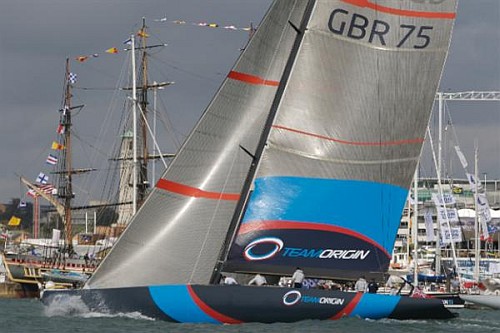
The headline appointments won’t come as any huge surprise to readers of the Cup tea leaves, with Ben Ainslie skipper and Juan Kouyoumdjian as principal designer. But if you dig a bit deeper (and you can do it yourself here – but I warn you that this is a 3M PDF file) there are some interesting appointments.
On the sailing side, Ben has been joined at the back of the boat by Iain Percy – these two have been raising flags on their intentions to win the America’s Cup together for some years now. Percy brings his Star crew, Andrew Simpson, with him, as aft grinder and strategist. Joining from Team Director Mike Sanderson’s winning Volvo Ocean Race boat, ABN Amro, is Rob Greenhalgh, as strategist and traveler – the up-the-mast role going almost exclusively to skiff sailors these days it seems. While Ben has brought navigator Ian Moore with him from Emirates Team New Zealand (ETNZ), where they sailed the ‘B’ boat together.
But the most notable defection from ETNZ is Andy Claughton, who joins as Design Coordinator, a role he filled in 2007 for ETNZ. He’s had some kind of involvement with the Kiwi Cup teams dating right back to 1987, and he will leave at big hole over at Grant Dalton’s camp.
Also on the technical side, Mickey Ickert has come from BMW Oracle, where he’s spent the last three Cups, and will be Aero Director – the lead sail designer. And to complete the rig package, spar designer Bruce Thompson also joins from Oracle along with trimmer, Robby Naismith – keeping it in the family. And with Neal McDonald on the mainsheet (who knows a bit about mast design himself) this is a really strong aero development team. Another notable on the technical side is Stan Honey, who was Mike Sanderson’s navigator on ABN Amro. Honey joins as Technical Director and navigator.
Up the front of the boat we have Chris Brittle, David Carr, Pawel Bielecki and Ian Weighell turning handles, with Julien Cressant and George Skuodas on the mast, and Kevin Batten, Justin Slattery and Matt Cornwell on the bow, with Nick Bice as Boat Captain.
På bloggar, bryggor och segelmakerier diskuteras det. Om mätregler. Om LYS. Om hur vi skall få fler att börja kappsegla.
Många verkar dock tycka att det bara är gnäll, och menar att seglarna skall “lära sig segla” eller ännu hellre anpassa sig; “segla entyp”, “köp en Smaragd” eller “köp en Express”.
Vi skall alltså helst segla Smaragd, Express, IF eller majbrasa. Gärna 3 och 3 runt nån ö. Expresserna drar 50 båtar en gång på sommaren och de andra har knappt SM-status. “Hetaste klassen” CB66 drar 24 båtar när det är stor samling. Vi står oss slätt i internationella entypsklasser. Vill man vinna några race lägger man pengarna på nåt gammalt skit som man kan optimera.
De som just har sålt sin Express eller Smaragd kanske inte vill köpa tillbaka den bara för att vara med och kappsegla på ett vettigt sätt? Är det inte en varningssignal att jätteduktiga seglare inte seglar moderna båtar?
Bästa havskappseglarna kör IMX-40, First 40.7 eller X-332 (de senare är 13 år gamla kontruktioner – inget fel med det, men nåt kul har kanske hänt sedan dess).
Shorthand är hur hett som helst i våra grannländer, men här är det ingen som bry sig.
Ingen bredd? Ingen höjd? Ingen utveckling?
Samtidigt slår tävlingar som Færderseilasen (1200 båtar) och Round the Island (nästan 1800 båtar) rekord. Både bredd och massor av coola kappseglingsmaskiner. Man får till och med begränsa deltagarantalet i vissa race, som Fastnet och TwoStar.
Men SSF verkar nöjda. SHF verkar nöjda. Våra stora klubbar verkar nöjda. Medierna verkar nöjda. På bloggarna debatteras skitsaker som om LYS-talen är rätt på Neptunkryssare och RS Elite.
Uppenbarligen har vi precis de handikapp-system vi förtjänar.
Steve Tedeschi har varit ett av mina bollplank när det gäller segeltrim. Hans J/109 “Tastes Like Chicken” går alltid fort och nu vann de solklart Sailing World NOOD på Long Island Sound. 58% av deltagarna seglade J/Boats, och J/27, J/30, J/105 & J/109 hade egna klasser…
In sailboat racing there are two degrees of quickness: there’s fast and then there’s blazing fast. Ask Stephen Tedeschi where his J/109 team fell in that range at this weekend’s Sperry Top-Sider NOOD Regatta in Larchmont and I guarantee he have no qualms confessing that his Tastes Like Chicken is plenty fast: fast enough, that is, to earn the regatta’s overall trophy and a trip to the British Virgin Islands for the Caribbean NOOD Championship in November.
Tedeschi’s crew, a mix of Chicken veterans and some fine young imported talent, put on another stellar performance on the water today, finishing the first of its two races some 3 minutes ahead of the second-place boat, and then wrapping up the regatta with a second Related Resources
In the first race of the day, most of the J/109 fleet were OCS, leaving Tastes Like Chicken—perhaps a bit close to the line themselves—a virtually open racecourse and an easy win. But the last race was the toughest of the series, courtesy of Rick Lyall’s Storm (fourth overall), which justifiably dragged them into a drawn-out, sweaty tacking duel. Tastes Like Chicken crewmember Forrest Williams estimates they rolled through at least 20 tacks.
The old saying in one-design sailing circles is that you look smart when you’re fast, but for Tedeschi’s clan, victory wasn’t just about being fast, it was about being smart, aggressive when they needed to be, and sailing their own race when they got away. They’d get far enough ahead, says Tedeschi’s crew, and everyone else would end up battling it out for second place, slowing each other down at every opportunity.
En båt det snackats mycket om (framförallt på Saling Anarchy) är Flying Tiger 10M. Nu skall den börja säljas i våra trakter. Samma målgrupp som HP 1020?
Det brukar ju vara norrmän som håller sig framme, men nu är det våra grannar i öster som tar upp stafettpinnen. Jag har efterlyst provsegling med sauna.
Pris “på startlinjen” inklusive segel men exklusive utombordare och elektronik beräknas hamna på 620.000:-!
9.96 x 2.78 m
Draft: 2.32 (keel up: 1.0 m)
Displacement: 1985 kg Keel: 870 kg
Mainsail (37.4 m²) + jib (23.4 m²) + assymetrical (106.8 m²)
We did the Helsinki-Tallinn Race, the largest offshore race here (201 boats) with the Tiger and had a reporter and a photographer from Helsingin Sanomat (combine Svenska Dagbladet and Dagens Nyheter and you still lack some, it’s like the only newspaper in Finland) that did a front page article of our sail.
The weather was tough! We had 22-27kts of wind straight from the nose and 2-4m waves. With only OEM Neill Pryde sails (100% jib and only one reef on the main) it was quite a ride but I have to say that after that I have 150% confidence in the Tiger. She was overpowered (trimguide says that over 15kts of wind you shuld change to the 85% Q jib) but handled VERY WELL. Anyhow, not the weather for the Tiger. We did it in LYS-1 and of course lost to 40-footers that are better suited for going uphill in those conditions. We ware 16th in our class (out of 38 boats), and I have to admit we are happy with it.
Anyhow, coming back from Tallinn on sunday was a blast! We had 12kts of wind from the west and maintained sustainable speeds of 10-11kts (measured by GPS) and everytime we had a wave we surfed 13-14kts. A blast!! It was absolutely fantastic!!
Tiger Trading Ltd has been awarded the rights to sell and market the Flying Tiger 10 sport boat in Scandinavia and the Baltics. The Flying Tiger 10M is a ten meter modern One Design Club Racer. It features a lifting keel and carbon fiber mast, boom and bowsprit. The yacht weighs 1985kg of which 870kg is in the keel.
The Tiger has been designed by the acclaimed yacht designer Robert Perry. The commercial rights for the yacht are owned by the American company Hiptrader Ltd, based in Coronado California and managed by Bill Stevens. The yacht is assembled by Hansheng Yachts, based in Xiamen, China.
The yacht is delivered as a complete sail away package with jib (23.4 m2), mainsail (37.4m2) and asymmetrical spin (106.8m2) from Neil Pryde Sails. Both North Sails and Quantum Sails have class sails readily available. The Flying Tiger 10M features deck hardware from Harken and Spinlock. The furling system is from Facnor. The carbon fiber mast, boom and bowsprit are manufactured by CST Composites of Australia.
The Flying Tiger 10M has been a huge success in an incredibly short time. Regattas in the United States have had nearly ten Tigers competing in their own One Design class. The international media has been enthusiastic about the Flying Tiger 10M and the yacht is now competing for the “Boat of the Year” prize in the United States.
“You can get a hold of a tiger with a few pals with the same amount of money you would be spending on just sails alone when trying to refit a yacht for competitive racing. The same kind of feeling and functionality that the Tiger has just can’t be rebuilt in a cruiser/racer”, argues Tiger Trading Ltd’s Janne Kjellman.
The story of the Flying Tiger 10M starts off in early 2005 when Bill Stevens introduced the idea of a new project to yacht designer and naval architect Robert Perry. Stevens suggested that they design a revolutionary new sport boat. The idea was to design a One Design yacht that would feature good performance characteristics at a low price. Additionally, the yacht should fit a standard sea container for transportation.
Stevens knew several yards from China from previous projects, so all that was needed was a good plan. Perry drew a draft and sent it to Stevens, who in turn posted it to the sailinganarchy.com site asking for comments from the global yacht racing community.
Interest was immediately huge. Literally thousands of comments and suggestions came around the world from the sailing community. The final nail was when Bill announced that the price for the first 50 boats would be $39,500 with a $1000 deposit for the hull. Deposits started coming in very quickly and soon exceeded the 50 boat mark. Bill Stevens negotiated a deal with Hansheng Yachts. The factory had built composite boats from 1984 and Bill had worked with them before.
Production started soon after. Several prototypes and a lot of testing later the first boats started to arrive to their owners in the United States in the end of 2006. Stevens and Perry ware right. There was a huge demand for a dead-simple high performance sport boat at an affordable price.
Over 150 boats have been sold now and 65 delivered to customers, mainly in the United States and Australia. Our exhibit yacht, FIN-10738 “Tigru” (hull #43) is the first Flying Tiger 10M in Europe.
“We believe that the Tiger will be a great success also on this side of the Atlantic”, Anssi Sallinen says. “A sport boat that features great performance at an affordable price tag has a clear demand.”
The Flying Tiger 10M is delivered sail away (ex outboard and electronics) with all deck hardware, halyards, ropes and sails. The suggested retail price in the Scandinavian Countries and the Baltics is 65000€. The price includes VAT, customs duty, freight and shipping. Customers placing orders during the year 2007 can expect yachts to be delivered for the 2008 season.