



Segling med asymmetrisk spinnaker

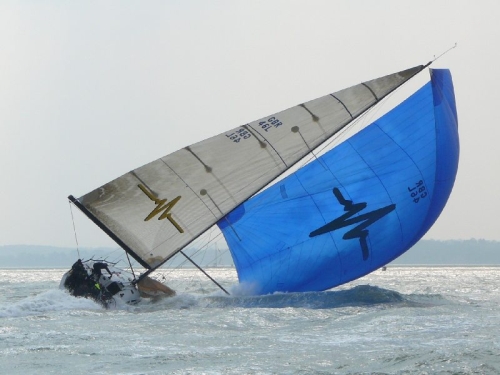
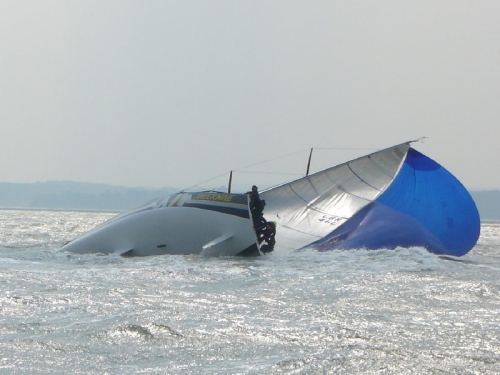
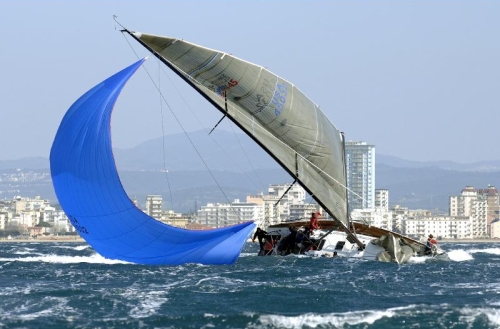
J/109:or kör undanvind på Skandia Cowes Week 2006. Foto: onEdition.
Nytt och kul på J/109 är ju asymmetrisk spinnaker. Ingen ombord har seglat särskilt mycket med sådana så här finns det mycket att lära. Vi skall väl försöka få med folk ombord som har koll och segla på andra båtar. Nedan en del obligatorisk läsning för besättningen på Blur.
Under 2007 kör vi med en allround-gennaker (Quantum Renegade r3) så får vi klura på vad man behöver komplettera med till nästa säsong. Det finns säkert folk som läser blur.se som har synpunkter på vad man behöver :-)
Jag kollade in North U som har en sjysst serie om “Trim Downwind”. Det tydliga budskapet när det gällde trim var “Ease, ease, ease”. Vanligaste felet är att man kör för hårt i både halshorn och skot.
Sailing World har en bra artikel om “The Commandments of Asym Trim”:
- Thou shall rotate your asymmetric to weather.
- Thou shall keep the tack line in mind.
- Thou shall never sail a straight line.
- Thou shall use your twings only if you must.
- Thou shall always have and talk about pressure.
Här är några andra bra artiklar:
- 5 Keys to Asymmetric Speed and Teamwork
- Klingler’s Downwind Speed Tips
- The Bowman’s Guide to the Asymmetric
- Mastering the A Sail (pdf)
- Code Zero – The New Way To Close Reach (pdf)
Harken/North Sails Melges 24 Instructional Video:
Segelmakarna har olika kodsystem för att hålla koll på alla varianter…
Quantums Renegade Asymmetrical spinnakers
Reaching sails are r0, r1, r3, r5 and r7. Running sails are designated as r2, r4 and r6. Materials range from Cuben Fibre and other custom composites to more traditional nylon and polyester spinnaker fabrics depending upon application
r 0
This is the sail now generally referred to as the Code Zero.
- 70% of maximum area, and 40% larger than a Genoa.
- Excellent light air performance. The choice for light to moderate air close reaching.
- Great distance racing sail
- TWA of 70-130, AWA of 30-120 depending on girth and velocity.
- Critical for the newest swept-back-spreader rigs with non-overlapping jibs.
- Can be used on a furler
- Foot length typically 168% of SPL
- Mid girth 75% of foot or smaller if rule allows
- Leech length 90% of Luff
- Genoa-like shape
r 1
The r1 is designed as a VMG (velocity made good) sail for tacking downwind. It is typically slightly smaller and flatter in the head sections to optimise light air performance with pole at or near the headstay
- 100% of maximum area.
- TWA 100-150 degrees, AWA of 70-120
- Foot Length 180% of SPL
- Mid girth typically 90-95% of foot
- Leech length 87-90% of Luff
- Flatter specialized shape for light air tacking angles
r 2
The r2 is designed as a light to moderate air sail. It is typically used as soon as the spinnaker pole squared is back from the headstay. 10-22 knots is a normal true wind range.
- 100% of maximum area.
- TWA 130-160 degrees, AWA of 90-145
- Foot Length 180% of SPL
- Mid girth typically 100%of foot or larger is class rules allow
- Leech length 87-90% of Luff
- Full, powerful sections for running, modified slightly to allow for pole on the headstay angles in transition conditions.
r 3
A full sized reaching asymmetrical, it is the best choice when adding an asymmetrical to an existing inventory, since it is as close to an all-purpose sail as possible. It is designed for the middle range of reaching angles in moderate breeze, but as a fullsized sail, it is capable of working effectively at broader angles.
- 100% of maximum area.
- TWA 100-150 degrees, AWA of 80-140
- Foot Length 180% of J
- Mid girth 100% of foot or bigger if rule allows
- Leech length 87% of Luff
- All Purpose Shape
r 4
A full sized, maximum power running asymmetrical, for use with the pole well-squared. Optimised shaping and structure for moderate to heavy air running, typically used in 18-30+ knots of true wind.
- 100% of maximum area.
- TWA 150-180 degrees, AWA of 120-165
- Foot Length 180% of SPL
- Mid girth typically 100% of foot or larger is class rules allow
- Leech length 87-90% of Luff
- Full, powerful sections for running.
- Additional reinforcing and plying for high loads
r 5
Designed for moderate air close reaching and heavy air reaching at broader angles when maximum area is too much. r 5 shapes also work reasonably well in light air at very close angles when a r 0 is not available. Design emphasizes flat, well-twisted shapes with straight exits to reduce heel angle and maximize performance, with balanced, forgiving entry for trimming ease.
- 90% of maximum area.
- TWA 90-160 degrees, AWA 80-150
- Foot length 180% of J
- Mid girth 85%-95% of Foot depending on aspect ratio
- Leech length 88% of Luff
- Reacher shape
r 6
A slightly reduced, maximum power running asymmetrical, for use with the pole well-squared. Optimised shaping and structureb for heavy air running, typically used in 25+ knots of true wind.
- 100% of maximum area.
- TWA 150-180 degrees, AWA of 120-165
- Foot Length 180% of SPL
- Mid girth typically 90-95% of foot
- Leech length 87-90% of Luff
- Full, powerful sections for running.
- Additional reinforcing, plying, and generally bomb-proof construction for maximum loading
r 7
A reduced size asymmetrical designed for extreme reaching conditions. Also used when it’s too scary to put any other spinnaker.
- A sail for the serious offshore inventory.
- TWA 90-160 degrees, AWA of 60-145
- Foot Length 160-180% of SPL
- Mid girth typically 78-85% of foot
- Leech length 87-90% of Luff
- Extremely flat, specialized reaching mould.
- Additional reinforcing, plying, and generally bomb-proof construction for maximum loading
North har ett liknande kodsystem:

CODE 1A:
Light Reach/
VMG Run
70-120 AWA
CODE 2A:
Light Runner
110-150 AWA
CODE 3A:
Medium Reacher
70-120 AWA
CODE 4A:
Medium Runner
110-150 AWA
CODE 5A:
Heavy Reacher
95-130 AWA
De mest korkade sakerna…
man kan göra med en segelbåt.
Högt på listan hamnar att segla runt jorden åt fel håll. Eller att segla J/80 över atlanten (tipstack till skota.se). Fler förslag?

Sweet… JJ Flash

En av de mest aktiva J/109-seglarna i våra vatten är Geir Inge Juriks på “JJ Flash”. I år skall han bland annat segla Hovdan-Skagen Race, Færdern, Watski TwoStar, Simrad OneStar, Hollenderseilasen, Ulabrandseilasen och kanske någon mer.
Vi får ju fajtas på både Færdern och TwoStar men nu är det också klart att jag skall segla med ombord under Hovdan-Skagen Race som startar 17:e maj (tydligen är inte alla helt nöjda med att man starten denna dag).
Hittills 52 anmälda båtar men man hoppas på en hög till.
Det blir ett bra tillfälle att segla J/109 och få lite koll på läget, speciellt då man kör Quantum genomgående.

Watski Skagerrak TwoStar 2006

SimradOneStar 2006

Ferderseilasen 2006

Ferderseilasen 2006

Faster than a fat kid to a doughnut

Bilden är från “Seilas tester hardcore seilmaskin” (tryck här).
A35:orna regerade i sin klass i Spi Ouest härom veckan. På SA diskuterade det en del kring dessa båtar och hur man fick fart på dem. Nedan kommer en kul beskrivning på hur det går till…
I don’t know much about the A-40, but I do know the A-35 quite well, I race on the A-35 Chenapan out of La Trinité sur Mer. The boat holds its rating when we don’t fuck up, and will sail well above it if we do everything perfect. We are esentially a stock boat, the IRC is standard rating, we have cushions, trim, a stove etc. We are still not up to speed though (far from it, especially in light air)
Batisyl, the winner of the Spi Ouest last year, and Garance Peinture, who won by a hair this year are both highly modified, nearly 300kg lighter and have gone to carbon sticks. Garance has completly re-rigged as well, getting rid of a lot of weight that way. (went to purchase main sheet vs. winches, changed the sheeting systems etc) Batistyl is also the program run by the guys from Sailingstyle, who sell A-35’s.
In the light, the boat does go, but it’s super tweaky, we are about 0.15-0.25 kts off the pace for the moment. You need to keep the boat flat until litterally 0 TWS, with lightweight genoas super deep and slack trimmed mains upwind. Downwind you really need an Assy on a pole until about 12 too keep the boat moving. Both upwind and downwind you have to get at least 3 crew in front of the mast, more if you’re skinny fuckers like me.
In the middle wind ranges, the boat goes like a bat out of hell, just trim the sails, stack your ass on the rail, weigh forward upwind, and center on the downwinds. Once again, sail choice is important.
In the bigger winds range (28+) upwind goes quite well, but wet. Downwind it’ll go faster than a fat kid to a doughnut, if you keep the mast right side up. You’ve allso got to get all the weight to the back of the bus, unless you like to swim.
The move to poles is because the prods don’t do well in IRC, and the speed is absolutly god aufull in light air with the prod (this is hear-say, we don’t have one) We do have a light, pole based assy. Batistyl has a 4th declaired kite, a heavy assy, which they use on reaching legs and seems to get them going good and scary fast once they get everyone hanging off the windward corner of the transom.
The build quality does not seem to be a problem, although the interior ressonates like a fucker, leading to some scary moments when you’ve got your head in a spin and some asshat bumps you trying to luff you into the rocks. (the noise was impressive, considering how little damage was done) It is built light, but light does not mean insufficient, or weak. I haven’t repaired any though, so I can’t attest to much more than that. There are several doing the Trans-quadra next year. The blocks and lines are not undersized, they are over spec’d though, we’ve yet to blow anything to hell, nor has Batistyl iirc and they did 45 000 miles on that boat last year, including the english races.
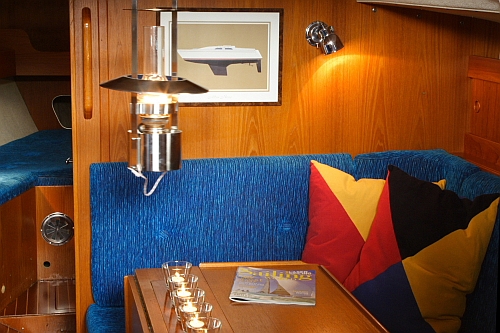
Ja, den är inredd…

Jag har fått en del påstötningar om att det bara fanns fräcka kappseglingsbilder under “Blur till salu“. Nu har jag kompletterat med interiörbilder för de som är intresserade :-)