Men när det gäller att pricka en lång startlinje i full fart så gör moderna hjälpmedel det mycket enklare. Man kan ju fundera på hur mycket beräkningar som ligger bakom, när Peter Burling gör det på en meter när i 30+ knop…
När vi började använda expedition seriöst, kan ha varit 2010, så var många ombord tveksamma. Så vi lade ett par träningspass där alla ombord fick gissa hur lång tid det skulle ta att pricka en linje från långt avstånd. Ingen lyckades slå Expedition, mer än enstaka gånger.
Även solo kör jag oftast en full startsekvens med hela apparaten kring startlinje och gör några teststarter. Det ger mig bra referenser och en trygghet kring var jag är i förhållande till linjen. Lite överambitiöst kanske, men det tar inte mycket tid och det är skönt att ha fasta rutiner.
Vi har ju också kört ProStart på J/70, och var nu lite sugna på att se hur det funkade på B&G H5000 som har många av de här funktionerna inbyggda.
Det roligaste var egentligen första gången vi startade i våras. Det var på HH Skagen Race, och vi pingade märkena i Expedition (man kör ju fram till respektive startboj för att tala om för Expedition var de ligger). Plötsligt dök den här displayen upp på Graphic-displayerna i brunnen – och på plottern så körde nedräkningen igång med gigantiska siffror!
Integrationen mellan Expedition och H5000 är mycket snyggt gjord. Jag älskar när teknik överraskar på ett positivt sätt.
Displayen på Graphic innehåller de saker man skulle vilja ha. De viktiga är ju avstånd till linjen (som jag satt till båtlängder) och tiden så klart. Extra plus för den lilla strömpilen som ger en bra uppfattning om var strömmen kommer ifrån. Hade jag velat ändra något så vore det att ha tid i stället för avstånd till de två märkena (som i Expedition). Och kanske time-to-burn (hur mycket tid jag måste slarva bort för att kunna starta med full fart på skottet).
Zeus3 har samma info, och man kan också få en display där man ritar upp geometrin på samma sätt som i Expedition.
Summa summarum. Grym funktionalitet i H5000 och Zeus3. Vi kommer nog att fortsätta köra Expedition då man får lite mer funktioner, men jag skulle inte ha några problem alls att förlita mig på B&G-systemet. Och man får all denna funktionalitet med ett enklare instrumentsystem, som Triton, i kombination med en Zeus3.
Disclaimer: Blur har ett formellt samarbete med Navico och Happy Yachting, och denna artikel är en del av detta samarbete. Juridisk sett är detta reklam, men jag är noga med att inte skriva sådant som jag inte kan stå för, oavsett relation med andra parter.
Eftersom det är den här personen som skall göra service på mina segel så är det lite extra viktigt att vi hitta rätt :-)
NORTH SAILS GÖTEBORG SÖKER SEGELMAKARE!
Hemlängtan blev till sist för stor för Mathias Lantz som nu flyttar tillbaka till Skåne där han är född och uppvuxen. Så nu söker vi en ambitiös och noggrann segelmakare som kan axla ansvaret för reparationer och service och se till att våra kunder får den kvalitet de har rätt att förvänta sig.
För att klara det behöver du ha några års erfarenhet som segelmakare. Däremot behöver du inte vara närmare insatt i North Sails och våra produkter. De skiljer sig visserligen en hel del från det du förmodligen är van vid – våra 3Di-segel är exempelvis helt unika på marknaden – men det där ser vi till att du lär dig. Till din hjälp har du North Sails ”The Blue Book” och på loftet i Göteborg finns två erfarna segelmakare som stöttar vid behov.
Tjänsten är på heltid och du kan räkna med ett självständigt arbete med mycket kundkontakt. Vi planerar att tillsätta tjänsten under augusti och vi utvärderar ansökningarna löpande så om du är intresserad av jobbet bör du höra av dig så fort som möjligt.
Kontakt
Henrik Ottosson, vd North Sails Sverige och ansvarig för Göteborgsloftet
031-388 08 01, henrik.ottosson@northsails.com
North Sails är världens ledande segelmakare och levererar segel till allt från Optimister till Volvo Ocean Race och America’s Cup. I Sverige har vi loft i Stockholm och Göteborg som alla jobbar hårt för att våra kunder skall få ut mer av sin segling. Sedan ett par år tillbaka har North Sails-gruppen nya ägare som satsar hårt på att utveckla bolaget och våra produkter, vilket gör det lite extra spännande att jobba hos North just nu.
NORTH SAILS GÖTEBORG
Hulda Mellgrens gata 1D, 2tr
Västra Frölunda, 421 32
031 388 08 00
SWE@northsails.com
I helgen körde vi återigen Sjælland Rundt. Det är ett race som verkligen lyft sig, framför allt genom bra kommunikation. Här är antalet startande sedan 2013: 28-45-80-72-112-149. Imponerande.
Vi transporterade 100′ ner till Helsingør på onsdag eftermiddag/natt, och besättningen bänkade sig med öl och snacks framför matchen Sverige-Mexico.
Morgenmad på klubbhuset är inte fel efter en natt på havet. Resten av besättningen anslöt till skepparmötet och sedan kunde vi ta en lunch i lugn och ro innan vi gick ut 01:30 före start.
Kryss-start i 5-7 m/s norrut med mycket medström. Dessutom många løb/båtar på en ganska kort linje. Vi ville asap slå höger för att komma ut i mesta möjliga ström, och lyckades klämma styrbordsmärket på skottet i något som slutade i allmän omstart. Nästan alla stora båtar hade varit för tidiga och klumpat ihop sig i lä.
Även nästa start helt ok som 2:a eller 3:e båtar i lovart, och så snart som Knierim 49 Ben Cotta med Mads Christensen slog ut så kunde vi följa med.
Vi försökte hålla oss höger, med korta slag ut mot trafikseparationen (som man inte fick gå in i), och vi hängde med bra mot de större båtarna i vår klass. Vi visste ju att kryssen upp till Sjællands Odde skulle vara vår svagaste bog jämfört med First 40 Karukera, IMX 40 Exabyte, Kracer 40r Krackemut och Arcona 430 Sirenita. Gissningen var att lätta Frost 38 skulle ha sin edge på samma bogar som oss.
Efter att ha passerat Gilleleje så hade vi fått utväxling på vår högerkant. Rakt i lovart om Sirenita, Krackemut och Karukera (med de andra akteröver i lä). Här kändes det som att vii hade kontroll på jämförbara båtar och alla modeller pekade på ett högervrid som skulle göra att vi sträckte till rundningen.
Gänget på railen verkar happy.
Det viktigaste med det här racet var inte att prestera ett bra resultat, även om det så klart är kul, utan att testa saker inför Middle Sea Race. Bland annat ett nytt vaktschema med 3-timmarsvakter på dagen (på Fastnet körde vi 2 timmar dygnet runt) och en del andra saker.
De som var ombord var:
Peter Gustafsson
Mats Björk
Wille Eriksson
Johan Fredriksson
Joachim Keim
Mattias Bodlund
Pelle Pedersen
Jens Allroth
Simon Kindt
Vi AIS så har vi koll på motståndarna, och försöker hela tiden jämföra SOG/COG både för att se mönster på banan och driva vår egen båt så hårt det går.
Nu kom inte högervridet som planerat, utan ett vänstervdrid som tvingade alla att ta sig höger. Här tappade vi både Karukera och Krackemut.
Vid rundningen, som var ganska stökig med mer vind, motström och stökig sjö, så var vi nästan 14 minuter efter Karukera. Jobbigt, men kanske inte helt oväntat i förhållanden som passade dem. Och det där vänstervridet så klart…
Ner mot Storebæltsbroen var det halvvind för fock. Stökigt “vattenlinjeåka” på första halvan, men sedan kunde vi köra upp gennakern för en läns ner under bron.
Här tappade vi lite på de där framme, men dryga ut mot de bakom. Här var Frostboxen snabbast.
Direkt efter bron blev det en lite brantare slör in på insidan Agersø. Vi fortsatte med A2 vilket funkade fint. Krackemut byte till code och vi kunde segla om dem.
Nere på Smålandsvarvandet bytte vi också till code och kunde sakta hinna ikapp och förbi Karukera. Det tog nästan 6 timmar, men vi hämtade in 22 minuter vilket innebär att vi var 6% snabbare. Bra besked.
Men… innan Farøbroen dog vinden och vi fastnade rejält. I 3.5 knops motström. Det försprång vi kämpat för hela dagen var nu borta, och vi var 25 minuter efter i den lätta vinden.
Efter kryss i lätt vind och massa motström kunde vi byta till J2 och sätta kurs mot Møns Klint.
Krackemut gick mycket bättre i den krabba sjön, och de hann upp oss precis vid Klinten. Men vi satte A5 snabbare, och efter att vi nästan direkt gick till A2 kunde vi dra iväg igen. Phew.
Skön undanvind norrut mot Dragør. Vi trodde att vi skulle kunna hämta hem mer på Karukera, men de verkade hela tiden ha lite mer tryck än vad vi hade.
3:a i klassen och 3:a totalt på vår bana. Det måste vi vara nöjda med. Bra speed, bra arbete ombord och otroligt värdefull debrief inför Middle Sea Race.
Swan 45 Tarok var “untoucahble”. De höll sig höger på kryssen och klarade alla transitioner utan att fastna. Väl värde segern. Stort grattis.
Även Karukera seglade stabilt. Bra fart och på rätt plats vid några avgörande tillfällen. Stort grattis till dem med.
1 Swan 45 Tarok 7 Erik Berth 486.8 1:19:59:25 7.195 kn
2 First 40 Karukera Ola Sandell 511.4 1:21:53:39 6.491 kn
3 J/111 Blur Peter Gustafsson 512.8 1:22:14:12 6.413 kn
4 IMX 40 Exabyte Jens Mohr Ernst 521.6 1:22:32:47 6.261 kn
5 Kracer 40r Krackemut Anders Hansen 519.0 1:22:34:43 6.284 kn
6 Knierim 49 Ben Cotta Mads Christensen 466.4 1:22:37:21 6.91 kn
7 Frost 38 Frostboxen Jakob Frost 515.0 1:22:52:48 6.276 kn
8 one off Buksesnedkeren Stig Jørgensen 410.0 1:23:17:35 7.578 kn
9 Arcona 430 Sirenita Carsten Dilling 503.6 2:1:26:56 5.978 kn
10 X-43 Dixi Erik Stannow 527.2 2:5:10:41 5.264 kn
11 Dufour 44 Jeanne d Arc Erik Kragh-Hansen 511.2 2:6:37:00 5.215 kn
12 Farr 44 Kiwi Martin Skøtt 517.0 2:7:58:58 5.018 kn
13 Luffe 44 Chili Per Henriks 541.8 2:8:56:13 4.755 kn
14 Hanse 411 JOY II Jan Hoejman 547.0 DNF
15 X-412 Exocet Peter Bo Rützou 535.2 DNC
Det är ju ett väldigt speciellt retro-race; “sailing like it’s 1968”. Båtarna skall vara gamla produktionsbåtar och inga moderna navigationshjälpmedel är tillåtna.
As a RETRO Race, for the Golden Globe, generally speaking only equipment that was available to Robin Knox Johnston on Suhaili in 1968 may be used. That means NO GPS, Chart plotters, electronic wind instruments, electric autopilots, electronic log, iPhone, satellite phones, digital cameras, computers, cd players, pocket calculators electronic clocks and watches, water makers, carbon fibre, Kevlar, spectra etc… so it is back to film cameras, cassette tapes, sextants, wind up clocks, trailing logs and Dacron sails, wind vanes and typewriters.
There is a place for all types of sailing races in the world and just maybe, RETRO sailing is the new kid on the block!
Inga svenskar med, men Are Wig från Norge seglar en OE32. Också Fionland har en representant i Tapio Lehtinen, ordförande i Helsingfors Segelsällskap och seriös R6-seglare. Och från Estland: Uku Randma.
Därmot har vi ju ett antal andra solosvenskar på haven just nu: Anders Eriksson i Malala (hemsida + Facebook) hoppas bli förste svensk att segla jorden runt solo non stop. Han deltar i franskla Longue Route 2018, som har lite lösare regler för hur man skall ta sig runt.
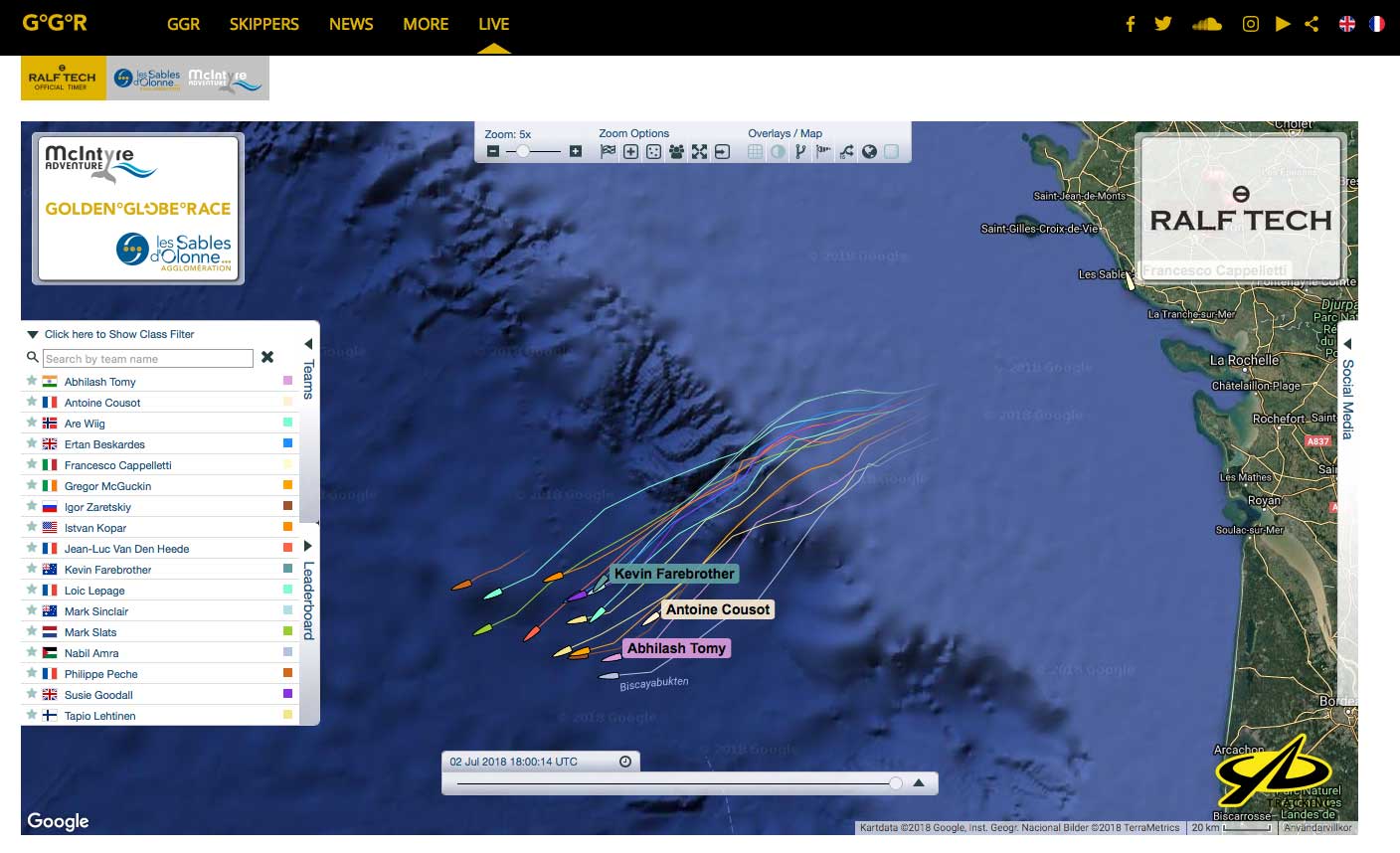
Han är just nu förbi Biscaya. Man kan följa hans position här.
Där syns också Kjell Litwin som försöker samma sak i Vagabond 31:a Selene. Han verkar dock inte lika aktiv online.
Philippe Péché gets head start from Les Sables
d’Olonne at start of the 2018 Golden Globe Race
They have 30,000 miles to sail over the next 9-10 months, but judging from the start today of the 2018 Golden Globe solo non-stop around the world yacht race from Les Sables d’Olonne, the leaders will be fighting over every mile.
First to cross the line at Noon (CEST) was the fiercely competitive Frenchman Philippe Péché aboard his Rustler 36 PRB. He has ensured that she is one of the lightest in the 18-strong fleet, and carrying a huge lightweight genoa, Péché pulled out a 100 metre lead within minutes of Sir Robin Knox-Johnston, winner of the first GGR 50 years before, had fired the canon from the deck of his historic yacht Suhaili.
Behind him, Jean-Luc Van Den Heede, who has five previous circumnavigations to his credit and at 73, is the oldest skipper in this Race, appeared to tangle with Tapio Lehtinen’s Finnish yacht Asteria, and one hour after the start were still locked in a 3-way tie with Dutchman Mark Slats (Ohpen Maverick) for third place. Their regatta style tactics allowed Russia’s Igor Zaretskiy to sail his Endurance 35 Esmeralda quietly into second place.
Another in the mix was Are Wiig’s 32ft Norwegian double-ender Olleanna along with Indian Navy pilot Abhilash Tomy sailing a wooden replica of Sir Robin’s Suhaili.
By contrast, Britain’s Susie Goodall, who raised by far the biggest send-off from the dock, kept her Rustler 36 DHL Starlight well clear of other yachts and made a good mid fleet start in line with Istvan Kopar’s American yacht Puffin, fellow British entrant Ertan Bescardes (Lazy Otter) and Antoine Cousot’s French Biscay 36 Métier Intérim.
Trailing these boats last night was a third group led by Ireland’s Gregor McGuckin sailing the Biscay 36 Hanley Energy Endurance just ahead of Frenchman Loïc Lepage (Laaland) and the two Australian entrants, Kevin Farebrother’s Tradewind 35 Sagarmatha, and Mark Sinclair’s Lello 34 Coconut.
The dark horse within the fleet appears to be Nabil Amra’s Palestinian flagged Biscay 36 Liberty II, which was one of the last boats across the line but last night was flying through the fleet at 4.6knots as apposed to 4.2 for the leaders. Like Igor Zaretskiy, he is taking a more southerly route towards Cape Finistere while others were heading well out into the Bay of Biscay in the hope of finding stronger winds.
One skipper, Italy’s Francesco Cappelletti, remains in port preparing his Endurance 35 007. The yacht has still to pass safety inspection and Cappelletti has yet to complete 3 days of solo sailing trials. He has until Noon next Saturday to beat the deadline to join the race.
The leading yachts are expected to reach the first ‘gate’ set off Lanzarote in the Canaries around 11th July to hand across film and letters. The Race is expected to take 9-10 months with the leaders taking between 240-250 days to complete the voyage unaided.
Today, technical partner Boatshed.com announced that they would provide a £5,000 cash prize the for the fastest skipper around the world – the same amount that the Sunday Times newspaper posted for its race 50 years ago.
How to follow the race.
The yachts are being tracked by satellite. Visit goldengloberace.com/livetracker/ for latest positions.
IMOCA 60 boats have been invited to participate in the next race…
A partnership agreement has been made with the International Monohull Open Class Association (IMOCA), which provides the exclusivity to use the IMOCA 60 for crewed round the world yacht races.
Last week, during the finish of the Volvo Ocean Race in The Hague, an Educational Session for interested parties was held around the IMOCA Class Rules.
Sailors from the most recent Volvo Ocean Race and IMOCA events, along with yacht designers currently involved in construction of new IMOCA Class boats such as Guillaume Verdier and Juan Kouyoumdjian, came to The Hague to brainstorm around the changes.
“This is a first step of many in preparing for the next edition of the race in 2021,” said Johan Salen, co-President of the race. “There is an ongoing co-operation process to put in place the elements we need to make the next race a success from a sporting and business point of view.
“This is a complex matter with many perspectives, and we are respectfully welcoming continuous input from all key stakeholders, from World Sailing to individual sailors, teams and partners. We are confident that this is the right way forward.”
“Moving the race into foiling monohulls under the IMOCA class will motivate more sailors, teams and the wider marine industry to prepare for the next edition. Partnering with the existing IMOCA infrastructure means the professional offshore sailing calendar becomes more unified and efficient, this helps the sport as a whole and helps to build a sustainable business model for teams and sailors.”
“This agreement provides IMOCA owners and sailors with access to the premiere fully crewed offshore race in the world, which is also a great storytelling platform,” said Antoine Mermod, President of IMOCA.
“As we work together to bring the most important offshore races in the world – short-handed and fully crewed – to the IMOCA class boats, it will allow us to grow the class internationally and offer more value to our stakeholders.”
The move to include IMOCA boats will ensure the race continues to be at the forefront of yacht design and technology while challenging the best sailors in the world in a fully-crewed, offshore environment.
A joint committee is being formed to draft a specific section of the Class Rules for Crewed IMOCA 60, respecting the spirit and intent of the partnership, which includes cost control, security and sporting fairness.
The rule relating to crew numbers on board the IMOCA class in the next race is among the items under consideration, with the goal of retaining an On Board Reporter role.
The latest Volvo Ocean Race concluded this past weekend having seen the closest racing in the 45-year history of the event. Three teams started the final leg with an opportunity to win the overall race title. With less than 10 miles left in the 45,000 nautical mile, 11-leg race, the outcome was still in doubt, until Charles Caudrelier’s Dongfeng Race Team finally slipped ahead of their rivals to secure a thrilling victory off The Hague.
“This change is very exciting,” Caudrelier said after receiving a briefing on the changes. “The Open 60s are just amazing boats. I really enjoy sailing on these boats and I think when people see it, they will enjoy it. If the two best offshore races in the world are going to join the same class, to me it’s good news.”
“I think as a sailor, this is very exciting,” said Bouwe Bekking, a veteran of eight Volvo Ocean and Whitbread Round the World races. “For the younger generation of sailors, they’re all about foiling and surfing and going fast and you have to get the best sailors involved in the race. With the Open 60s, they’ve nailed it, because this is what the sailors want.”
“Of course there are some hurdles to negotiate,” said Torben Grael, Olympic champion and a Volvo Ocean Race winning skipper as well as a Vice-President of World Sailing.
“But if we manage to join the two worlds together then it will be positive as it opens the race to many new sailors to join and creates a much bigger calendar of events for the teams racing in Open 60s.”
The partnership means the leading designers in offshore sailing will be engaged in the next edition of the race with the goal of producing the fastest fully-crewed offshore round the world racing monohull in history.
“Yachting is a sport that isn’t only about the crew, but it’s also about the equipment, so combining the two elements is what allows you to say you are at the pinnacle of offshore racing,” said Juan Kouyoumdjian, who has designed three Volvo Ocean Race winning boats in the past.
“I think it is a very positive step forward. The future will allow for the sailors and designers to push to the next level which will inevitably trickle down to other classes.”
“We’re trying to make a boat for the future that is capable of doing both short-handed and fully-crewed races,” said Guillaume Verdier, among of the busiest of the current IMOCA class and America’s Cup designers. “My opinion is that it is doable with a bit of compromise from both worlds to meet in the middle.”
The partnership with IMOCA will also ensure that the boats will allow for the production of cutting-edge media, as was the case on the current edition of the Volvo Ocean Race.
Live access to the boats while they were racing in some of the most remote oceans of the world, as well as drone footage and media produced by on-board reporters made for ground-breaking coverage that produced record fan engagement.
This remains an important priority for the next race.
As does crew diversity. The 2017-18 Volvo Ocean Race featured 23 female sailors as well as 30 sailors under the age of 30. Both were records for the race. This is a trend to be encouraged for the future.
“The process is just starting,” said Nick Bice, who is leading the project to develop the Open 60 rule for the next race. “We’ve had four of the current IMOCA designers with us to help us understand the issues we’re going to face.
“We’ll forward everyone’s input to the joint committee and get started on developing the rules that will be used for Open 60s to participate in the next race. Our goal is to have this ready to go by the end of the year.”
The future of the VO65 class of boats, used in the last two editions of the race, will be revealed in the coming weeks.
The Hague – 28 June 2018 – Twelve former Whitbread Round the World Race and Volvo Ocean Race yachts gathered to compete in the Legends Race from Gothenburg to The Hague. It was the first time that legendary yachts from the 45-year history of the world’s leading ocean race have gathered to compete in an offshore race
The Legends Race started on June 21 in Gothenburg, 45 minutes before the start of the final leg of the 2017-18 edition of the Volvo Ocean Race, which saw Dongfeng Race Team claim the overall victory.
The Legends fleet on the start line was a sight to see, a reminder of years gone by, with the fleet including Copernicus,who raced in the first edition in 1973-74, and overall winner Flyer in 1977-78, to modern yachts like Telefónica Blue , which competed in 2008-09 and Ericsson 4, the winner of that edition of the race.
While the Volvo Ocean 65s started their leg racing in Kattegat and Skagerrak, the twelve Legends Race yachts sailed around the horn of Denmark to face strong winds and rough conditions, which was a big test for these historic boats.
”The conditions were critical at some moments and the fact that all the teams made it to the finish is real proof of a high level of seamanship. It is amazing to see how well the yachts held up and how some of the more modern boats actually reached almost record-breaking speeds on the way south to The Hague,” says Ola Åstradsson, Project Manager of the Legends Race.
“We gathered all these yachts together because we wanted to highlight and promote the history of the race and its legendary stories. The way the teams raced really made it into a celebration of the heritage of the race, which will continue to be built on in the future,” he added.
The fastest yacht to reach The Hague was Ericsson 4, who finished first of the three VO70s. “It has been a fantastic race and very well organised. The activities and facilities around the event are high class and our team and our friends are very pleased with being part of this regatta”, says Joern Larsen CEO and founder of Trifork and crew on Ericsson 4 in the Legends race.
Illbruck, famous for winning the Volvo Ocean Race in 2001-02, was the fastest of the six competing Whitbread 60s. But it was by a narrow margin as she beat Assa Abloy by just six minutes. This earned Illbruck third place on the scoreboard on corrected time behind Ericsson 4 and Telefónica Blue. Of the older yachts, Flyer showed she’s still got it, beating the other competitors Neptune and Copernicus. Rothmans retired from the race before the fleet entered the tough conditions in the North Sea and Copernicus was the last yacht to reach the finish on June 26, after the crew had chosen to stop in Skagen, Denmark to make repairs early in the race. Her finish position was 11th place, the same as it was when she raced around the world in 1973-74
The Sir Peter Blake Trophy will handed over to the overall winner, Ericsson 4, on Saturday June 30 on the main stage at the Race Village in The Hague.
Following prizes were presented at the Legends prize giving ceremony on June 26.
Flyer (1977) – Winner Vintage Whitbread pre- 1990
Illbruck (2001) – Winner Volvo Ocean 60/W60
Ericsson4 (2008) – Winner Volvo Open 70
Ericsson4 (2008) – Overall Winner
Flyer (1977) – Concours d’elegance
Copernicus (1973) – Best effort Award
Neptune (1977) – Best effort Award
Legends Race Results on Corrected time – Start on June 21 13.15 CET
1. Ericsson 4 – 1d 23h 54m
2- Telefónica Blue- 2d 2h 53m
3. Illbruck – 2d 6h 28m
4. Assa Abloy – 2d 6h 34m
5. SEB – 2d 9h 24m
6. Flyer – 2d 19h 34m
7. Tokio II – 2d 23h 15m
8. Silk Cut – 3d 1h 59m
9. Green Dragon – 3d 2h 33m
10. Neptune – 4d 4h 28m
11. Copernicus – 4d 23h 59m
12. Rothmans – Retired
13. Amer Sport One – Did Not Start
Kul att killarna på killarna på Birdie 24 Khadine fått ordning på det mesta inför ÅF. Stort lycka till.
PÅ SÖNDAG SMÄLLER DET!
På söndag klockan 11:00 går starten för oss utanför Skeppsholmen. I skrivande stund ligger vi på en av bryggorna vid Skeppsholmen och skvalpar bland de stora båtarna. Kom förbi och säg hejsvejs!
Till att börja med vill vi uttrycka en enorm tacksamhet för all den hjälp och det stöd vi fått i våra förberedelser. Framför allt vill vi tacka de eldsjälar som lagt ner tid och energi på oss för att få oss till start. Två av de eldsjälar är Pär Lindforss och Nadine Kugel som hjälpt oss med planering, förberedelser och att förmedla mycket värdefulla kontakter till andra eldsjälar som hjälpt oss.
Mycket mycket förberedelser, utrustning med säkerhetsdetaljer har det tänkts på. Allt ifrån arbete med sponsorer till fix med exempelvis VHF, AIS, elektronik, bottenslip, genomföringar, trimmöjligheter och mycket mer.
Till slut lyckades vi trimma upp lilla Birdien till ett SRS på 0.85 shorthanded. Detta tack vare en längre spinnakerbom och en större spinnaker, mycket större. Vi tjuvstartade lite smått med havskappsegling under Sandhamn Open för några helger sedan. Där fick vi pröva på ett dygn ute på havet i vår 24 fotare. Det blev en kall natt och mycket dyningar när vinden avtog. Det slutade på en 9e plats vilket vi är mycket nöjda med. Lärdomar vi tar med oss ifrån den kappseglingen är att sömnen verkligen är viktig, utan sömn går det inte att fatta kloka beslut.
Under ÅFOR kommer Solidsport att sända en livesändning där de kommer att klippa in material från vår segelbåt under vår segling ut genom Stockholms skärgård. Vi kommer även att försöka publicera så mycket vi hinner med under hela seglingen på vår Facebooksida så ett hett tips är verkligen att gå in och följa:
https://www.facebook.com/khadinebirdie24/
För att följa oss finner ni vår båt och vart vi befinner oss på:
http://race.ksss.se/sv/AFOR/Boatpage/?reportId=62