Nedräkning till Commodores’ Cup 2008

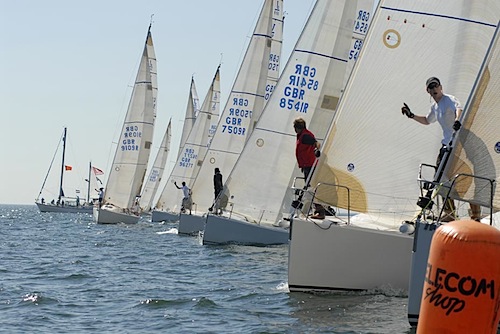
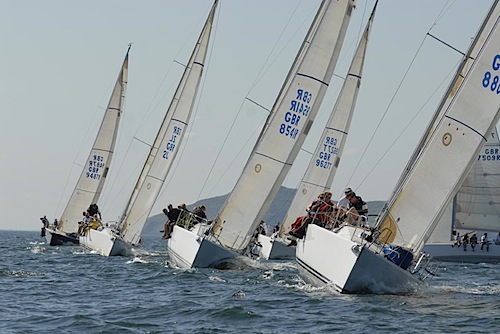
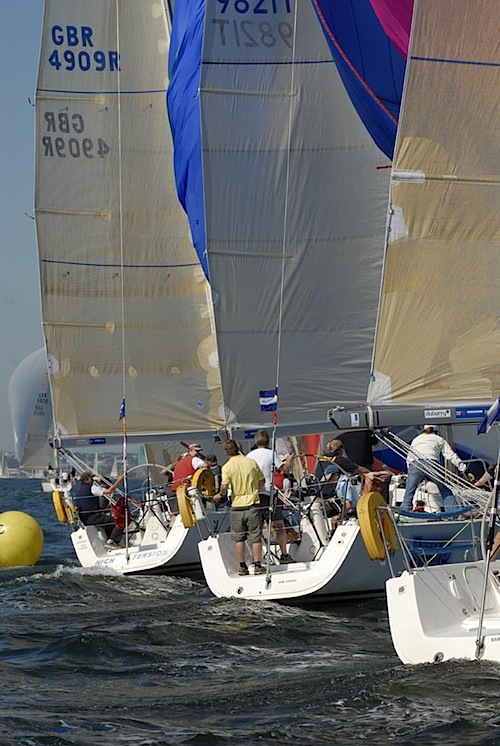
På bilderna har vi J/109 “No Naked Flames” som seglade för IRL Green Team i Commodores’ Cup förra gången. Här jagade av fransmännen i A-35:an Batistyl. Foton: Daniel Forster/ROLEX.
No Naked Flames ledde alltihop inför sista dagen då de söp bort ett race. Tight! I år har de ju en ny Sllim 37. Commodores’ Cup verkar väl bli VM i sweet?
With three months to the start of the 9th biennial Rolex Commodores’ Cup on 29th June, team preparations are beginning to really heat up. Organisers, the Royal Ocean Racing Club, expect 14 or 15 three-boat teams to take to the water for this increasingly fiercely contested international competition and challenges are anticipated from Hong Kong, Ireland, France (winners in 2002 and 2006), The Netherlands, Spain and Great Britain (winners in 1996 and 2004), which includes a team representing Scotland. Other teams known to be close to forming are Germany (winners in 1998) and Russia (debutants in 2006).
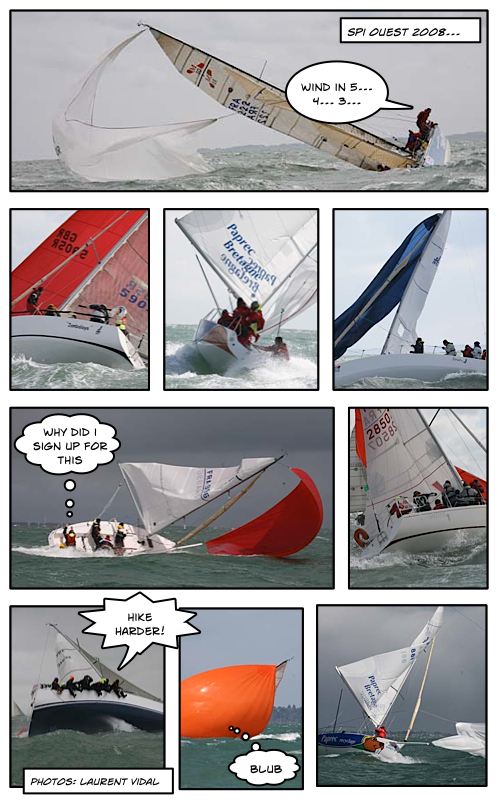
Whilst prospective French team-members were engaged in dodging wintery conditions and a fishing boat blockade at the Spi Ouest regatta in the Bay of Quiberon over Easter weekend, a number of their Irish and British counterparts were struggling with equally extreme weather conditions on The Solent at the Red Funnel Easter Challenge. Familiar names topped some of the Classes at the end of both events. Gerry Trentesaux, who led the two successful French teams to the Rolex Commodores’ Cup in 2002 and 2006, was the winner of IRC 1 at Spi Ouest. Eamon Rohan, who was part of the Irish contingent that led the 2006 event until being pipped at the post by the French, was winner of IRC 1 at the Easter Challenge. Both will be in Cowes come the end of June.
As has been the norm in recent events, the French, Irish and British will enter multiple team challenges. Elsewhere, the nation challenges will comprise single teams. But the work for these groups is no less intense and demanding. One such challenge is currently being finalized and will be formed out of Hong Kong, where Gerry Daughton a member of the Royal Hong Kong Yacht Club is marshalling the preparations. Hong Kong’s only other appearance at the Rolex Commodores’ Cup was in 1992, five years before the transfer of sovereignty from the United Kingdom to China – “The Handover” – in 1997. Now a Special Administrative Region of China, rather than a British colony this challenge is a significant moment for yachting in the region.
The initial idea to enter a Hong Kong challenge came about a year ago from a team of like-minded sailors. After gaining the early support of the Hong Kong Sailing Federation and Royal Hong Kong Yacht Club, this group has been working closely together on forming and preparing the challenge, particularly as the event gets closer. Daughton is looking forward to bringing a team to The Solent, “Hong Kong is a vibrant sailing centre and has just hosted the Rolex China Sea Race, one of the major events of the season. Entering the Rolex Commodores’ Cup is seen as very important for Hong Kong, helping to put it back at the forefront of international yachting, especially in this year of the Beijing Olympics.”
Daughton is confident that Hong Kong will be a force to be reckoned with, “we have gathered some of the best of Hong Kong’s most experienced sailors, and have lined up some top professionals to fill the few available roles on the boat. It is clear the competition in Cowes is going to be fierce, but we are confident our team is going to be competitive. Put it this way, we are not intending to be there just to make up the numbers.”
Two of the three boats required are already confirmed. The small boat will be a J-109; the former Jeronimo that used to belong to Jonathan and Lisa Goring and which did well for the GBR Red team in 2004. This will be skippered by Jamie McWilliam whose brother Tom is also part of the team. The middle boat is a new X41, owned by Rick and Inge Strompf, and which will be helmed by Mark Thornburrow. The big boat is close to confirmation, but at this point the name could not be divulged.
For the RORC, the overall signs are wholly encouraging. The interest and activity is on a par with two years ago when 13 teams lined up and the event was not decided until the end of the final race of the weeklong series. David Aisher, RORC Commodore, expressed the feeling within the Club, “we have every reason to be confident that this year’s event will be every bit as successful as previous years. If anything we expect heightened competition. Over recent Cups there has been a gradual, but distinct improvement in skill standards within the individual crews, the teams and their management. This year looks to be no exception in that trend.”
The Rolex Commodores’ Cup will be held off Cowes, Isle of Wight, from 29th June to 6th July 2008. Entries, which must be made by Member National Authorities, close on Monday 26th May.
Further information about the Rolex Commodores’ Cup may be found at: www.rorc.org


Solo Racing Festival | sammanfattning
Här kommer en kort sammanfattning från Petit Bateau Solo Racing Festival. Det är Graeme Sutherland som antecknat. Vi hade ju en kort video tidigare. Kan finnas lite matnyttigt för shorthandedseglare.
Sleep
The day kicked off before lunch with a lecture by Dr Chris Idzikowski, director of the Edinburgh Sleep Centre. Sleep, or lack of it, is a major factor for a solo sailor, and there’s a strong correlation between those who can cope with very little and race winners.
There were some useful pieces of advice: Try to match sleep to the natural ninety minute cycles, though this can be difficult for skippers who can’t get more than thirty minutes at a time; sleep can be “banked” before an event; 4 am is the most likely time for accidents to occur, due to the daily cycles; and there is evidence that creatine can aid alertness when someone is fatigued.
Less useful is that fourteen days of complete sleep deprivation will kill a rat. And the word snorgasm…
Design
After the lunch break, the second track covered design and build. Charles Bertrand brought us up to date on the Fox Class 950 project. The first boat is in build, and is designed to the Class 950 rule, a smaller (32′) version of the Class 40. Paul Metcalf gave updates on the Express 40, an Owen Clarke designed production Class 40, which saw action in the Transat Jacques Vabre.
This session was rounded out by Guillaume Verdier and Simon Rogers discussing their Class 40 and Open 60 projects. There was an evident contrast between the approaches. Safran was designed around lightness and simplicity, whilst the Rogers designed Artemis looks to be a more powerful and complicated beast, with a large wingmast and a “no comment” response to a question about whether she’d have a trim tab fitted. It’ll be interesting to see how the approaches pan out in the Vendée later this year.
The amount of research and development that goes into the Open 60s is staggering: Verdier, along with his partners VPLP, stopped tracking time after they hit 5,000 hours on Safran, whilst Rogers logged 10,000 hours developing Artemis, including third scale tank tests.
Safety
Offshore sailing can be dangerous. This point was driven home by Ross Hobson, who capsized his trimaran Ideal Stelrad during the 2006 Route du Rhum. Graham Elliot gave a chilling account of what happened to the crew of Hooligan V when her keel failed in February of last year, and which led to the loss of Jamie Butcher.
Both stressed the importance of having safety kit available in an emergency, and the difficulties inherent in being rescued. Both talks were very moving, and I hope that I never end up in that sort of situation.
Their practical experience was put into context by Professor Michael Tipton, who carries out research into sea survival, which is used by the RNLI, RYA and events such as the Volvo Ocean Race and Velux 5 Oceans.
Professor Tipton provided compelling statistics that your survival chances are massively increased by wearing a properly fitting life jacket, and that crotch straps and spray hoods are essentials, and not optional extras.
Racing
The day was rounded off with Nicko Brennan, Nigel King and Sam Davies talking about their experiences racing.
Nicko Brennan placed fifth overall in last last year’s Mini Transat, after a two year, unsponsored campaign. He discussed tactics, but was overall modest, saying that somehow he managed to gain places. Come on Nick, the opposition can’t have been that bad!
Nigel King’s background is in crewed racing, but has undergone a conversion to the solo side of the sport. He decided on the Figaro, as he didn’t fancy getting involved in a boat building project, and it fitted into his budget.
His first race sounded like a hellish experience, and King vowed never to sail solo again, until he found he’d placed well, at which point he was hooked. Unfortunately an autopilot failure in bad weather forced him to retire from the Solitaire, but he’ll be back this year.
The lovely Sam Davies has been racing for years, and has sailed on everything from a Mini to a G-Class catamaran. After four years in the tough Figaro class, she landed the role of skipper for the Roxy team’s Open 60, the former PRB, and winner of the last two Vendée Globes.
Sam gave an insight into the life at the top end of the sport. Her schedule includes a lot of training, not only on the boat, but also in the gym and classroom, along with corporate events for her sponsor. (Though sailing around the South of France with a boatload of bikini clad girls doesn’t sound too taxing to me.)
However, due to the leap in performance of the newer designs, the old boats are no longer competitive. They now have an unofficial second division where they race amongst themselves. So far Sam is winning on this, and hopefully she’ll get something a bit more competitive with the bigger teams before too long.
Overall, it was an excellent day, and you really should attend next year. Even if it does clash with the Six Nations.
Thanks are due to Jerry Freeman for organising the event, the RSYC for providing the venue, and Paul Metcalf sponsoring the beer. (Do I have to buy one of your boats now?)
Nya segel
Så har man varit på loftet och hämtat segel. Det är den här gången Henrik Ottoson och hans gäng på nya Quantum-loftet i Kungälv som satt ihop seglen, men det är Quantums globala J/109-designer som har använts (precis som på racingstället).
Här har vi en ny stor som skall vara för cruising och shorthanded. Sydd i cruisinglaminat SDC55+DC66 (Dimension-Polyant DC) och med lite rejälare rev än i racingstoren (framförallt 2:a revet sitter högt upp). Vi jobbade väldigt aktivt med reven när vi körde shorthanded. Mycket snabbare än att byta försegel. Borde ju också vara bra när man seglar med familjen…
Uppe till vänster två fockar. Dels en cruisingfock i DC55+DC66 och en hårdvindsfock i DC77. Denna har vi gjort något mindre än vad reglerna föreskriver (12% i stället för 13.5% av kvadraten på förtriangel-höjden). Den blir ändå 23 m² vilket räcker när det brallar…
Sedan tidigare har vi ju ett racingställ i det som Quantum kallar Fusion-X. Storsegel och fock i FLX24A (Dimension-Polyant FLEX-Line) och genua i FLX16A.
Ny gennaker. Det blev en R5 (på Quantumspråk) som funkar bäst på lite brantare vinklar, men också för skärning i lättare vind eller som alternativ när det skall slöras i lite brall. Lite smalare, lite öppnare akterlik och byggd i AIRX 900+700 (Bainbridge). Det blir alltid en kompromiss då man inte kan ha mer än två gennakers, men det ser ut att bli ett användbart segel framförallt shorthanded. Vi skall också kolla om man då skulle kunna ha det på någon form av rulle (t.ex. Bamar).
Sedan tidigare har vi ju en länsgennaler/runner i NyLite NY90 (Contender).
Till sist lite härligt orange stormsegel. Ett try-sail och en stormfock, som vi valde att göra lite mindre än vad reglerna säger (3.5% i stället för 5% av kvadraten på förtriangel-höjden). Skall bli kul att kolla hur de sitter uppe.
En idé vore att köra ett kort race med orange segel; från Långedrag till Nya Älvsborg och tillbaks. Bra träning för alla som inte riktigt har koll på hur seglen skall sättas upp…
Något för sommarens race?
Pyewacket till salu. Tyvärr har man ju modifierat hgenne med ett par riktigt fula vingar inför Transpac 2007. Men ett skambud kanske?
Full Metal Jacket | rapport
Nu har vi fått en rapport från Peter Backe på Full Metal Jacket. Vi har ju haft lite bilder och officiella rapporter från Rolex China Sea Race, men det här är ju “The real deal”:
Förra Torsdagen började vi med att köra ett träningspass utanför Hong Kong. Detta var första gången jag seglat med FMJ sen Kings Cup. Båten har varit på varv i Malasia för att göra ändringar på kölen och kom inte upp hit förän två veckor innan start. Sen dess har det jobbats febrilt för att sätta ihop köl, mast och göra den redo för offshore.
Det var en otrolig skillnad på hur båten ufförde sig. Det kändes som en helt ny båt. Vi hade Sherly Robertson från CNN mainsail med oss ute för att dokumentera träningspasset. I lätta vindar gjorde vi upp mot en 10 knop med code 0. Eftersom många var nya i besättningen så var det en bra dag på vattnet för att bekanta sig med varandra och den nya båten.
Torsdagen klockan tio minuter över tolv gick starten för Rolex China Sea race. Starten gick mitt i centrum med en kryss i byiga vindar på upp mot 12 m/s ut längs med Victoria harbour. Det var otroligt kul med så pass tight racing med helikopter och kamera båtar runt omkring oss.
En timme senare var vi ute på öppet hav. Vi hade legat i täten när vi seglade ut, men så fort det blev en öppen bog så lämnade de större båtarna oss. Vi fick en relativt jobbigt första dygn med stora vågor och vindar på 10 m/s. Vår navigatör George Hendy hade planerat vår rutt för att komma ner runt 40 nm syd om rumbline. Detta för att minska risken att fasta i de ökända vindhålen mot slutet av racet. Första dygnet gjorde vi 230 nm och de första 350 nm gick relativt enkelt. Det var en lång babordsbog med ca 90 grader TWD. Vi skiftade mellan code 0, fock och JT allt efter vindstyrka.
Under eftermiddagen på dag två så hände det vi försökt unvika. Vi fastnade i ett vindhål. Efter att försökt segla på mkt lite vind i en timme, tog vi beslutet att ta ner storen och endast ha staysail uppe. Vi passade på att slappna av lite och vi kunde dyka ner och kontrollera att vi inte hade något som fastnat på kölen och rodret. Delar av besättningen passade då öven på att göra sina toalett besök eftersom toaletten ombord ej fick användas (tror aldrig den har använts).
Efter 3-4 timmar i stiltje började den sydliga vinden att fylla in. Vi kom snabbt upp i tre knop och ökade gradvis. Vi kunde hissa gennaker och var äntligen påväg igen. Som vi hade beräknat vred vinden äver mot väst och vidare upp mot nord så vi gippade helt enkelt och hade kurs rakt mot Subic bay. Efter att inte sett en enda båt sen vi lämnade Hong Kong så såg vi en stor vit gennaker på horisonten. kikaren kom fram och vi började gissa hej vilt. Tillslut kom vi fram till att det var TP52an Ffreefire. Vi var nöjda eftersom de enligt handikapp var tvugna att gå i mål flera timmar före oss för att komma före. Några timmar senare såg vi en båt på horisonten bakom oss. Vi trodde länge att det var den andra TP52an Strewth men efter några timmar insåg vi att det måste vara Sydney 46an.
Med gennaker uppe närmade vi oss snabbt sista udden in mot Subic bay. Det så bra ut med vindar upp mot 15 knop räknade vi med 5-10 minuters segling runt udden för att nå mål. När vi väl kom runt så var det absolut bleke. Vi skickade upp fördäckarn i masten för att leta oss igenom det lilla som fanns. Några timmar tidigare så hade vi mötts av ett kameraflyg, så vi visste att vi låg bra till. Nu hade vi även en kamera båt bredvid oss och det var otroligt frustrerande att tappa allt tryck när det var så nära målgång. VI tog ner gennakern, seglade på fock. Vi hade inget tryck alls och ändrade snabbt till staysail. Detta för att det är ett väldigt lätt segel som fyller av minsta vindpust. Efter mkt tålamod i otroligt låga hastigheter så närmade vi oss slutligen mål. Nu såg vi även Sydney 46an runda udden. De hade tagit in ett stort avstånd när vi legat still och guppat. Vinden fyllde in väldigt snabbt från land och vi tog oss i mål strax därefter. Vi möttes av kall öl av vårat team som ska segla presidents cup några dagar senare. Vi var mkt nöjda och visste att vi gjort ett bra race. Solen gick precis ner på söndag kväll när vi la till vid bryggan. Båten var otroligt bra och en härlig kännsla att vara tillbaks på land igen. Vi förstod snabbt att avståndet till våran konkurrent bakom inte var stort nog och att de gjort ett ännu bättre race än oss. Visst var vi där för att vinna, men var ändå nöjda med vår prestation.
Vi möttes också av beskedet att Strewth, den ena TP52an hade tappat kölen, men att allt gått bra och de var påväg hem till Hong Kong. En stor lättnad att allt gått bra då vi känner många i besättningen och det lika väl kunde slutat med att båten kapsejsat.
Efter några DRC tog vi oss till hotellet för en snabb dusch. Min taxi till flygplatsen gick tidigt dagen efter vid sextiden så jag såg till att ingen tid var försummad och hade en bra helkväll med gänget.
Tyvärr var jag tvungen att åka hem för att jobba. Båten kommer nu segla presidents cup med start idag (Onsdag). Jag ser fram emot att följa resultatet och tror de har stora chanser att göra bra ifrån sig. De ska bli kul att se hur båten står sig mot Quantum, DK46, som varit ett riktmärke för oss.
Jag hoppas du har tillgång till CNN och kan se racet mer i detalj under nästa avsnitt av mainsail som kommer sändas om ca 3 veckor.
När jag kom tillbaka så tog jag en sväng ner om klubben för att tilla till Strewth. Den stod på land utan köl. Där fanns helt enkelt inget kvar, avsliten från botten. Pratade med några i besättningen och var otroligt imponerad hur väl de skött situationen. Det visar hur viktigt det är att vara förberädd för det mest otänkbara när man gör offshore segling.