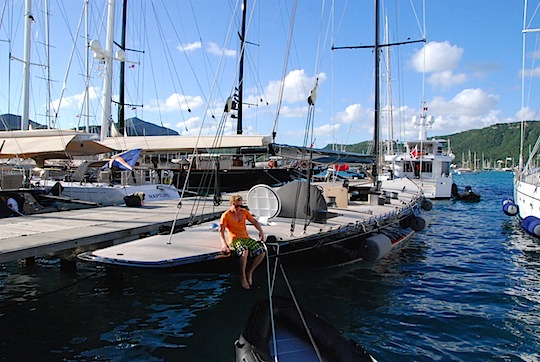
Det har varit jämt den första veckan. Hur går det för er?
De första dagarna har varit riktigt spännande och vi har kunnat se de flesta båtarna under nästan hela racet vilket gjort att vi lätt kunnat hålla koll på hur fort vi seglar. Det känns överlag som att vi varit snabba i de förhållanden vi stött på än så länge men visst är det vinklar och vindar då vi är lite långsammare och andra där vi är snabbare.
Det är väldigt varmt i vinden och man svettas mycket så det gäller att dricka mycket och hålla sig ren men det har hittills inte varit så kokande hett inne i båten som det varit under tidigare etapper.
Såg att det fanns någonting som hette “löpningens dag” – som faktiskt infaller just idag, 26:e januari. Det är för att uppmärksamma den enkla träningsform som löpning är… Och det finns ju massa andra mer eller mindre suspekta temadagar.
Men varför har vi inte seglingens dag?
Det skulle ju vara någon lördag i maj eller augusti när det går massor av race överallt, och så skulle man kunna göra jippon högt och lågt. Öppna klubbarna, provseglingar, slå konstiga rekord, … ja ni fattar. Massor av PR för segelsporten helt enkelt.
• The Volvos 70s are heading back to work
• Dream Regatta in Key West
• Romantic Event in Malaysia
• The Handicap in Charlotte Harbor
• Back to business in the America’s Cup
There’s lot of new cool apps coming out for us sailors. Many are just a quick fix to solve a common problem, but some goes a bit further to take advantage of the iPhone or iPad (or Android) in a more ingenious ways.
I recently stumbled upon the North U Tactician App, and really liked the simple but clear representation of multi-dimensional data. Since the app was released just last week, we still have to try it live.
I became curious on the background and philosophy of the app, so I asked Stephen Jones to write something.
The intent of the app is to give the tactician on a racing yacht a new way of keeping track of port and starboard headings, as an alternative to writing them in a notebook or even on gelcoat. Then, taking advantage of the computing power in an iPhone, the app remembers key data points and calculates useful angles. This relieves the tactician of the short-term memory and mental arithmetic burdens, allowing him or her to focus on the bigger picture. Further, the app displays the data graphically, which helps bring out patterns and trends.
The app puts into practice the principles taught in the North U. racing tactics courses. In fact, the graphing screen of the app is a deliberate recreation of a table that appears in one of the North U. texts. (See the attached image.) Software can automate much of the note-taking, and is much more flexible to change the presentation of the data, or change assumptions. One thing we are able to do in the app is to reverse the flow of time, so that more recent observations are at the top. This is an example of breaking out of paper-based conventions, which one can really only do with software.
We were using an early version of the app on a Farr 30 last summer. At the time, the app would only display the port and starboard numbers in the history table. I think by mid-summer, the app remembered the highs and lows. Even in that crude version, we found it to be a big improvement over pencil and paper. It quickly became apparent that you need to be able to open any datapoint and make corrections. The most common error is to tap starboard instead of port, or vice versa. Such an error throws off the highs and lows quite dramatically. Now, you tap and hold a row in the history table to call up a screen to edit a record and save the changes. The edit feature added unplanned development hours, and delayed the app but I am glad I made it a priority, because the app is almost unusable without being able to correct an error.
Another new feature that came up in testing with North is the ability to change the baseline time, so that the tactical analysis ignores readings prior to a selected time. For instance, you could have the app only tell you the highs and lows on each tack since the start of the day’s second race. This is particularly important if there has been a major wind shift.
The intent of the app is not to invent a new tactical tool, but to use existing sources of information like the boat’s digital compass, and improve record keeping and data analysis on that information. The app therefore makes no use of an iPhone’s internal GPS, but instead relies on the tactician to enter the yacht’s heading into a keypad. Some might find this manual data entry approach unsophisticated, but it is a chief virtue of the app. It uses the most readily accessible and reliable instrument on the boat: the compass. Please see the Frequently Asked Questions for more thoughts on the iPhone’s internal GPS.
The app makes no attempt at any sophisticated algorithm to arrive at a weighted average for the wind direction. Instead, it simply detects the max and min headings, and initially finds the midpoint between the two. The user can then fine tune this initial starting position. Early on in my thinking, I had considered ways to automate the identification of the average wind direction, but abandoned the plan. I did not want to frustrate an experienced tactician who would find that the app is forcing him or her to accept a tactical analysis that runs contrary to his or her experience or intuition. There really is no generally agreed upon method for determining an average wind direction and updating that direction in the light of new information. If there was one, we would all be using it. The upshot is that the app is suited to tacticians of any experience level. It finds a good starting point for a novice user, but it allows an experienced tactician to move the markers as his or her intuition dictates.
The app is focused on typical windward-leeward racing. I don’t see the app being a key tool in a coastal race, for instance. Within the context of windward leeward racing tactics, the app deals primarily with upwind tactics. Downwind angles are much more volatile, so at least for this version, the app makes no inferences about true wind direction from port and starboard headings on the run. See the FAQ for further thoughts on this. We would like to tackle downwind tactics in the next version. I’m open to suggestions.
I see this app finding its niche in boats that carry sufficient crew numbers that someone has the job of watching the numbers and reporting on the patterns and trends. These boats may have basic or even mid-range instruments, but these boats still have crew members using pad and pencil to keep track of port and starboard tack headings. Given the challenges of calibrating instruments to the point where you get reliable true wind direction solutions, I think it will be possible with this app to detect windshifts more accurately and with a finer resolution than the acuity of a typical mid-range instrument package. I am quite confident that using this app one can detect windshifts much more easily and accurately than with pad and pencil — and that is precisely the intent of the app.
Det är mycket diskussioner kring frågan om samgående med SSF och SBU. Ingen av organisationerna ansluter ju seglarna individuellt utan har båtklubbar och segelsällskapen som medlemmar. Men på Seglardagen 24-25 mars 2012 skall alla distrikt i SSF rösta om vi skall fortsätta arbetet med att slå ihop SSF och SBU.
Nu vill vi i Stockholms Seglarförbund ta reda på vad seglarna faktiskt tycker i den här frågan. Vi har därför satt ihop en enkät som vi hoppas att så många seglare som möjligt deltar i – lämna alla synpunkter ni har kring denna fråga och bidra till att organisationerna fattar rätt beslut! Sprid enkäten till andra seglare!
Stockholms Seglarförbund har tagit initiativet till denna enkät men vi vill ha svar från ALLA seglare oavsett region. Vi har lovat att dela med oss av resultatet till alla regioner samt SSF centralt. Det går bra att svara anonymt men om man lämnar sin mailadress kommer ni automatiskt att få den rapport som vi avser lägga fram inför Seglardagen i denna fråga. Vi genomför motsvarande enkät direkt för klubbarna och även resultaten från denna kommer att sammanställas i rapporten.
OBS: Farr 30 i länken beror endast på att Sthlms Seglarförbund har fått låna internationella Farr 30-förbundets polldaddykonto för denna enkät beroende på den förväntade svarsvolymen.
Vill man segla entyp i riktigt stora båtar så ffinns det ju några olika alternativ. Wally Cento och Wally Otto är väl två exempel. men gillar man den klassiska looken, och inte orkar med tjafset i J-Class, så skall man spana in F-class. Rätt läcker!
Tipstack till Jocke Persson som spanade in dem på Antigua.
Om det inte gick så bra i Perth, så verkar många ha bättre flyt i Miami. Framförallt sticker juniorerna upp i Stare och ligger nu 5:a i Stare i gott sällskap. Även våra vänner från Norge verkar heta…
1 24/ NOR 8317 Melleby, Eivind/Pedersen, Petter Moerland NOR
2 6/ USA 8267 Mendelblatt, Mark/Fatih, Brian USA
3 2/ SWE 8450 Loof, Fredrik/Salminen, Max SWE
4 8/ BRA 8456 Scheidt, Robert/Prada, Bruno BRA
5 25/ SWE 8254 Carlson, Philip/Peterson, Benjamin SWE
6 9/ FRA 8237 Rohart, Xavier/PONSOT, Pierre Alexis FRA
7 28/ USA 8177 Smith, Jud/Morey, Ed USA
8 26/ CAN 8361 Clarke, Richard/Bjorn, Tyler CAN
9 5/ IRL 8418 O’Leary, Peter/Burrows, David IRL
10 11/ DEN 8441 Hestbek, Michael/Olesen, Claus DEN
I Laser utmärker sig Jesper Stålheim på 4:e liksom Jonas von Geijer & Niclas During i 49er. Det blir svårt att ta ut i Laser-klassen när det är olika seglare som gör bra ifrån sig på olika regattor.
Tuffaste klassen är väl Matchracingen, där det inte har gått riktigt lika bra.