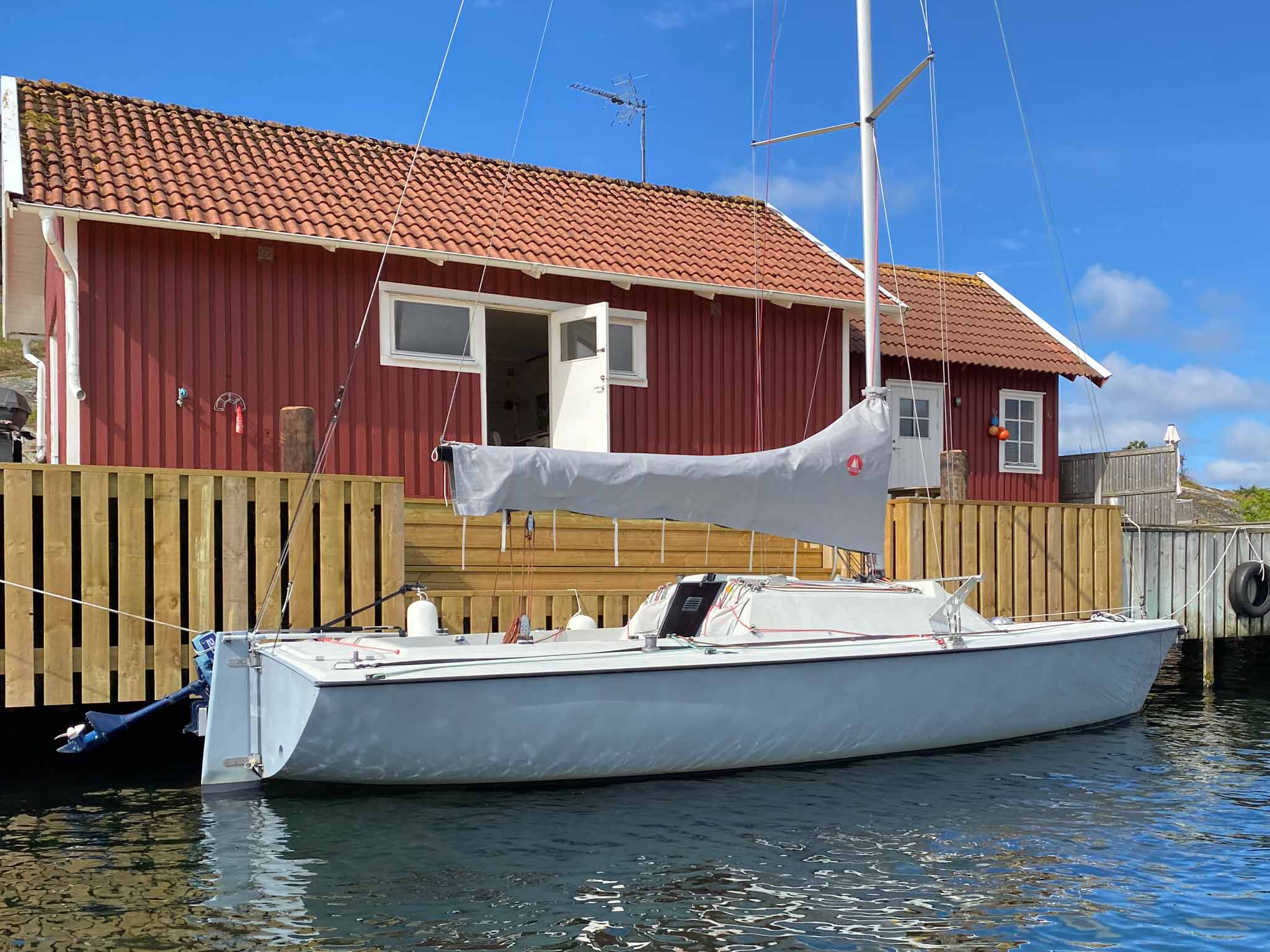
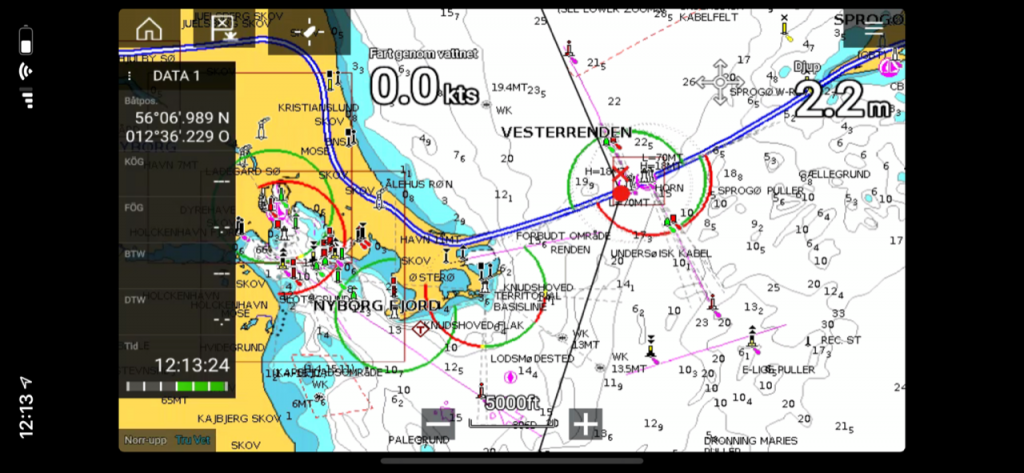
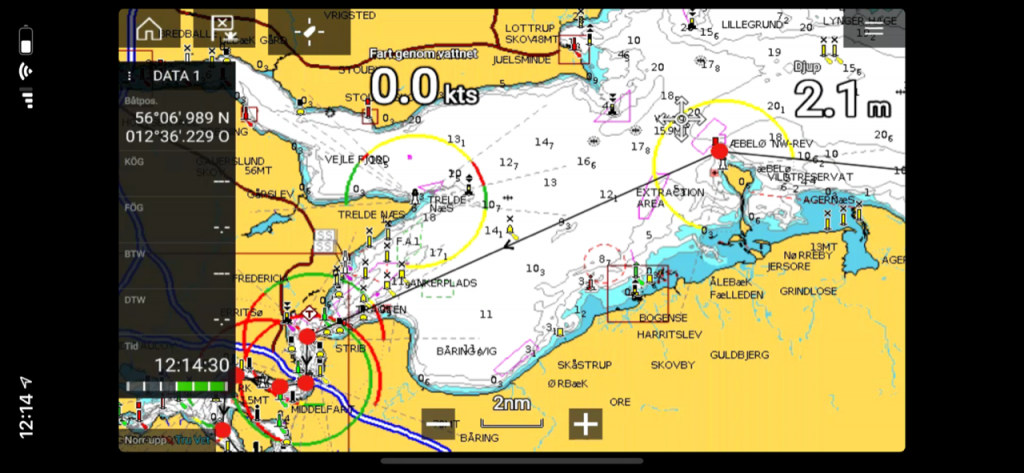
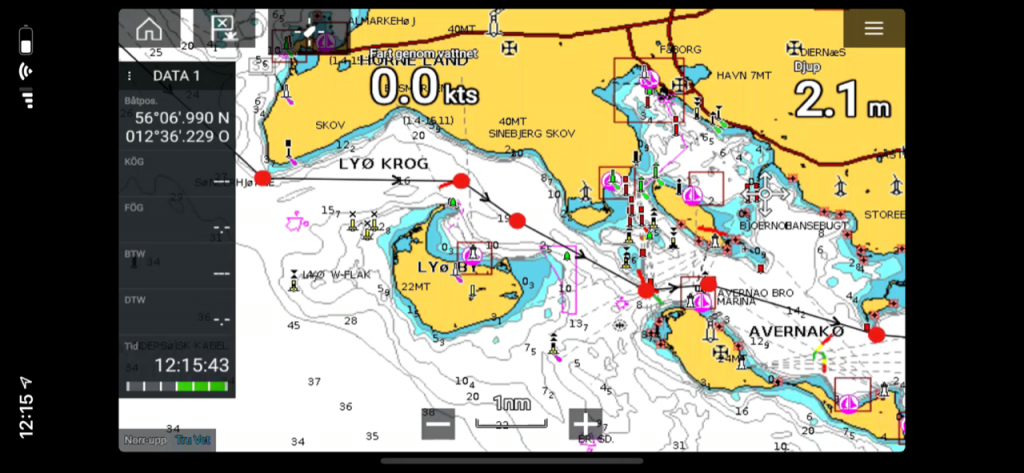
Jag har fått ganska mycket frågor om hur det var att segla Gråå, den Dominant Race Special, som jag fick låna av Dan Ekström.
Upplägget var enkelt; jag fick tillgång till en kul båt, och i gengäld skulle vi försöka ta ut så mycket prestanda som gick ur båten och komma med förslag på hur det skulle kunna bli en ännu bättre solobåt.
Då båten nu är tillbaks i Råå, så tänkte jag försöka reflektera lite mer strukturerat…
Vad är det – och vad är det inte?
Kappsegling
Camping
Seglingsupplevelsen
Sammanfattning
Vad är det – och vad är det inte?
Dominant Race var ju en sportig båt på sin tid, och även med moderna mått så är det ju en snabb 25-fotare. Men det är inte en J/70 eller Melges 24.
1230 kg är ju inte lätt, och skrovformen är från tidigt 80-tal.
Just specialen har ju både djupare köl och mer segel. Det är en styv båt som man kan segla solo i 10 m/s utan att den välter. Men det fanns lite frågeställningar kring hur fort man kan seglade den på undanvind, där känslan var att den kanske “snubblade” på den djupare kölen och relativt stora bulben, och inte ville lyfta riktigt. Även jämfört med den vanligare Racen som går att göra 20 knop med även om det kräver en del våld…
Dominant Race
0,929 SRS
1250 kg
Melges 20
0,944
540
CB 66 Racer
0,960
530
Dominant Race Special – Gråå
0,962
1230
B One
0,966
1060
Platu 25
0,970
1220
J/80
0,978
1500
J/70
0,981
810
Seascape 24 – Sunkini
0,981
1090
Melges 24
1,038
820
Efter att ha seglat den mycket kan vi nog konstatera att det inte är en båt som vill sticka iväg på undanvind, oavsett hur stor gennaker man sätter på,
Däremot kan man få den att gå riktigt fort i deplacementsmode. På bilden ovan blåser det 8-10 m/s, TWA 100 och man seglar stadigt i 8.5-9 knop solo.
Jag hade med mig Anders Dahlsjö ut en dag med mycket vind för att köra igenom olika code-vinklar. Kul segling,
Det känns lite som man måste välja mellan stabilitet och planingsvillighet. Här tycker jag inte man skall göra båten sportigare utan optimera kring dess styrkor.
Och styrkor finns det. Kryss i 6-9 m/s är magiskt, men genom hela registret så känns det som en allroundbåt.
Kappsegling
Vi visste ju från början vad förutsättningarna var. Seglen sjöng på sista versen och vi skulle på kort tid behöva lista ut hur man skulle få fart på båten, Jag skrev om det här: “Up to speed | Dominant Race Special“.
Måndagssegling på slören. Detta är perfekta seglingar för den här båten. Enkelt meck innan start, korta intensiva race på typ en timme och sedan kort hem till Långedrag igen. Och många båtar! Jag tror rekordet var 39 båtar. Vår serie blev 5-4-3-13-1 vilket vi är mycket nöjda med (13-platsen var när jag försökte köra solo och sumpade starten). Räknar vi de race där vi var med så var vi bästa båt totalt 😯 Framförallt hade vi bra starter, och båten går mycket bra när det blåser 6-9 m/s. Men även i lättare vind hängde vi med ok, även om vi inte hade en chans mot lättvindsbåtarna.
Bohusracet (full rapport här). Här hade vi lärt oss båten hyfsat och listat ut vid vilka vinklar som coden funkade. Bra speed, koncentrerad segling och lite tur med vägvalen gav klasseger 🏆
Solotrubaduren (full rapport här). Bra fart och rätt vägval gjorde att jag kunde spika här 🏆
Tillfartssegling Tjörn Runt (full rapport här). Massor av undanvind. 3:a av 14 båtar bara sekunder efter Pelle Lindell.
Tjörn Runt (full rapport här). Som så ofta, årets mest frustrerande race. Vi var bra med väldigt länge, men hade extremt svårt i 2-4 m/s. Under det glider vi på ok, men ingen annan har någon edge här. I 2-4 m/s så går många andra riktigt bra, men vi saknar power. Frustrationen gjorde att vi chansade lite väl mycket efter Tjörnekalv och slutade 12:a av 36 startande.
Göteborg Lighthouse Race (full rapport här). Grym första halva ner till Trubaduren, sedan bröt focken ihop och i frustrationen chansade jag lite mycket. 4:a av 15 startande.
Sammanfattningsvis så är resultaten lång över förväntan.
Jag kan också konstatera hur nyttigt det är att ha duktiga seglare med nästan samma SRS. Att få köra mot Pelle Lindell och hans Pogo 850 Calypso på i stort sett alla race har gjort stor skillnad. Pelle har vunnit både Bohusracet och många av shorthandedracen, så det är svårt att hitta ett bättre bechmark. Känslan är att vi var nästan lika efter alla dueller?!
Här kan man ju inte låte bli att fundera på vad ett nytt segelställ hade betytt…
Camping
En av de saker jag bävade lite för var hur det skulle vara att leva i en liten båt. Både till och från olika race, men också under längre seglingar som Bohusracet. Men det har funkat mycket bättre än jag trodde, och jag uppskattar det enkla livet.
Jag skulle mycket väl kunna tänka mig en veckas cruising i en liknande båt, men då behöver jag nog kunna göra kaffe på något sätt och ha en riktig kylbox.
Seglingsupplevelsen
För mig, som lägger stor vikt vid data och instrument, så var det nyttigt att få segla analogt. Initialt var det svårt, då jag inte hade några referenser alls, men efter ett par kappseglingar så vågade vi lita på våra inställningar och på slutet slog vi inte ens på loggen.
Jag tror ju fortfarande att jag hade kunnat kräma ur ytterligare prestanda med rätt verktyg, men med den ambitionsnivå vi hade så var det nästan ett självändamål att segla analogt.
I en liten båt så blir även kortare seglingar små äventyr.
Bilden kommer från hemseglingen efter Hermanö Runt, som på grund av motström och pinkryss blev en lång nattsegling, Men efter säsongen så var det en av sommarens bästa upplevelser. Med en större båt hade man bara kört motor hem och varit i land innan solen gick ner.
På samma sätt blev seglingarna mellan Råå och Långedrag, och tillbaka, utmaningar som krävde noggrann planering.
Jag har också upptäckt att jag seglar på ställen där jag aldrig hade tagit en Nova eller J/111. In mellan skären och långt utanför lederna. Både storleken och den lägre farten gör att man gärna utforskar nya vatten.
Sammanfattning
Det är något visst med enkel segling.
Och med små båtar.
För mig har det varit mycket nyttigt, och jag tycker att jag har utvecklats som seglare. Både i att få ytterligare en båt “up to speed”, men också i att göra det mesta av de förutsättningar man har. Och visa mig själv att jag kan segla utan instrument 😃
Jag känner att jag vill göra mer av detta och kommer på mig själv med att surfa på J/22, J/80, Späckhuggare och Platu 25… men jag saknar också min J/111 mer än någonsin.
Massor av unga seglare har fostrats i 707, Dominant Race och liknande båtar. Och jag hoppas att det kommer att fortsätta vara så. Men jag ser också att många i min ålder skulle kunna hitta ett enklare båtliv i båtar runt 25 fot.
Tack Dan för att jag fick låna din båt och återupptäcka en annan sida av seglingen.
Another fantastic race report from Silverrudder. This time from Per Svanberg who were fastest (keelboat) around the island in 37t 34m 17s. Conditions were similar to my race in 2014, but this time everyone struggled in Lilla Baelt. Photo: Rolf Engels.
Congrats and well done 🏆
Background
I have been asked to summarize my experience and impressions from this year’s Silverrudder. I have written two previous race reports in Swedish, but maybe Google Translate can help you with your local language if you want to read them as well. These reports are from 2016 (pdf) and 2017 (pdf).
This year’s Silverrudder was my 4th attempt of breaking the record set by Wolfram Heibeck in his Open 32 swing keel boat “Black Maggy”. His sailing time was 19 hours 18 minutes and 3 seconds set back in 2015. This represents an average speed of 6,9 knots around the 134 nm long course.
Photo: Per Svanberg.
I know I have the boat capable of beating this record – a “no compromise racing machine” – a Fareast 31 R. I am just not sure the skipper is capable enough or if there ever will be conditions with winds and currents in good sync at all critical points of the course allowing for such an attempt. This year was NOT that year as you will soon find out if you haven’t already.
The Silverrudder concept and success story
Photo: Katarina Svedjefält
Silverrudder is the largest singlehanded race in the world. It is a full lap around the Danish Island Fyn and it takes place in the middle of September each year. Registration in the spring stops at 450 boats and a few hours after the organizers open up the registration site, the participants list is full.
Photo: Katarina Svedjefält.
The race itself is more of an adventure, a challenge and a happening than a true sail race. Since there are no racing rules or rating systems in play, boats are simply categorized according to the length of the boat. Class “Mini” is everything below 25 foot. Class “Small” is anything between 25-30 feet. Class “Medium” (my class) is everything from 30-35 feet and so on.
Photo: György Juhász.
This means that “no compromise racers” like the Flaar 26 with swing keel and foils in the Small class are competing with heavy cruisers and anything in between. A little bit like if Formula 1 race cars would compete against bicycles on the Nürnburg racetrack. There are probably many reasons for the growing popularity of this race. I believe some of these are:
The Silverrudder spirit – Super easy format. Super friendly and service minded event organization. Super nice town. Super nice harbour. Super nice waters (well some of us don’t love the currents…). Super nice competitors – everyone is helping each other out. Like a big warm family in a nice cosy home.
The challenge – it is a true challenge and an accomplishment to sail your boat 134 nm nonstop solo. No matter what type of boat you have or what level you are at.
The records to beat for each class inspire some of us
The ability to wear the desired “finisher T shirt” as a proof of your great achievement attracts many
The races within the race – everyone has their eye on some boat(s) they would like to beat no matter if you are in a cruiser or pure racing machine. I have set my eyes on a couple of boats I would like to beat for sure. More about them later. My boat is one of the smallest in my class – only 31 feet long – but I think it is considered to be the fastest according to any rating system among the participants starting in my class this year. So, anything but victory in my class would mean I have lost to a slower boat. A challenge of its own.
The race has grown in popularity in just a couple of years. A true success story well managed by the organizers.
My preparations for this year’s race
The season of 2020 was crazy for everyone due to COVID-19. Race after race was cancelled. Silverrudder remained as a beacon of hope for many sailors. But until the last minute it was uncertain for us sailors outside of Denmark if we were allowed to enter or not. Luckily for us we were all welcome at the end.
This year I upgraded my boat with a new carbon fibre rig (mast-boom-vang) from Pauger Composites in Hungary. It saved me 55 kgs in the rig which corresponds to almost 250 kg in the lead bulb. The new rig was also much thinner in the profile and the new rod shrouds were also much thinner than the previous Dyform ones. The boat became much stiffer and I increased my upwind performance but also the reaching performance was improved. The new rig is also much easier to handle when working with it up and down from the boat standing on the trailer. Unfortunately for me, there were only a limited number of hours where I had any use of increased stiffness and righting moment.
Photo: Philip Karlberg.
I had only done two races in my boat this year leading up to the Silverrudder. One singlehanded regatta (Robline Solo Challenge) and one double handed regatta (Nordic Yacht Open). Both events are fantastic races in the Stockholm archipelago with lots of participating boats and great conditions. I messed both events up. At Robline Solo Challenge the conditions were tailored for my type of boat, but I was just…. off. Sloppy and lazy and too late with critical decisions on sail selection. I didn’t push the boat as hard as I should have. I ended up at an OK result, but I was disappointed with my own performance. This was frustrating, but I did have a fantastic day on the water and the boat was really performing well upwind with the new mast. This was promising.
Photo: Lasse Eklöf.
The second event was much worse for me. Not the event itself. Nordic Yachts Open with 120 participating boats is one of the largest doublehanded regattas in Stockholm. It is a truly amazing event that has grown rapidly in the past couple of years thanks to Mats Runström & Crew at Nordic Yachts. This year offered great conditions with 16-22 knots of wind. First leg downwind. This seemed to be too good to be true. It was. 10 seconds after the start I managed to set my boat on a rock. The rock was not visible on my chart so I can at least blame the chart, but an epic sailing day seemed to come to an end. I withdrew from the race since it was a lot of wind on the racecourse and sailing with a potentially loose bulb made me uncertain if I could keep my crew mate and myself safe. I decided to dive into the water directly after we had been towed off the rock to get a feeling about how severe the damage was. It looked almost undamaged. Just a few scratches. We jointly decided to sail the course anyway. We were full of adrenaline and just going back to the dock and wait for the other boats to come in from the racecourse just seemed too depressing. After asking the RC for permission to run the course outside of the official event we started almost one hour later than our time slot allowed. We had a fantastic day on the water. Again, the boat and mast were delivering really well upwind. After these two happenings I felt ready to go to Silverrudder. It would just take some epoxy and sanding to get the bulb up to decent shape and finish again.
Photo: Per Svanberg.
Me and my father (my great shore crew with a heavy trailer driving license) left Stockholm with the boat on a trailer 05:45 Tuesday morning before the race. We drove together with Kattis Svedjefält, her dad and her uncle towing her Fareast 28R. We arrived in Svendborg 12 hours later. I like to arrive Tuesday evening and hence launch the boat Wednesday before lunch and have the whole afternoon to prepare the boat without any stress. I then go on a test sail Thursday before lunch. This year was extra nice with a summer warm week leading up to the race start. The skippers meeting was possible to attend in person or via web link. It worked really well, but all our fears regarding the very long race ahead of us were confirmed. Just a little bit of wind on Friday, less wind Saturday morning and if you haven’t finished by then you might be out on the course for a very, very long time.
Photo: Katarina Svedjefält.
On Thursday evening we had a dinner for all Swedish participants with some great stories around the table from past races and other experiences. Very nice indeed!
Photo: Katarina Svedjefält.
My coach and mentor – Jimmy Hellberg – helped me with routing in Expedition from Stockholm. He was sending me tips and ideas on how to trickle past the light wind patches we could already now anticipate. I prepared myself for a three-day nonstop racing event and packed a lot of water, food and snacks to not have to stop racing because of too little food and water. I decided mentally that anything faster than Sunday mid-day was to be considered a bonus. I would only abandon the race if I – without a doubt -wouldn’t make the finish line in time for the deadline Sunday 12.00. I also set up another goal – this time I needed to get some sleep in during the race to be able to push and make smart decisions throughout.
My main competitors for this year in my class based on last year’s main fights were;
“Black Caravella” – a Caravela 950 sailed by Tomasz Odzioba from Poland
“The Beast” – A Figaro 2 sailed by Jan Hansen from Denmark
“OM” – An Archambault 35 sailed by Stefan Voss from Germany
And practically all x-99s and x-332s sailed by disturbingly skilled skippers. Especially in light wind conditions, I fear the x-99s with their shallow keels able to go where no one else can go.
All skippers are really experienced and well-tuned in with their boats. Black Caravella has a similar performance curve like mine, similar sail plan like mine, a little bit heavier but with a wider beam and water ballast and therefore probably better righting moment than me. He is tough to beat in all conditions and Tomasz has spent a lot of time in this boat since last year when the boat was new. The Beast and OM are both sailed by sailmakers with tons of experience. I fear these boats especially in heavy upwind or medium fast reaching conditions where their long waterlines and/or stability will come into play.
Race day – The start to Thuroe Rev
Photo: Jan Svedjefält.
I started the day with a dive cleaning the hull and fins. I have no antifouling paint and it is surprising how much get stuck on the hull from just being in the water for two days in these salty waters. I dived in just after I woke up to have as little current as possible. After that I had a long relaxing breakfast with my father. After the breakfast I discussed the latest routing with Jimmy. It didn’t look promising. The gradient wind should come from the west, but in the sound, it would be close to zero. In 2017 I anchored multiple times both at the start and also 800 m from the finishing line for three hours in the middle of the night and in pouring rain. At the time it was super frustrating, but this time I decided not to let such things drain any mental energy from me. I would instead try to anchor faster and smarter than the rest of the competition – truly making this activity a part of the race and become one tactical piece of the puzzle just as any other.
This year the organizers didn’t split the medium class into two starts. We were all squeezed into one start. I think 98 boats in my class actually started (from 130 registered). It was not super crowded on the line though because many of the boats played it very safe and stayed a long way back from the line.
Another new thing was introduced – a 100 m “no motor zone”. 100 m before the actual start line there was another line marking where it was forbidden to run your engine. The reason was that it made it easier for the event organizers to check compliance to the no engine rule. The complication this year was that there was absolutely no wind but only 1,5 – 2 knots of current pushing you over the line. I figured out that I had two main options. Either I drift to the start line in good time and anchor with some margin and then just lift my anchor when the gun goes off. The other option was to do a rough calculation on how long time it would take me to drift from the border of the no engine zone to the starting line with the current we had. I chose option two mainly because of two reasons: Firstly, I have anchored in this canal before (2016 and 2017). Both times I pulled up smelly stuff that was hard to get off the boat without a proper cleaning. I didn’t want that on my boat for the coming two days. Secondly, I felt it was risky to drop the anchor just before the starting line – what if it didn’t stick or what if I have problems getting it up again. The calculation method seemed to be the “lower risk” version of the two. I calculated I would need 100 seconds to drift the 100 meters to the starting line with a current of 2 knots. I added 20 seconds for safety. I then missed the start with more than one minute so maybe my math skills need some improvements, but I got away OK. I was the 11th boat across the starting line. I was squeezed between two boats, but at least I was on my way and soon in free air. This is what this slow moving chaos all looked like:
For the full race replay I recommend you to go here.
I struggled for a couple of minutes to get out of the squeeze. With zero wind and 1,5-2 knots of current my sails felt some pressure and I managed to use that to get free. Lucky for me the wind arrived from the south east all of a sudden. This allowed me to get totally free air and start the chase for Black Caravella, MAXX (a X-99) and OM that had done much better starts than me. I caught up with OM at the end of the sound and MAXX and Caravella got stuck in light wind just south of Thuroe allowing me and OM to pass them on their south side. We were out, but the ocean looked like a mirror with just a small breeze to the south of us. I was very close to Stefan in OM at this stage, almost sailing into him since my head was in my boat and not looking outside at that moment. Sorry Stefan once again! After that Stefan and I had a tactical chat between us on how to pass the boats ahead of us. That would never happen in any other race than a solo race. Really cool! The tactics we agreed upon – to go further south in the “wrong” direction to meet the new wind – proved to be very successful. We literally flew past (well…) most of the boats in the previous starting groups. After Thuroe Rev we hoisted various types of downwind sails. I started with my Code 1 when the wind was below 3 knots. When the wind finally increased, I switched to my A2 runner. Stefan was staying on my hips for a disturbingly long period of time.
The downwind from Thuroe Rev to Stora Baelt
This second part of the race was amazing. Good winds between 8-12 knots. Warm weather with clear blue skies. It doesn’t get much better than this. Well, dead downwind is not ideal for a gennaker boat like mine, but at this stage I just enjoyed life. 100% perfect would have meant a TWA of 140 degrees. But you can’t have everything. I passed most remaining boats including Firlefranz and the Flaar 26 from the previous class. Petrulla – an 11metre one design- went really well and deep with her spinnaker close to land and actually went up in the lead for a while until I got some more pressure. It seemed it was only the Flaar 26 that might have a slight speed advantage over me in these conditions, but I managed to capture a couple of nice shifts to pass him. I had my first warm cup of noodle soup, some chocolate, and coffee and tried not to think about the horrors ahead such as all the light wind patches with strong counter currents.
Photo: Katarina Svedjefält.
There was a lot of seaweed in the water and my boat picks this up very nicely. To fix this I had a line prepared with knots on it. I throw it in at the bow, I let it slide under the hull, so it folds nicely over the fin and then pull it up again mid ship allowing the knots to push/drag the seaweed away. The rudder I clean with the backside handle of a paddle. I laid down at the stern pushing the paddle towards the rudder and rubbing up and down until I didn’t feel or see any more straws leaving the stern. It is not a perfect method, but it is better than stopping the boat and backing up or other methods I have tried. I had to go through this procedure maybe 10 times before reaching Fyns Hoved.
As I got closer to the Stora Baelt bridge I started to plan my jibes to fit nicely into the slot I had decided to sail through. I didn’t want to take any chances, so I already beforehand decided to go for the safe route through the main slot in the lower part of the bridge. This part has a 18m height which is more than enough for me.
Then the same strange thing happened again as every year. Sailing through the bridge is almost like entering a new weather system. The bridge apparently impacts the wind so much that there is always different directions and strengths on the other side. The wind became very patchy and unstable for a long time after the passing. Eventually the southerly wind died out and the second “almost no wind at all area” happened. The boats behind me still had some speed and were quickly eating up my lead, but soon they got stuck as well. I assumed that the gradient westerly wind would now finally find its way down to us, so I decided to point my bow towards land and slowly skimp over there to meet the new wind. Eventually it arrived. I rolled out my Jib0 and started making progress towards Romsoe stretching out my lead again. I had to do one tack to avoid the long sandbank on the inside of Romsoe but after that it was just pointing the bow to Fyns Hoved and put the autopilot on. Just before Romsoe I passed the last boat – “Jynx” a T-24 skippered by Patrik Heinrichs from class “mini”. I ate for the second time, looked at the weather and had a couple of phone calls with family and friends. The trimaran “Black Marlin” was approaching fast, but for now I was the first boat of all the boats in the field. Pretty cool feeling!
The reaching to Fyns Hoved
This part of the race was rather uneventful. Just reaching along with my Jib0 in a straight line. Wind was 8-10 knots and I was doing 6-7 knots of boat speed. I noticed I was not the fastest boat in my class during this part of the race. The Beast and OM was constantly a couple of tenths faster than me.
When I reached Fyns Hoved I passed over some shallow waters which are always scary. I had less than 2,8 meters of water under me when I passed over the shallowest areas. Scary stuff with my type of bulb and history of close encounters with underwater rocks. I sheeted in hard and went upwind. Shortly thereafter Black Marlin overtook me to windward.
The upwind to Aebleo
The upwind to Aebleo was very pleasant compared to previous years. This year I had between 7-10 knots of wind and moderate waves. A little bit too much for my Jib0 though so I switched to my ordinary jib. The routing suggested more wind further out from land, so I went far out. Too far out, unfortunately. This was my biggest mistake in the race. The idea was to meet the new wind and the northerly shift and then hoist my Jib0 again and fly away from the competitors. The northerly shift arrived but not with as many degrees as the routing suggested. Therefore, I couldn’t unfurl the Jib0 and I was simply way over the layline with my normal jib. Jimmy blamed me afterward for being a coward not pushing the boat hard enough unfurling the Jib0, but I just wasn’t sure it would have worked. I lost the lead as the first keelboat to Dehler 30 “Humbolt” with skipper Morten Bogacki at Aebelo due to this mistake. My general reflection was that the Dehler 30 ODs performed really well upwind.
The arrival and passing of Lilla Baelt
After Aebleo I bore away, unfurled the Jib0, and went past the Dehler 30 “Humbolt” to leeward. I tried to get some sleep, but I couldn’t relax enough to do that, unfortunately. I feared I would not be able to reach this goal of mine.
It seemed like we would be able to go straight into Lilla Baelt for a long while, but just when we entered the outer skirts of the sound the wind shifted left, so we had to start tacking upwind again. The air got lighter and lighter and I could already now see the growing current on the difference between my log and my GPS. I feared the worst. I cleaned the fin and rudder one more time to have minimal drag going into this very tricky part of the course. All my three main rivals from last year were in place 2, 3 and 4 now turning up the pressure for sure.
When entering the first bridge on starboard tack the air got very light. My speed was down to 0,5 knots at times. I was in the strongest current, but I was also in the patch that had the most wind. Tricky decisions indeed. When I went past the first bridge the wind died completely and I tacked to port and tried to reach the north shore asap to get out of the strongest current. I barely moved. I did 0,6 knots through the water in a 0,4 knots of head current. I tried to go as close to the north shore as I dared. I thought I could see some wind patches in the middle of the water, and I went out for it despite the fact that it was heading straight back into the strong current. I managed to get through the second bridge thanks to this move. It was almost pitch dark by now, but the lights from the surrounding building reflected on the water to display potential patches of wind.
After the second bridge the wind got even lighter. I moved over to the other side – to Fyn side. To be on the inside and hopefully benefit from some counter current. I didn’t detect any. Maybe I was too far away from the shore or maybe it hadn’t started yet. I could now see Black Caravella just a couple of hundred meters behind me, but she got stuck for a long time and I managed to slowly pull away and build a lead of almost 10 nm until she got away from this dreaded place. Black Caravella was the last boat to get away from Lilla Baelt before the wind completely died. Everyone else had to anchor and wait for many more hours before they could get going again. This was the point of the race when most boats decided to abandon the race and go home. They simply realised they wouldn’t make it to the Sunday 12.00 deadline in time. I was very lucky to get out in time!
The downwind to Horne Naes
The downwind started in extreme light wind conditions. Since my boat is relatively fast for being a monohull I quickly build apparent wind. This means that in really light winds I always have the apparent wind from the front. This in turns means I go downwind in 1 knots of breeze with my Jib0 almost sheeted as if it were sailing upwind. It looks and feels crazy, but it works. Then when the wind builds to 2-3 knots I switch to my Code 1. It wasn’t until I was south of Sønderskov that the wind was strong enough for my A2 runner to work properly. I used the A2 until the wind dropped again at Helnaes. I had gotten a tip to go to close to Fyn side for any type of wind effects I could find. The new wind was supposed to come from the south, but until then my best bet was to get close to shore for some local sea breeze effects. It worked and I even managed to pass the trimaran Kekima. That was cool! He was completely stuck further out at sea. After that the wind died completely and I was just lucky there was a south going current carrying me in the right direction at 0,4-0,5 knots. Black Caravella was eating up my lead quickly, now doing 2-3 knots behind me. My lead of 10 nm was reduced to some 6,5 nm within a couple of hours.
At this stage a lot of boats were passing me with their engines on. Very demotivating! Luckily for me my friend Leif Jägerbrand – proud owner of a Figaro 3, previously owner of Seascape 24 “Sunkini” with several Silverrudders under his belt called me up and had the pep talk of the century. I will leave out the details, but I can safely say that it made my commitment to stay in the race firmer than ever. I would not quit now! Not after that call!
This is also the part of the race where I managed to squeeze in 4 x 15 mins of sleep. This felt great and that made a lot of difference to my focus and motivation!
When I got to the South west corner of Fyn at Horne Naes I witnessed a cool phenomenon. I could see smoke from a house in the direction of Svendborg. The smoke went straight up for an hour or so. Then all of a sudden the tip of the smoke pillar got bended into my direction. I could literally see how the wind came closer and closer to the sea level. When the pillar was completely gone, I felt a small breeze on my forearm hairs. I took the Jib0 sheet between my thumb and middle finger and tried to feel the wind. I made sure the top tell-tale in the main started to fly as well as the top tell in the Jib0. Everything else was just dead. I managed to get the boat moving again. All of a sudden, I was doing 2 knots of boat speed almost in the right direction towards Svendborg. Who would have thought that kind of speed would make me smile from ear to ear?
The reach to Svendborg sound
As soon as I got into the southern part of the course the wind shifted north and I got a fantastic reach with my Code 1. I did between 5-6 knots in 3-5 knots of wind almost all the way to Svendborg sound at Rantzausminde. My lead was once again close to 10 nm. It was pitch black and the only thing I could see was the lights from the houses on the surrounding islands. A little scary I must admit. I was just hoping that vessels around me would have their lanterns switched on. Just when I thought I was home safe the wind dropped again just outside the final stretch. This was the only time when I felt true frustration for stopping. The reason was that I was about to miss the time window of supporting currents into the sound. Two more hours and I would face currents pushing me out again and the risk for me having to anchor and my opponents to catch me was imminent.
The final upwind to the finish
After what felt like an eternity, I got out from the leeward side of Rantzausminde and into the final stretch to the finish. The wind picked up to a solid 8-10 knots and I felt like flying. I felt I was going too fast to be in full control actually. My brain was now working slower than normal, I was tired, it was pitch black and the sandbanks didn’t allow for much wiggle room or time between the tacks. Going straight upwind in this part of the course is a challenge with a deep fin like mine. Later I heard that the fog came in on top of this. I can’t imagine doing this intense upwind without seeing anything but the front of my boat. To me, this level was scary enough. Halfway through the sound the wind shifted left luckily and I could reach the bridge and the final turn and the finish line on one single tack. Just as a final “thank you and goodbye” from the goods of wind the wind died completely before the finish line again and I drifted over the finishing line doing 0,5 knots drifting with the current. Nice wrap up I thought since the start was exactly the same type of “sailing”. The race was over after 37 hours, 34 mins and 17 seconds. I could go home now. I finished first in my class. Second place to Black Caravella with Tomasz Odzioba from Poland. Third place to X-99 “MAXX” with Thomas Nielsen from Denmark and fourth place to JPK 10.30 “Beluga” with Ander Johansen also from Denmark. No other boats in our class managed to get into Svendborg in time, unfortunately. I also happened to be the first keelboat over the line across all classes thanks to me being able to get out of Lilla Baelt in time. I only had two trimarans ahead of me overall. Pretty cool actually!
Summary
This year’s race was for sure a challenge, but for me personally not as difficult as 2017 when I was totally unprepared for being awake for more than 40 hours straight.
Photo: Jan Svedjefält.
There were a couple of true accomplishments that I think is worth mentioning here – the biggest one in my book being Göran Artman who managed to win his class “large” with his X-382 “Xusidus”. Winning with that kind of boat in these kind of conditions against the other sporty boats in his class proves true skills, seamanship and perseverance. Hats off Göran – that achievement was truly amazing! Other accomplishments worth mentioning – Bert Forsberg managed to get over the finishing line in time with his Seascape 27 Black Magic after drifting up on the sandbanks just after the start and being stuck at Lilla Baelt for several hours. Hats off to you as well Bert! I heard he was nominated for the “Ultra Hard Bastard” award from the Seascape community. I also heard about Max Gurgel from Germany who also drifted onto the Sandbanks with his Dehler 30OD right after the start. Max dove into the water and pushed (!) his boat off the sandbanks with his bare hands not to have to abandon the race and go home. When you think you have heard everything there is always someone out there with a worse story than yours! Hats off to you too Max!
Photo: Per Svanberg.
I would like to take the opportunity to thank my coach and mentor Jimmy Hellberg for all his support in setting up my boat effectively for solo-sailing and all hands-on tips on how to round this Island in the fastest way possible.
I would also like to thank Leif Jägerbrand, Jesper Johansson and last but not least my dad and my wife Anna for all support before and during this race keeping my hope and spirit up!
När man inte seglar själv, får man roa sig med andras rapporter. Årets Silverrudder var ju en långsam historia, där många fastnade i Lilla Bält, men där två svenska båtar var snabbast i respektive klass. Per Svanberg var inte helt oväntat snabbast runt i sin klass “medium” i sin Fareast 31R, men i år var han också snabbaste kölbåt totalt. Sjukt bra. Vii väntar på hans rapport.
Lite mer oväntat var att en X-382 skulle vara snabbaste båt i klassen “large”. En minst lika stor prestation!
Här kommer Görans Artmans rapport.
Söndag morgon kl. 07:18:38 hör jag tutan som bekräftar att vi (Xusidus och jag) efter 43 timmar 48 minuter och 38 sekunder fullföljt ännu ett Silverrudder runt Fyn.
Förtöjer båten och kojar in. Vaknar till vid lunchtid och frågar en funktionär om han kände till något om resultatet. Då tractrac hade havererat p.g.a. alla som brutit racet, hade jag ingen aning om min placering. Funktionären visste inget men påminde mig om att prisceremonin skulle börja om 20 min. Går in i lokalen och får ett munskydd och en öl (dålig combo).
Storbildsskärmen tänds upp och presenterar de tre första i de olika klasserna. I klassen ”Large” hittar jag mitt namn med en etta framför…
I år var startproceduren ändrad. Det var infört en extra ”startlinje” ca.300m före den riktiga startlinjen. Mellan dessa linjer skulle motorn vara avstängd 4 minuter innan start. Bakom detta område fick man ha motorn igång ända till start. En smart lösning för tillfällen med stark medström och svaga vindar. Detta var ett sådant tillfälle.
Vår båt är en X-382 årsmodell 1997, inköpt i Tyskland för 8 år sedan. Xusidus är förberedd med putsad botten, lättad från onödig vikt, tömda ändskepp och med rätt segel ombord.
Detta är vår 7 start i detta race och om väderprognosen stämmer så finns det möjlighet till 2 dygn till havs, där vi seglare vill vara.
Motorn stängdes av 3 min. innan start och vi gled in i den demotoriserade zonen. Lugn och fin start och de 75 båtar starka fältet gled majestätiskt iväg med strömmen. Medströmmen mitt i farleden låg på ca. 2 knop. En del sökte vind på kanterna men då kom de ur strömfåran. Min taktik var att ligga mitt i rännan och glida med strömmen.
Rundar upp norrut som 18 båt. Normalt är första valet gennaker men i detta fallet med vind rakt akterifrån valde jag spinnacker. Skära med gennaker kräver mer energi och det skulle bli en lång dag på jobbet. En avkopplande sommarsegling upp mot Storabältsbron följde. Vind och sol i aktern. Inte ofta man behöver solskyddsfaktor i knävecken.
Västerbron som låg-brodelen av Storabältsbron kallas har en max. brohöjd enligt kortet på 18m. Xusidus masthöjd är 17,5m inkl. VHF antenn. Väljer att gå två brofack väster om huvud facket. Något lägre men det gick bra i fjol. DMI har en mätpunkt precis här och de lovade normalvattenstånd. Vid bron hade vi tappat en placering och låg nu på 19 plats.
Direkt efter bron åkte spinnacker ner och coden hissades. Men innan seglet rullats ut insåg jag att vinden vridit ännu mer. Ut med focken och ner med coden.
Perfekt sträckbog mot Romsö i 10 minuter sedan vrider det ännu mer emot och det blir kryss i svaga vridande vindar. Håller mig konservativt i mitten och undviker kanterna och snart stabiliseras vinden på VNV ca 4m/s vilket återigen ger en sträckbog norrut.
Vid Romsö öppnar det upp ytterligare och jag kan sätta coden ,som är plant skuren och som med fördel kan skotas in i genuaskenan vid AWA 50-55 grader. Nu plockar vi båtar……..
30 minuter innan Fynshoved så var det dags att förbereda sig för rundning och nattlig kryss västerut, bort mot Lilla bält. Mat – segel – kläder är den ordningen jag använder. Gulaschsoppan avnjuts med Loka melon, focken ut och coden ner, på med torra varma kläder, häller upp en kopp nybryggt Zoegas med ett danskt wienerbröd och skotar hem. Kryssen har börjat.
Har seglat upp oss 9 placeringar och ligger nu på plats 10.
När man rundar Fyns hoved så inser man återigen vilket storslagen segling man deltar i. Här har de större båtarna seglat ifatt de mindre. Det har mörknat och man ser hundratals lanternor under en stjärnklar himmel. Då och då hör man utandningen från tumlare som är uppe och tar luft. Svag mareld i aktern.
Om strömmen är lika vid land och längre ut så väljer jag att gå där ute. Dels vill jag segla långt mellan slagen för att inte tappa rytm. En stagvändning på natten är ett tillfälle då det lätt strular till sig. Men huvudorsaken är att komma bort från alla de mindre båtarna som kräver mycket energi att hålla koll på.
Bonka-kryssen uteblir vilket var både bra och dåligt. Bra för att det blev en bra natt med gott driv i båten. Dåligt för att X-yachts traditionellt är konkurrenskraftiga i krabb sjö.
Vid Äbelö låg vi kvar på vår 10 plats vilket var glädjande. Kryss med fock i 4m/s är inte optimalt för oss. Nu blev det en sträckbog ner mot mynningen till Lilla bält, den besvärliga udden Strib. Vinden avtar och vrider mot VSV och vi väljer att följa Fyn-sidan, bort från den rådande motströmmen. I fjol på denna sträcka tappade jag fokus och 10 placeringar. Det skulle inte få hända igen. Vinden avtog och vred 30 grader fram och tillbaka och det kändes som en befrielse när Strib rundades i gryningsljuset. Placering 9 och väldigt nöjd.
Klassisk motströmssegling i Lilla bält är att hålla innerkurva. Coden hissas och vi styr mot landsvägsbrons västra pelare vid Jyllandsidan. Med bra fart 6-7 knop, så ser jag runt kröken att båtarna där ligger absolut stilla. Fångade av motström och stiltje. Bestämmer mig att gå så nära land som möjligt d.v.s. följa 3m. kurvan. Mäktig känsla att komma i drygt 6 knop och segla förbi båtar som ligger helt stilla. 3m. kurvan blev snabbt en 2m. kurva. Studsar till på en sandbank utan att fastna men tappar fart. Plankskotar stor och Code och glider vidare. (1,9knop AWA 24) Till slut stannar även Xusidus. Ner med coden och upp med lättviktsankaret ur ankarboxen och i med det.
Har haft funderingar på att flytta bak det 7,5 kg tunga Fortressankaret, 10m. blyade linan samt 40m band med änden schaklad i boxen. Men det är i ankarboxen det ska ligga för smidig och säker hantering. TracTrac visar nu att Xusidus ligger på 3:dje plats. WOW !.
Nu gäller mat och sömn. Kollar in båtarna runt omkring. Om babord ligger the Beast, Jan Hansens Figaro2 och om styrbord ligger Javelin, Janne Magnussons J105. Båda startade 30 min innan Xusidus. Känns bra…
Nöjd med första dygnets segling så unnar jag mig sovmorgon. Sätter klockan på 15min istället för de vanliga 10.
Efter några timmar började det fläkta lite men strömmen var fortfarande stark. En del kloka båtägare låg kvar medan en del stressiga ville vidare. Jag tillhörde tyvärr den senare gruppen. Försökte kryssa längs kanten mot strömmen men efter en knapp timme har vi avancerat endast 200m. Ankrar upp igen.
Efter ett tag kommer det vind så det går att komma över till Fyn-sidan strax innan järnvägsbron. På denna sidan är det bakvatten som hjälper oss framåt. Efter bron blir det stiltje igen och båtar driver på varandra och upp i strandkanten. Ny ankring. Nu ligger jag vid sidan om min danske vän Anders Johansson i hans nya JPK 10.30. (Startade 30 min innan oss)
Anders är en av Danmarks mest meriterade ensamseglare. Lite småsnack innan vi går och lägger oss några minuter.
När vinden återigen hittar oss med 1-3 m/s så har strömmen lagt sig och sakta men säkert, efter 7 timmar kan vi glida ut ur Lilla bält.
Vinden avtar igen, Anders kommer ifatt och vi stiltjeseglar tillsammans ner mot Bagö. I fyra timmar sitter jag framför ratten, med två känsliga fingrar på ratten och finlirar i 1-2m/s.
Återigen visar det sig att fock är det bästa förseglet i dessa mycket svaga vindar. En del säger att det beror på att genuan gör större luftmotstånd andra menar att vinden måste forma lättvindgenuan och det finns det inte kraft till medan focken står som en formad vinge.
Tacksam för läsarnas åsikter om detta.
Dags för mat: Resterna av gårdagens gulaschsoppa står kvar i grytan, blandas med Keldas Thaisoppa, en grabbnäve färsk pasta samt bullens pilsnerkorv till detta dricks Loka citrus.
Äntligen kommer vinden strax för om tvärs och coden åker upp. 10min senare vrider vinden till en bit akter om tvärs och då ska gennakern upp. Här kommer tröttheten in. Fast jag vet att förseglet ska bytas så börjar man hitta anledningar att slippa. Självklart kom gennakern upp och färden ner mot Bagö fortsatte i 5-6 knop.
Efter Bagö lovade vi upp 15 grader, bytte tillbaka till coden och satte kurs längs Fyns västkust. Nu behövde jag sova. Positionerade mig medvetet längst ut från land, styr 5 grader SB om idealkursen, scannade horisonten, plottern och paddan. Sjönk sedan ner på riskudden i sittbrunnen. Vaknade av klockan 10 min. senare. Scannar återigen horisonten, plotter och padda samt justerar skotningen. Ytterligare 10 min. sömn.
Det blev tre sömnpass innan det var dags att lova in under Fyn ovanför ön Lyö. Ön som i Silverrudder kretsar kallas ”Sebastian Island”
Återigen brist på vind. Coden byts mot fock som byts mot gennaker. Börjar räkna på tiden till söndagens deadline kl.12.00. Måste göra 1,9 knop i snitt, vi gör 1,4.
Vinden ökar och ger oss bra fart mot mål. Då ändras diset till tät dimma och lanternorna runt omkring försvinner. Mistluren plockas fram.
När vi passerar smalaste stället vid Rantzausminde så brölar Svendborgsfärjan på mig samtidigt som autopiloten visar ”Battery low”. Svendborgsfärjan kan inte manövrera i farter under 7 knop så jag flyr mot strandkanten.
Väl framme i Svendborg började jag undra hur funktionärerna skulle kunna se mig i den täta dimman. Men strax innan mållinjen kommer en funktionärsbåt och eskorterar mig rätt.
Inne i hamnen står andra funktionärer och hjälper till med förtöjningen.
STORT tack till alla proffsiga funktionärer som gör detta event till årets höjdpunkt.
Själv ser jag tillbaka på en fantastisk segling/naturupplevelse som ledde fram till en osannolik första plats.
“200 nautical miles, fast and uncomfortable… you ready for this?” Kai and John come up with an idea to foil across the Kaua’i Channel on John’s 18′ cat. But first they gotta get Kai trained up on the boat, and figure out if it’s even possible. It’s a multi day mission, pushing their limits, and culminating in a launch from John’s front door on the North Shore of Oahu, to Hanalei Bay, Kauai. And back… maybe.
L’Occitane en Provence visade sin potential både under “speed runs” innan racet, och Armel ledde med 5 timmar kvar när han fastnade i ett vindhål innan målgång.
Skall bli hur spännande som helst att se den här båten i Vendee Globe.